
Neil Diamond’s “La Bamba” is a joyful detour—an early-career burst of borrowed sunlight where a young songwriter tries on an old folk melody and discovers, for a moment, that freedom can sound like pure rhythm.
The most important facts first, to place the recording in its proper time. “La Bamba” is not a Neil Diamond original; it’s a traditional Mexican folk song (widely popularized in rock form by Ritchie Valens, who is commonly credited as writer on many releases). Diamond recorded his own version in the Bang Records era, and it appears on his 1966 debut album The Feel of Neil Diamond, released August 12, 1966—where “La Bamba” is listed as track 3. Over the years, the track has resurfaced on Bang-era compilations such as The Bang Years 1966–1968 (released 2011), which also includes “La Bamba” in its track list.
Because it wasn’t promoted as one of Diamond’s signature chart singles, “La Bamba” doesn’t carry the tidy “debut ranking” story you might expect from his later hits. Its place in the catalogue is different: it’s a snapshot from the workshop years—when Diamond was still proving, record by record, that he could sing almost anything and make it sound like it belonged to his voice. And that is exactly why this recording is so charming. It isn’t grand. It isn’t profound in the sermon-like way Diamond could be when he aimed for the big emotional horizon. Instead, it’s bright, a little reckless, and delightfully un-precious—like a talented young man stepping into a crowded room, smiling, and deciding to play something everyone already knows just to watch their faces light up.
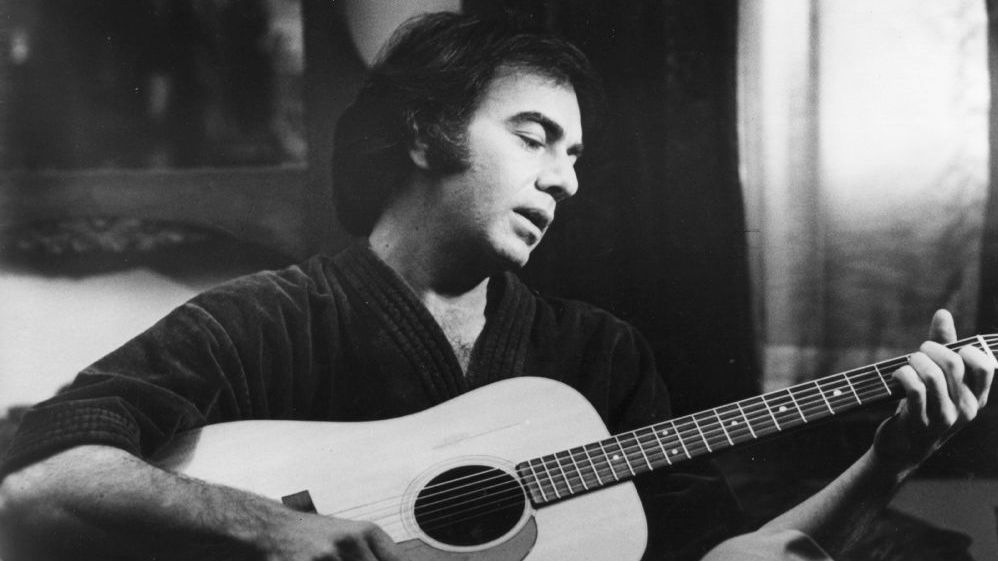
If you mostly carry Neil Diamond in your mind as the arena-era storyteller—the man of “Sweet Caroline” camaraderie and late-night ballad conviction—this earlier Bang-period energy can feel almost like meeting an old friend in an old photograph. The hair is different, the posture is looser, the ambition is still forming. The Feel of Neil Diamond itself is an album from a time when pop singers moved fast, cut fast, and leaned hard on immediacy: short track lengths, punchy arrangements, the sense that the studio was less a cathedral and more a storefront window. In that context, “La Bamba” works as a kind of musical wink—an upbeat nod to rock ’n’ roll’s habit of adopting, reshaping, and celebrating older songs.
But there’s more than novelty here. There’s something quietly telling about which traditional tune he chose. “La Bamba” is built for movement—its spirit is communal, repeating, circular, meant to be shared rather than owned. When Diamond sings it, he steps briefly away from the confessional voice he would master later and into something more physical: music as dance, music as release. It’s the sound of a performer learning that not every song has to carry a heavy message to matter—sometimes the point is simply to lift the room, to let people breathe.
And for listeners returning to it now, that lightness can feel surprisingly emotional. Not because the recording is sad, but because it reminds you of an earlier kind of pop optimism—when a record could be playful without apology, when the world felt a little less self-conscious, and when “fun” was still allowed to be a serious musical value. In a life filled with responsibilities and headlines, a track like “La Bamba” can feel like opening a window: the air changes, the shoulders drop, and you remember that joy—real joy—doesn’t always announce itself with fireworks. Sometimes it arrives as two minutes of rhythm and a familiar melody, delivered with a grin.
So Neil Diamond’s “La Bamba” isn’t essential because it’s definitive. It’s essential because it’s revealing. It shows the young Diamond—pre-myth, pre-monument—enjoying the simple power of a song that belongs to everybody. And in that simple power, there’s a gentle lesson: a free life isn’t only the dramatic escape. Sometimes it’s the small permission to turn the music up and let an old tune carry you, if only for the length of a dance.