
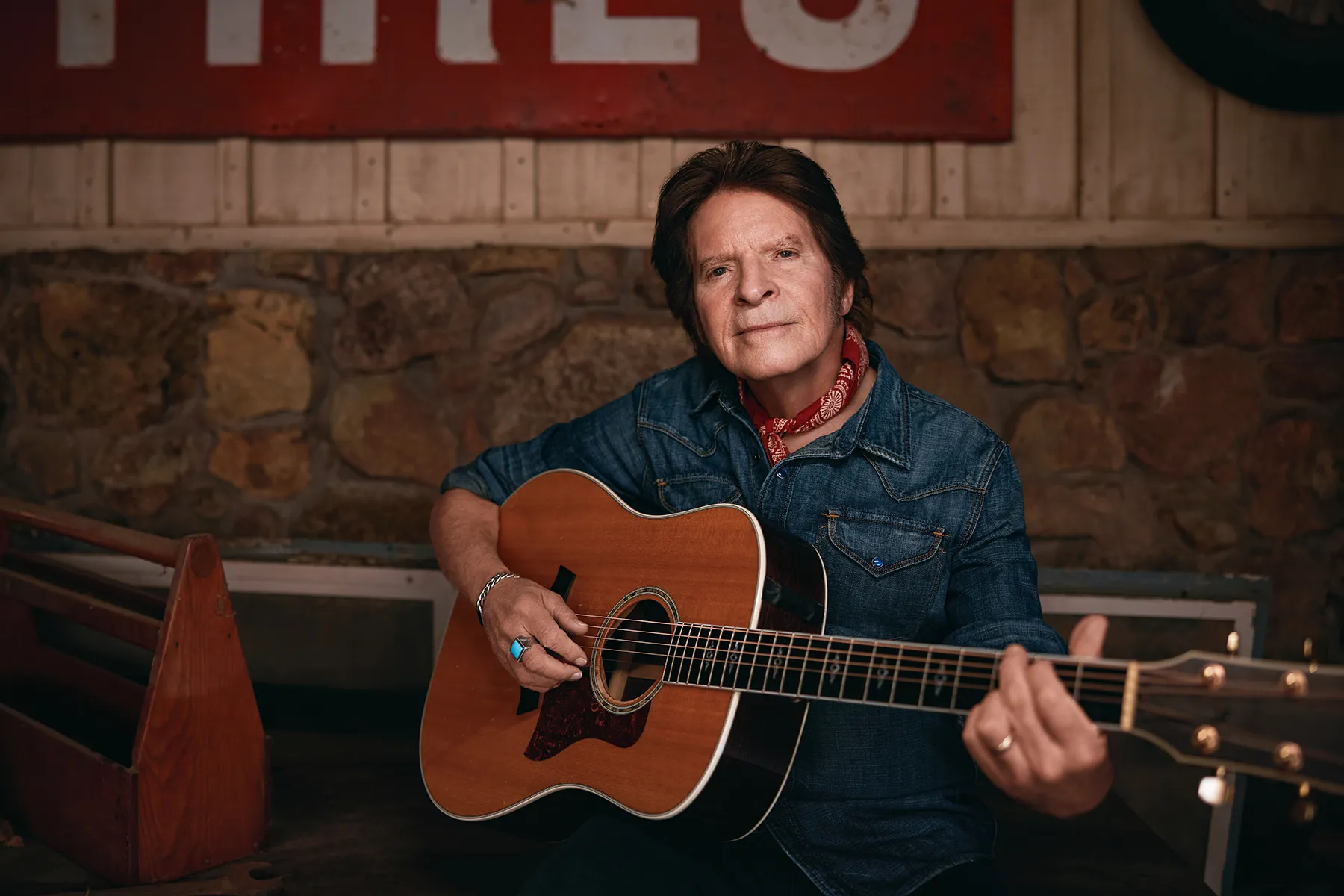
“She Thinks I Still Care” is the softest kind of heartbreak: the one that doesn’t shout, because it doesn’t need to—everything you do betrays what you’re still carrying.
The song itself is a country classic written by Dickey Lee and Steve Duffy, first popularized by George Jones, whose 1962 recording became a defining “career record”—spending six weeks at No. 1 on Billboard’s country chart after its April 14, 1962 release. That’s the bedrock: a lyric built from small, almost embarrassing tells—asking “a friend,” saying “her name,” dialing “her number by mistake”—the everyday slips that reveal a heart hasn’t finished letting go.
When John Fogerty takes on “She Thinks I Still Care,” the meaning doesn’t change, but the weather does. Fogerty recorded it for his first post-CCR solo project, released under the name The Blue Ridge Rangers on the album The Blue Ridge Rangers (released April 1973). The album’s story matters here: it was Fogerty stepping away from the swamp-rock legend and into a private room of American roots—country and gospel standards, played with a craftsman’s humility. (The record itself peaked at No. 47 in the U.S., a modest but meaningful success for something so deliberately un-flashy.)
And that’s why this particular song fits him so uncannily. “She Thinks I Still Care” is not about dramatic betrayal or a grand exit. It’s about the humiliating, ordinary evidence of love—how it leaks through the cracks even when you’ve sworn you’re done. The lyric’s genius is its structure: the repeated “Just because…” lines pile up like a quiet confession, each one a smaller, truer admission than the last. You can tell yourself you’ve moved on, but you can’t stop haunting the same old places. You can’t stop being “not the happy guy” you used to be. In country music, that’s the most honest kind of tragedy—love as habit, love as muscle memory.
Fogerty’s voice adds a particular shade: a kind of weary restraint. He was never a singer who needed to decorate a line to make it land. Even in his Creedence days, the power came from directness—plain words, hard rhythm, conviction. In The Blue Ridge Rangers setting, that directness becomes tender, almost exposed. There’s something quietly moving about a man so identified with roaring guitars choosing to stand still and admit: Yes, the town remembers her. Yes, I remember her. Yes, it shows.
What makes the song linger—especially in Fogerty’s hands—is its refusal to turn the narrator into a villain or a hero. He’s not stalking; he’s drifting. He’s not begging; he’s denying—almost politely—while the evidence keeps accumulating. That famous central turn is devastating precisely because it’s small: If she’s happy thinkin’ I still need her… then let that silly notion bring her cheer. It’s pride trying to protect itself by becoming generous. It’s the ego offering a gift it didn’t mean to give: permission for her to believe she mattered.
There’s also a quietly telling detail in Fogerty’s relationship to the song afterward: fan documentation notes he never played it live. That fact can be read a few ways, but one interpretation feels emotionally consistent with the recording: this wasn’t a song meant to be “performed” again and again under bright lights. It was a moment captured—Fogerty, in the early 1970s, building a new identity out of old songs, letting country music say what rock stardom couldn’t say so plainly.
So “She Thinks I Still Care” becomes more than a cover. It becomes a mirror held up to the quiet after: after the relationship, after the arguments, after the public noise of who you used to be. And in that mirror is a truth that doesn’t age—love rarely leaves in one clean motion. Sometimes it lingers in your fingers on the phone dial, in the streets you still take, in the forced smile you can’t quite hold. And yes—she may think you still care. The harder truth is that she may be right.