
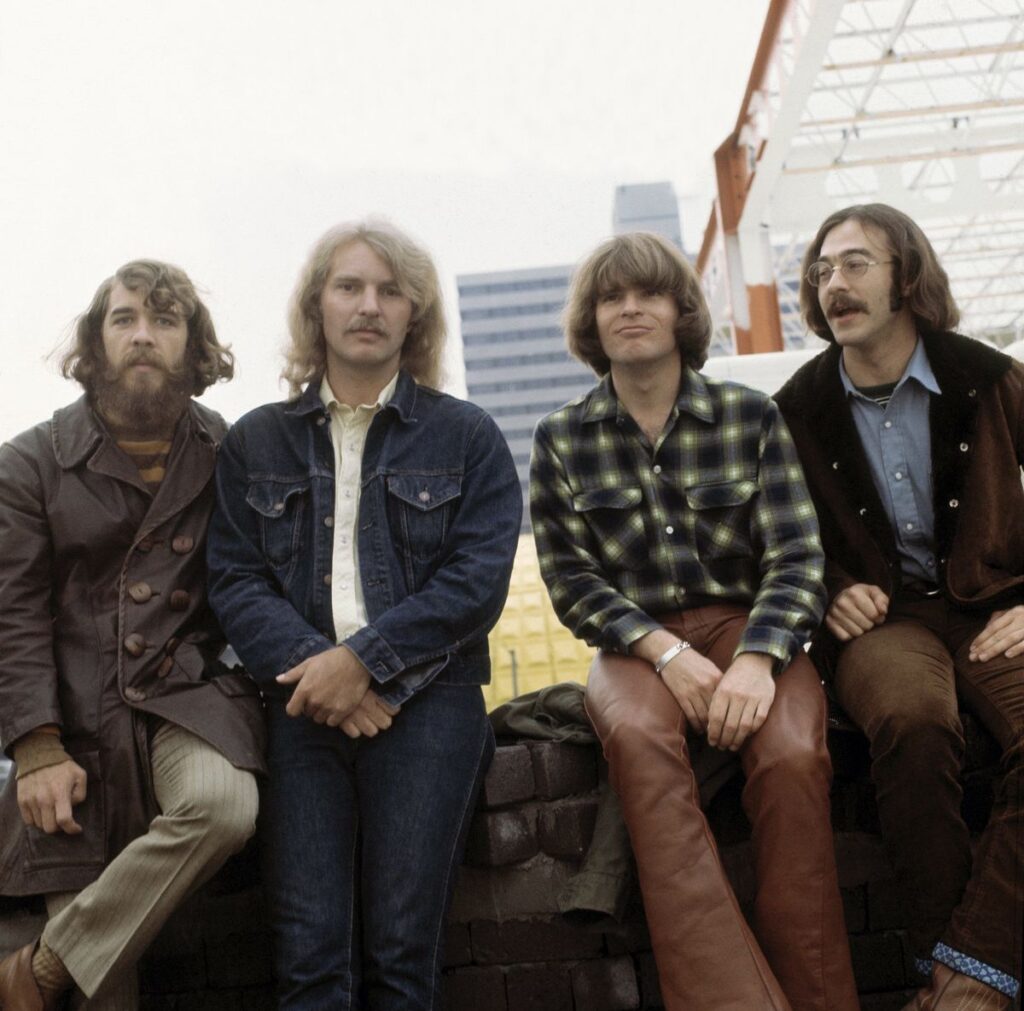
“Lookin’ Out My Back Door” is John Fogerty turning everyday life into a little parade of wonder—proof that innocence can sound “trippy,” even when it’s actually a father smiling at his child.
If you ever needed one song to explain the peculiar magic of Creedence Clearwater Revival—how they could sound like a bar band from the edge of town and still write melodies that lodged themselves in the national bloodstream—“Lookin’ Out My Back Door” is a perfect answer. It was released as a single on July 25, 1970, backed with “Long As I Can See the Light,” and it also appeared on CCR’s fifth album Cosmo’s Factory.
Now, the “arrival on the charts” is one of those near-mythic pieces of 1970 pop history: “Lookin’ Out My Back Door” climbed to No. 2 on the Billboard Hot 100, becoming CCR’s fifth—and final—Hot 100 runner-up, famously kept out of the top spot by Diana Ross’s “Ain’t No Mountain High Enough.” Yet in a delicious twist of chart trivia, it did reach No. 1 on the Cash Box Top 100, meaning that depending on which radio station’s countdown you trusted, CCR really did get to the summit with this one. And behind the single’s success stood the larger machine of Cosmo’s Factory, a record that spent nine consecutive weeks at No. 1 on the Billboard 200—a run so dominant it still feels like folklore.
But here’s the part that always deserves to be said gently, like a late-night DJ leaning closer to the microphone: despite all the swirling, dreamlike imagery, Fogerty insisted it wasn’t a drug song at all. People heard the flying spoon and the strange procession of characters and assumed acid-soaked allegory. Fogerty’s own explanation is warmer and almost disarmingly domestic: he wrote it for his young son, Josh, and shaped the lyric like a Dr. Seuss daydream—specifically drawing inspiration from And to Think That I Saw It on Mulberry Street, that childhood sensation of watching ordinary reality bloom into a marching carnival in the mind.
That story changes the way the record feels in your hands. Suddenly the famous “doot doot doo” isn’t coded language; it’s a playful hook a father can’t wait for his kid to hear on the radio. And the song’s great emotional trick becomes clear: it sounds like a carefree escape, yet it’s also about protection—locking the front door, keeping trouble from following you home, and finding a back-door path into a kinder world. You can hear the adult’s weariness at the edges, but the center stays bright: a man who has seen enough of the outside world to appreciate the small miracle of stepping into the backyard and letting imagination take over.
Musically, it’s equally telling that this was CCR at peak efficiency. Cosmo’s Factory was recorded at Wally Heider Studios in San Francisco, with John Fogerty producing—an arrangement that meant the band’s identity stayed tight, purposeful, and unmistakably theirs. The performance has that CCR snap: the rhythm moves like a steady gait, the guitar lines are plainspoken but sharp, and the vocal carries a grin you can actually hear. It’s country rock without costume—no big-city polish, no psychedelic haze—just a sturdy American groove that makes even surreal images feel like they came from down the street.
So when “Lookin’ Out My Back Door” comes on today, it doesn’t merely return you to 1970. It returns you to a feeling many people forget they once had: the belief that a backyard could hold a whole universe. The song’s meaning isn’t “escape reality.” It’s closer to: remember the part of yourself that still knows how to see wonder. And maybe that’s why it has lasted so long—because behind the chart numbers, behind the misread “secret meaning,” it’s simply John Fogerty offering a small, radiant scene of home, family, and imagination… with the door left open, in case you want to step through.