
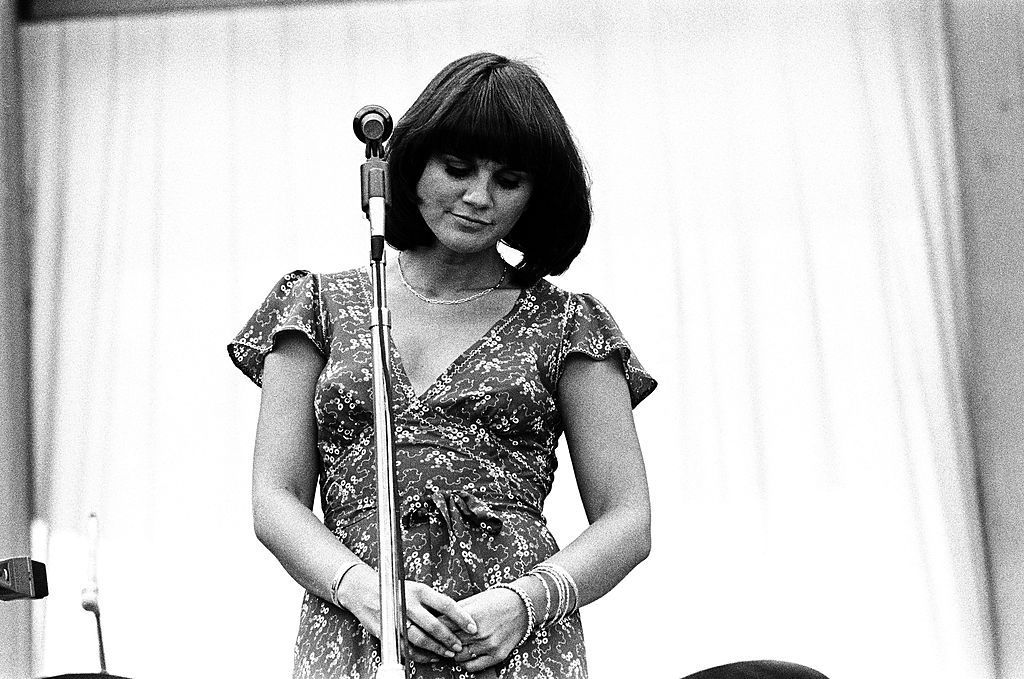
“Tumbling Dice” in Houston, Nov. 17, 1977 is Linda Ronstadt turning swagger into bittersweet truth—rock ’n’ roll desire sung with a clear-eyed heart, as if pleasure and regret were dancing cheek-to-cheek.
Linda Ronstadt’s “Tumbling Dice” (Live in Houston, Nov 17, 1977) captures her at the height of the Simple Dreams era—confident, glamorous, and fearless about stepping into a song that had already become a modern rock archetype. That night at The Summit in Houston, Texas, she performed it as part of her Simple Dreams Tour; the date and venue are documented in surviving set records. This is not just a random stop on the road, either. The Summit would soon be tied to a very specific pop-culture afterlife: the AFI Catalog notes that the Linda Ronstadt concert sequence in the 1978 film FM was “filmed at the Summit, Houston,” and IMDb likewise lists The Summit as the location for that concert sequence. When you watch this Houston “Tumbling Dice,” you can feel why filmmakers wanted it—she doesn’t merely perform a cover; she projects a whole world.
The song she’s inhabiting has its own legendary pedigree. “Tumbling Dice” was written by Mick Jagger and Keith Richards and released by The Rolling Stones in 1972, becoming a major hit—No. 7 on the U.S. Billboard Hot 100 and No. 5 in the UK. The Stones’ original is all heat and moral shrug: a gambler’s spirit in human form, restless, tempting, and proudly unreliable. Ronstadt’s brilliance is that she doesn’t soften that character—she reframes it. Her version is famously sung from a female perspective, and that one shift changes everything: the same lines suddenly feel like a woman naming the terms of desire and disappointment, not merely being caught inside them.
Her studio recording arrived first on Simple Dreams, released September 6, 1977 (Asylum; produced by Peter Asher), an album that helped define her late-’70s imperial phase. Then, in spring 1978, Asylum issued her “Tumbling Dice” as a single; it went on to peak at No. 32 on the Billboard Hot 100—a Top 40 moment that proved she could take even the Stones’ streetwise looseness and make it her own. The single’s chart “first footprint” is preserved in period chart documentation: it appears with an initial chart date of April 22, 1978, and by early May it was already climbing. (The single is commonly cataloged as Asylum 45479, pairing it with “I Never Will Marry” as the B-side.)
So what changes when she sings it live in Houston, late 1977—before the single had even made its chart run? The feeling becomes less about attitude, more about momentum. In the studio, Ronstadt can be exquisitely controlled; onstage, she adds that restless, breath-on-the-neck urgency that the lyric demands. Her voice doesn’t just ride the groove—it pushes it. You hear a performer who understands that rock ’n’ roll swagger is never only swagger. It’s also a mask people wear when they don’t want to admit how much they’re driven by wanting—wanting touch, wanting attention, wanting relief from loneliness.
And that’s the emotional secret inside “Tumbling Dice.” Beneath the gambler imagery is a painfully human confession: some hearts can’t stay still long enough to be faithful—not because they’re evil, but because they’re hungry, unsettled, forever negotiating with emptiness. Ronstadt doesn’t excuse that hunger, yet she doesn’t sneer at it either. She sings it like someone who’s seen charm up close and recognized the cost that comes after the lights go down. The performance has the thrilling surface of a great rock cover, but the undertow is darker: a recognition that the very traits that make a person intoxicating can also make them impossible to hold.
That’s why the Houston rendition lasts in the memory. It’s not nostalgia as wallpaper; it’s nostalgia as electric evidence—proof of an era when a singer could stand in front of a band, take a Stones classic, and make it sound like her own autobiography for three minutes. And in this particular night at The Summit, with cameras and crowds and late-’70s air crackling, Linda Ronstadt doesn’t just sing about the tumbling dice—she sounds like she’s watched them roll, again and again, and learned to tell the truth about what they cost.