
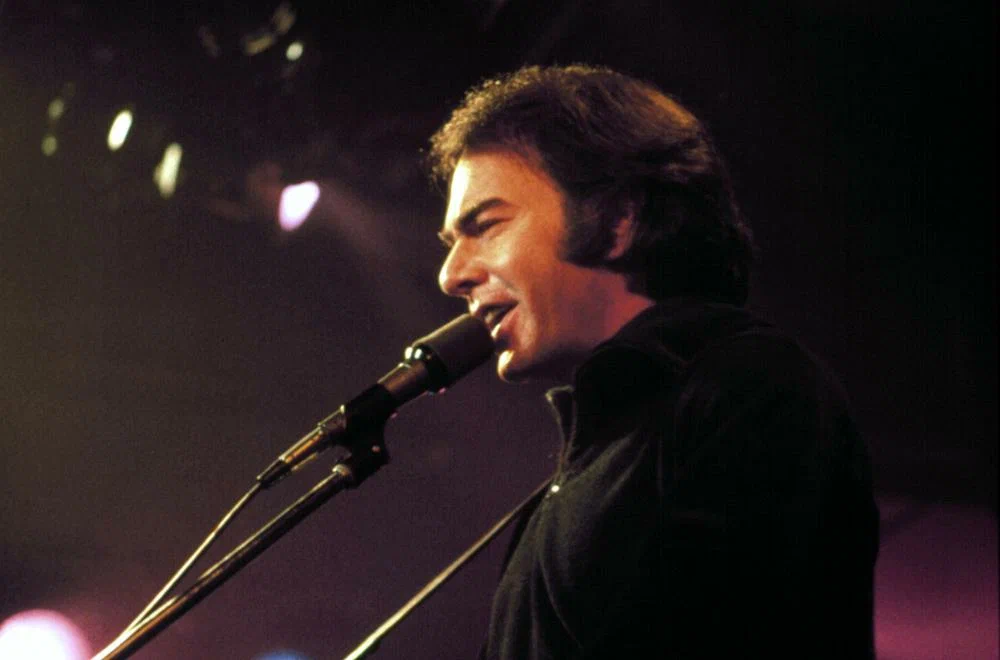
A Winter Hymn of Longing and Light Beneath the Snow
When Neil Diamond released his rendition of “White Christmas” on his 1992 holiday album The Christmas Album, he joined a long line of artists who had already touched one of the most beloved seasonal standards in American music. Yet Diamond’s version—released decades after Irving Berlin’s immortal composition first graced radios in 1942—found its own quiet place among the classics. The album itself became a perennial success, charting seasonally on Billboard’s Holiday Albums lists and reaffirming Diamond’s rare ability to cross genres, faiths, and generations with his singular voice. It was not a commercial novelty or a nostalgic indulgence; rather, it was a reclamation—a heartfelt dialogue between an American Jewish singer-songwriter and one of the most enduring songs about the universal longing for peace, warmth, and home.
What makes Diamond’s interpretation remarkable is not its novelty, but its sincerity. “White Christmas” is so deeply woven into American consciousness that each new performance risks becoming rote or sentimentalized. But in Diamond’s hands, the song feels reborn—stripped of its excess, anchored instead by the artist’s unmistakable gravitas. His baritone does not merely sing of snow; it carries the weight of memory, the ache of distance, and the faint shimmer of redemption that glows beneath Berlin’s deceptively simple words. Where earlier versions—most famously Bing Crosby’s—painted nostalgia in broad strokes of crooning warmth, Diamond approaches it as an intimate confession. He doesn’t simply wish for a white Christmas; he remembers one, as though conjuring a fragment of lost time that still flickers somewhere deep within him.
That quality—the tension between recollection and desire—is at the heart of both the song and Diamond’s artistry. Throughout his career, he has explored themes of yearning, belonging, and transcendence: the human need to reach back toward something purer even as life hardens around us. In “White Christmas,” those themes find their ideal canvas. The arrangement surrounding him is tasteful and restrained—gentle acoustic guitars and subdued orchestration rather than bombastic fanfare—allowing his voice to hover like breath on cold air. Every phrase he delivers feels deliberate, shaped by decades of storytelling experience and emotional authenticity.
To listen to Neil Diamond sing this carol is to hear more than a seasonal standard—it is to hear an artist communing with tradition itself. Beneath the glinting ornamentation lies a meditation on continuity: how songs endure, how memories persist through winters both literal and metaphorical. In this performance, Diamond stands as both participant and witness in America’s ongoing conversation with its own mythology of homecoming. His “White Christmas” is not simply about snow; it is about grace—the fragile kind that falls softly from above and disappears before we can hold it, yet leaves everything momentarily luminous.