
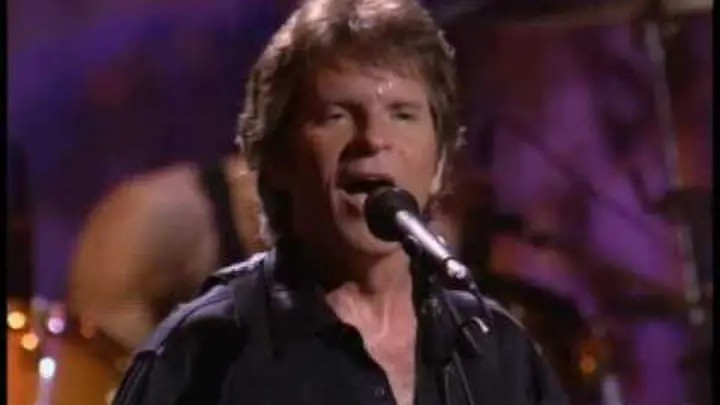
“Bring It Down to Jelly Roll” is John Fogerty turning worry into movement—an invitation to carry your troubles to the river, then dance them into something lighter.
If John Fogerty has a gift beyond riffs and rhythm, it’s this: he can make a phrase feel like a place. “Bring It Down to Jelly Roll” does that in two minutes and change—2:37, tight as a grin—appearing as track 6 on Fogerty’s long-awaited comeback album Blue Moon Swamp, released May 20, 1997. And the album didn’t drift in quietly. Blue Moon Swamp climbed to No. 37 on the Billboard 200, a real, hard-earned return after years away from the studio-album spotlight. Even more telling, it went on to win Best Rock Album at the 40th Annual GRAMMY Awards—Fogerty standing there with a record that sounded like him, not like the era.
Right up front, let’s pin down the “mystery” in the title, because Fogerty has pointed directly at it. In a post explaining the phrase, he wrote that the first time he ever heard “Jelly Roll” was in reference to Jelly Roll Morton, the early jazz figure. That matters because it steers the title away from pure nonsense and toward a kind of American musical genealogy: New Orleans lore, barrelhouse piano swagger, that feeling that the night can still fix you if you let it.
And listen to how Fogerty builds that feeling. In a Vintage Guitar interview from the album era, he’s asked—almost incredulously—how he managed to put dobro and Farfisa organ on the same tune. Fogerty laughs and admits the organ is him “letting it all hang out,” and then drops a delicious clue: he’d spent two years wanting to do a song in the spirit of “Mendocino” or “96 Tears.” That’s a Rosetta stone for the track’s personality. It’s not trying to be “modern rock.” It’s chasing that old, slightly greasy, wonderfully innocent pulse—garage-pop exuberance with a Southern drawl baked in.
The lyrics keep the same philosophy. They don’t solve life; they redirect it. If you want to ease your mind, Fogerty suggests, take it to the river—when you’re down, that’s alright—just bring it down to jelly roll. (You can almost see the hand wave: Come on. Don’t stay stuck. Move with me.) It’s a song about finding the little hidden pocket of joy where people “treat you right,” where you can “run and jump and shout,” where even being broke doesn’t stop you from dancing. And in that way, it’s classic Fogerty—his long-running belief that the cure for a bad day is often music plus motion, not another argument with the ceiling.
There’s also a craftsmanship detail that deepens the charm: Fogerty didn’t outsource the character of the track. The album’s credits note his hands all over the sound—guitars, lap steel/dobro colors, and yes, the tambourine and Farfisa organ that give “Jelly Roll” its party-room sparkle. It’s like hearing a man decorate his own kitchen: not with expensive furniture, but with the familiar tools he trusts.
So what does “Bring It Down to Jelly Roll” mean, underneath the foot-stomp?
It means the world can be heavy and still not win. It means you’re allowed to go looking for a place—real or imagined—where the rules loosen, where you can laugh at your empty pockets, where the night offers a kind of mercy. And with that nod to Jelly Roll Morton—that brash, foundational American musician—Fogerty quietly reminds you that this “mercy” has a history. People have always taken their troubles to the music. Long before self-help shelves, there was the dance floor.
That’s why the song endures as a fan-favorite deep cut from Blue Moon Swamp: it’s not pretending life is simple. It’s simply insisting that, for 2:37, you don’t have to carry it alone.