
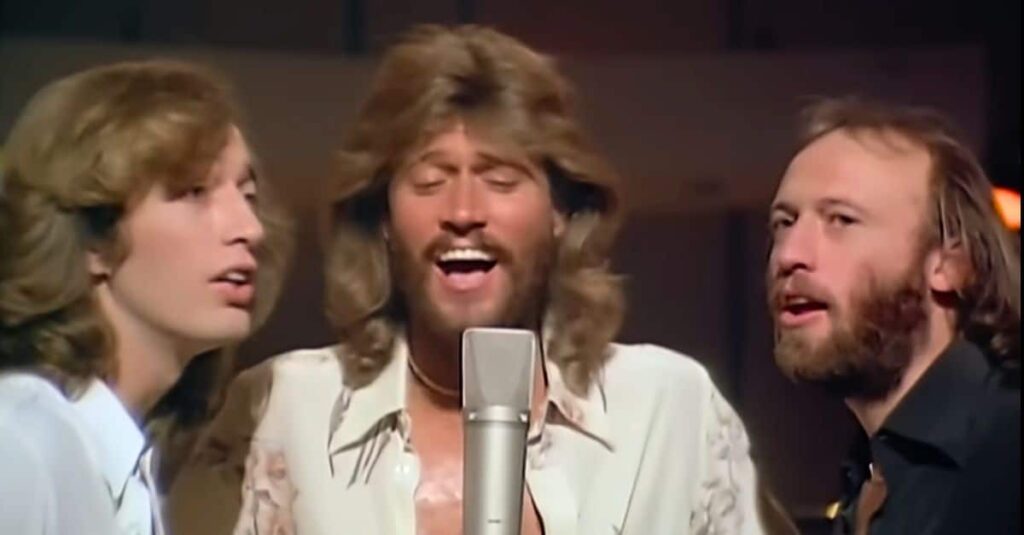
“I Love You Too Much” is one of the Bee Gees’ hidden early-1980s love songs—lush, yearning, and quietly fevered, as if desire has already crossed the line from sweetness into a kind of emotional helplessness.
One of the most important facts to place right at the beginning is that “I Love You Too Much” was recorded by the Bee Gees for the 1983 Staying Alive soundtrack, where it appears in the official track listing alongside “The Woman in You” and “Someone Belonging to Someone.” It was written by Barry, Robin, and Maurice Gibb, and standard Bee Gees song references identify Barry Gibb as the song’s lead vocalist. It was not a hit single in its own full vocal form, so it has no major chart peak of its own. What did receive single exposure was an instrumental version, used as the B-side to “Someone Belonging to Someone” in 1983 releases. That detail matters, because it places the song in a curious and revealing corner of the Bee Gees catalogue: not one of the era’s headline chart records, but not merely forgotten filler either. It was close enough to the front line of the project to be attached to an official single release, yet it remained slightly in the shadows.
That shadowed place in the catalogue suits the song’s emotional character. Staying Alive itself was a complicated chapter for the Bee Gees. The soundtrack followed the immense cultural force of Saturday Night Fever, but it belonged to a very different moment in the brothers’ story: post-disco backlash, changing radio fashions, and a period when the Bee Gees were still trying to adapt their sound without surrendering their melodic identity. The official soundtrack listing shows “I Love You Too Much” among songs built for that slicker early-1980s atmosphere, yet the Bee Gees’ deeper strengths remain audible underneath—their instinct for longing, their understanding of emotional excess, and their gift for turning simple phrases into unforgettable states of feeling.
The title says nearly everything, and that is part of its power. “I Love You Too Much” is not the language of balance. It is the language of overflow. In songs like this, love is no longer a measured exchange between two calm people. It has become an affliction, a pressure, a surrender of emotional proportion. The phrase “too much” carries both ecstasy and danger. It suggests that the feeling is real, perhaps beautiful, but also larger than the self can comfortably manage. That was always one of the Bee Gees’ great emotional territories. They understood that love in pop music is often most compelling when it becomes excessive—when it threatens to overwhelm restraint, reason, even identity. This song belongs squarely to that tradition.
What makes the recording especially intriguing is that it comes from a Bee Gees period often discussed more for style and production than for emotional nuance. Yet “I Love You Too Much” reminds us that even in the glossy, highly produced world of 1983, the brothers were still working from a very old emotional vocabulary: yearning, devotion, vulnerability, and the ache of wanting someone beyond all sensible limits. The soundtrack context may make the song seem like a period piece at first glance, but the feeling inside it is timeless. That is often true of Bee Gees songs. Their arrangements may belong to one era or another, but the emotional engine beneath them usually belongs to no era at all.
There is also something telling in the fact that the instrumental version became the B-side while the full vocal track did not emerge as a major single event. It gives the song a faint aura of unrealized promise, as though it remained one step away from wider recognition. That kind of fate has followed many Bee Gees tracks outside the giant canonical hits. And yet songs like this often become more interesting with time precisely because they were not flattened by overexposure. They let us hear the group in a slightly more private register. “I Love You Too Much” is not burdened by stadium familiarity. It can still surprise a listener.
The song’s deeper meaning, then, lies in emotional imbalance made beautiful. It captures that old human condition in which affection becomes larger than dignity, larger than self-protection, perhaps even larger than hope. To love “too much” is to admit vulnerability without defense. The Bee Gees had written many songs about heartbreak, desire, and devotion, but this title alone places the song in a particularly revealing tradition—the tradition of love as excess, as beautiful weakness. In Barry Gibb’s voice, that excess would naturally carry both warmth and ache, because he always had a way of making desire sound both urgent and wounded.
So “I Love You Too Much” deserves to be heard as one of the quietly compelling lesser-known Bee Gees recordings from the early 1980s: a 1983 song from the Staying Alive soundtrack, written by Barry, Robin, and Maurice Gibb, sung by Barry, and remembered partly through its instrumental B-side connection to “Someone Belonging to Someone.”
But beyond those facts lies the real reason it lingers. It understands that love is not always noble in its proportions. Sometimes it spills over. Sometimes it humiliates and exalts at once. Sometimes it asks more of the heart than the heart can wisely give. And in the Bee Gees’ world, that kind of excess was never a flaw in the song. It was the song’s truth.