
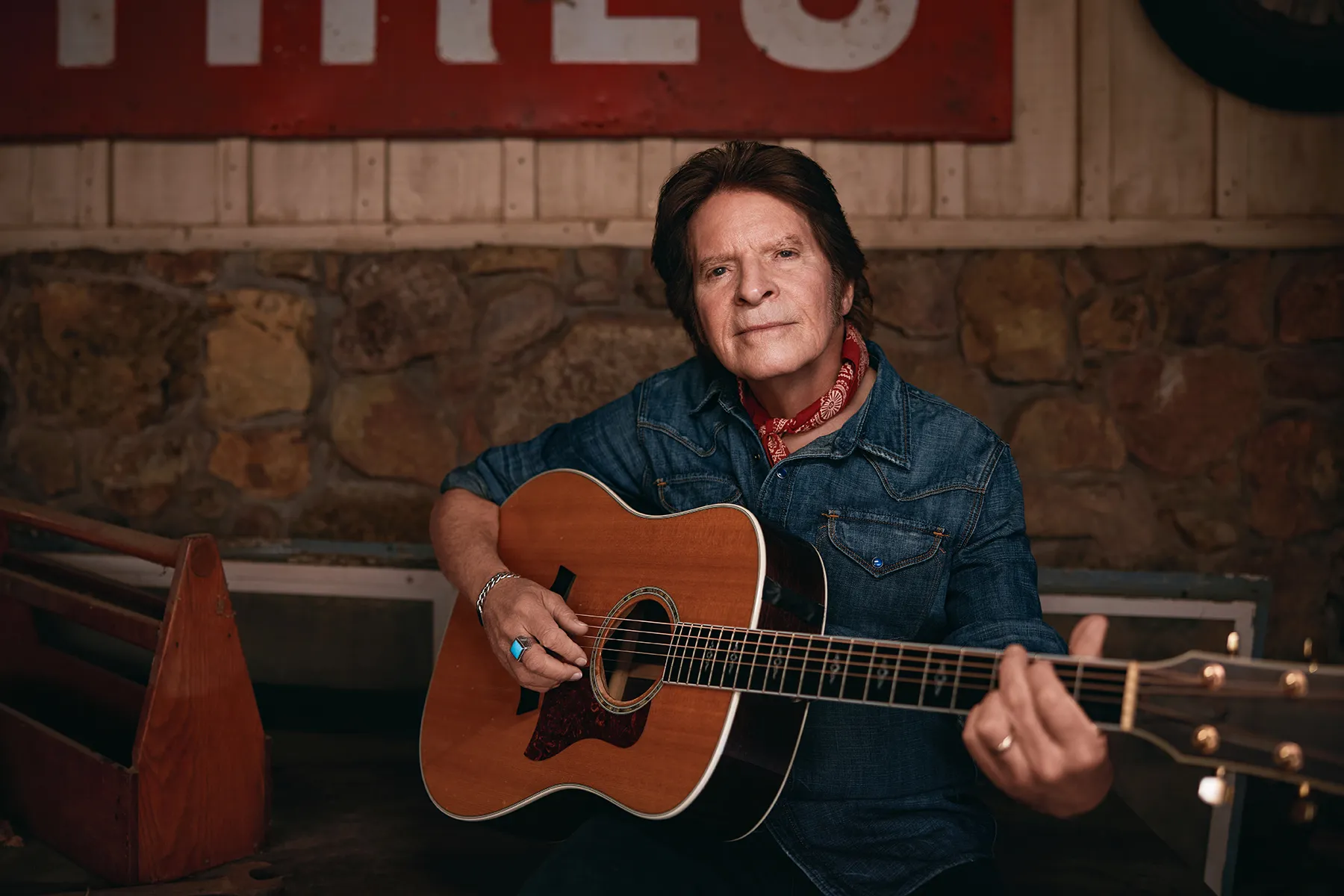
“I Will Walk With You” is John Fogerty at his most quietly faithful—less a protest than a promise, a hand offered when the road feels too long to finish alone.
Released in the autumn of 2004, “I Will Walk With You” sits like a warm lamp inside John Fogerty’s sixth solo studio album, Deja Vu All Over Again (released September 21, 2004). It is track 7, running a brief 3:02, and it matters that it’s brief: the song doesn’t try to impress you with length or spectacle. It tries to reassure you with presence. In a record better known publicly for its sharper political edge, this track feels like the human heartbeat underneath the headlines—Fogerty stepping away from the megaphone and speaking in a steadier voice, the kind you trust because it doesn’t need to shout.
As for “position at debut,” “I Will Walk With You” was listed among Fogerty’s 2004 singles tied to the Deja Vu (All Over Again) era, yet discography records show no significant chart placements for it. In a way, that fits the song’s character. Some songs aren’t built to burst through the front door of radio; they’re built to stay with you after the room empties, when the night has cooled and you’re left with your own thoughts.
The “story behind” the track is written in its soundscape—carefully credited and telling. On the album’s official personnel listing, Fogerty sings lead and background vocals and plays guitars, but he surrounds himself with distinctly rootsy, intimate colors: Bob Applebaum and Michael DeTemple on mandolins, Jerry Douglas on dobro, and Viktor Krauss on bass. These are not the instruments of swagger. They’re the instruments of porches, back rooms, and long drives—tones that suggest companionship and humility. Even if you never look at a lyric sheet, the arrangement tells you what kind of message this is: not conquest, but comfort.
And comfort, here, isn’t softness. It’s resolve. The title phrase—“I Will Walk With You”—carries a particular dignity because it implies time and effort. Walking is slower than fleeing, slower than chasing, slower than declaring victory. Walking says: I’m not leaving you behind. It’s a vow made in everyday language, the kind of vow that means more precisely because it isn’t dressed up. Fogerty has always been a writer of motion—roads, rivers, storms, hard travel—and on Deja Vu All Over Again he’s also a writer of conscience. Here, the conscience is personal. It isn’t about what’s wrong with the world; it’s about what’s right between two people when the world is wrong.
There’s something especially poignant about the year 2004 hanging over this album. Fogerty produced the record himself, and it was recorded across Fall 2003–2004, a period when public anxiety and national argument seemed to seep into everything. Deja Vu All Over Again debuted at No. 23 on the Billboard 200, proof that people were still listening for his voice in the public square. Yet in the middle of that square, “I Will Walk With You” feels like he turns and speaks to one person at the edge of the crowd—someone tired, maybe lonely, maybe trying to keep going without letting anyone see the strain.
That is the deeper meaning of the song as it lives on the album: it’s a reminder that the most radical thing you can do, sometimes, is stay. Not in the dramatic sense—no grand rescue scene, no heroic pose—just the daily decision to be alongside someone, step for step. The mandolins shimmer like small mercies; the dobro carries a rural ache that feels older than the moment; and Fogerty’s voice—seasoned, plainspoken, unmistakable—delivers the promise without ornament.
So if “I Will Walk With You” never arrived with a chart trumpet blast, it arrived another way: quietly, reliably, like a friend pulling into the driveway when you didn’t even realize you were waiting. And years later, that’s often the more faithful kind of success—the kind measured not in rankings, but in the simple fact that the song still knows how to keep you company.