
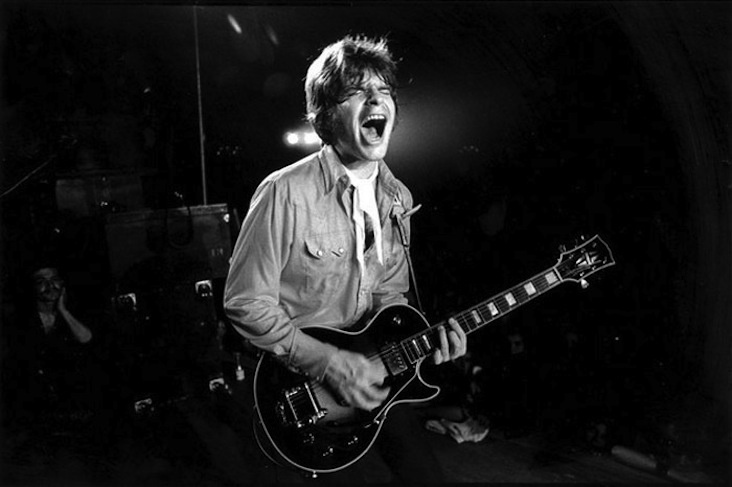
“Blue Moon of Kentucky” in John Fogerty’s hands is a bridge song—half porchlight, half headlight—where rock-and-roll gratitude leans into bluegrass memory and quietly says thank you for the road.
When John Fogerty stepped into “Blue Moon of Kentucky” in May 2000, he wasn’t “going country” as a novelty. He was paying a debt. His recording was made for a tribute album led by Ricky Skaggs—Big Mon: The Songs of Bill Monroe—released August 29, 2000 on Skaggs Family Records. This matters, because it places the performance inside a very specific act of reverence: a room full of voices gathering around Bill Monroe’s songwriting the way friends gather around an old photograph—each one pointing to a different detail, each one remembering something the others missed.
The chart story at release belongs to the album, not the track. Big Mon: The Songs of Bill Monroe debuted at No. 52 on Billboard’s Top Country Albums chart and later peaked at No. 42; it also reached No. 34 on Billboard’s Top Independent Albums. And the industry respect was real, too: the album is listed among the nominees for the Grammy Award for Best Bluegrass Album (early-2000s era), the kind of recognition that doesn’t come from hype—only from craft and community.
Now, about the song itself: “Blue Moon of Kentucky” is older than rock and roll, and in a way it contains rock and roll in its bones. Bill Monroe and his Blue Grass Boys recorded it in 1946 (released in 1947; it’s commonly cited as a September 1947 release), and it began life as a bluegrass waltz—lonely, moonlit, slow enough for regret to settle in. Then, in 1954, Elvis Presley famously turned it into an uptempo rocker at Sun—an early signal that country and rhythm could share the same heartbeat. The song became one of those rare American standards that doesn’t just survive new eras—it explains them.
That’s why Fogerty is such a natural voice to carry it. He came from the rock tradition, yes—but a rock tradition that always had river-mud on its boots, always listened hard to older songs. On this recording, you can hear a musician stepping into Monroe’s world without pretending he was born there. There’s humility in that. He doesn’t “improve” the song. He serves it—letting the melody stay simple, letting the lyric keep its plain-spoken ache: the moon shining on the one who’s gone, the stubborn sadness that won’t pack up and leave.
And that is the emotional meaning of Fogerty’s “Blue Moon of Kentucky”: it’s not just about a lover who disappeared. It’s about the way time disappears people, places, whole chapters of ourselves—until only music can reliably bring them back. The moon in this song is more than scenery; it’s a witness. It shines on what’s missing, and by shining, it refuses to let the missing be erased.
There’s also a deeper kind of storytelling tucked into the tribute-album setting. Big Mon is explicitly about honoring Monroe; Fogerty’s participation turns that honor into a dialogue across genres—bluegrass speaking to rock, rock answering softly, both agreeing that the old songs were never “old” at all. In fact, there’s a moving line in a Library of Congress essay connected to the song’s legacy—an emphasis on how this tune helps illuminate the roots of rock in country music, not only in the better-known African American sources but also in white rural traditions that fed early rockabilly. Fogerty’s version feels like he understands that history instinctively, in the way he phrases a line, in the way he lets the groove breathe.
So if you’re listening for fireworks, you’ll miss the point. This performance isn’t trying to “win” the song. It’s trying to keep it alive—to hold it up to the light one more time, so the next listener can feel what earlier listeners felt: that peculiar mix of sweetness and sting, the comfort of a familiar melody, the quiet ache of a goodbye that still hasn’t finished saying itself.
And when the last chord fades, what lingers isn’t virtuosity. It’s the sensation of standing at the edge of two eras—bluegrass behind you, rock and roll ahead—and realizing the road between them has always been made of the same thing: a voice, a story, and a moon that keeps shining anyway.