
A road-song about being stranded becomes a family song about finding your way back—because sometimes “home” is simply the people who know the words with you.
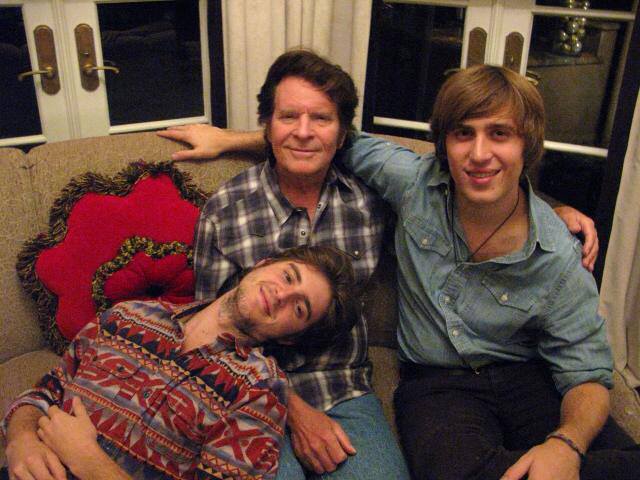
When John Fogerty revisited “Lodi” in 2013 with his sons Shane Fogerty and Tyler Fogerty, it wasn’t just another nostalgia lap. It was a quiet, meaningful reframing of one of his most human songs: a story originally sung by a lone, down-on-his-luck musician—now delivered as a small circle of voices, father and sons, sharing the burden and the blessing of the refrain.
That version appears on Fogerty’s collaborative album Wrote a Song for Everyone, released May 28, 2013. The album made a notable first impression: it reached No. 3 on the U.S. Billboard 200, and even hit No. 2 on Billboard’s Top Rock Albums—a reminder that Fogerty’s catalog isn’t a museum piece, but a living language people still speak fluently. And “Lodi” sits right near the front of that record’s story (track 3, running 4:19), as if to say: before we invite the world into these songs, let’s begin at the hearth.
To feel why this matters, you have to return to where “Lodi” began. The song was written by Fogerty and first recorded by Creedence Clearwater Revival in March 1969 at Wally Heider Studios in San Francisco. It was issued the following month as the B-side to Bad Moon Rising (released April 16, 1969), months before the album Green River arrived. The A-side exploded; the B-side lingered like a bruise you keep touching without meaning to. On paper, “Lodi” peaked at No. 52 on the U.S. chart—modest compared with the hit it traveled with. But songs don’t always reveal their rank through numbers. Some reveal it through the way they stay in the throat for decades.
The “behind the song” truth is almost disarmingly simple: Fogerty chose Lodi, California largely because the name sounded right—he later said he hadn’t even been there when he wrote it, and he liked how the word felt in a chorus. That’s the songwriter’s alchemy: geography becomes emotion. And the emotion here is painfully clear. “Lodi” is a character sketch of a working musician stuck after another bar gig, short on fare, short on dignity, and running out of tomorrow—someone realizing, with a slow chill, that a career can end not with fireworks but with quiet, repetitive defeat. Fogerty himself described seeing an older, tragic figure in the song—someone trapped in a place where the crowd doesn’t truly care.
What makes “Lodi” endure is that it doesn’t romanticize struggle. It doesn’t pretend the road is always freedom. It tells a harder truth: the road can also be a loop. The melody moves with that Creedence simplicity—direct, unshowy, built to feel like speech—yet the lyric turns that simplicity into heartbreak. The narrator isn’t asking for a miracle; he’s asking for bus money. And somehow, that smallness is what makes it universal. Most people don’t fear spectacular failure. They fear the slow kind—the kind where you wake up one day and realize you’ve been “stuck” for years.
So when Fogerty sings “Lodi” again in 2013 with Shane and Tyler, the meaning shifts just enough to matter. The song still carries the original ache, but the frame changes: it’s no longer only the voice of a man stranded; it’s also the voice of a father standing beside his sons, turning an old warning into a shared inheritance. The lyric says “stuck,” but the performance says something gentler underneath: you don’t have to be stuck alone. And there’s something quietly moving about that, because Fogerty’s songs have always been filled with motion—rivers, roads, trains, weather—yet this one has always been about the moment motion fails. In 2013, he answers that failure not with reinvention, but with family harmony: the simplest form of rescue.
Maybe that’s the deepest reason “Lodi” never fades. It isn’t just a tale of a musician in trouble. It’s a meditation on the places life leaves us—those unwanted layovers of the soul—and the thin, stubborn thread of hope that says: I can still get back home. Not necessarily to a town on a map, but to a steadier version of yourself… and, if you’re lucky, to the people who will sing you out of the dark.