
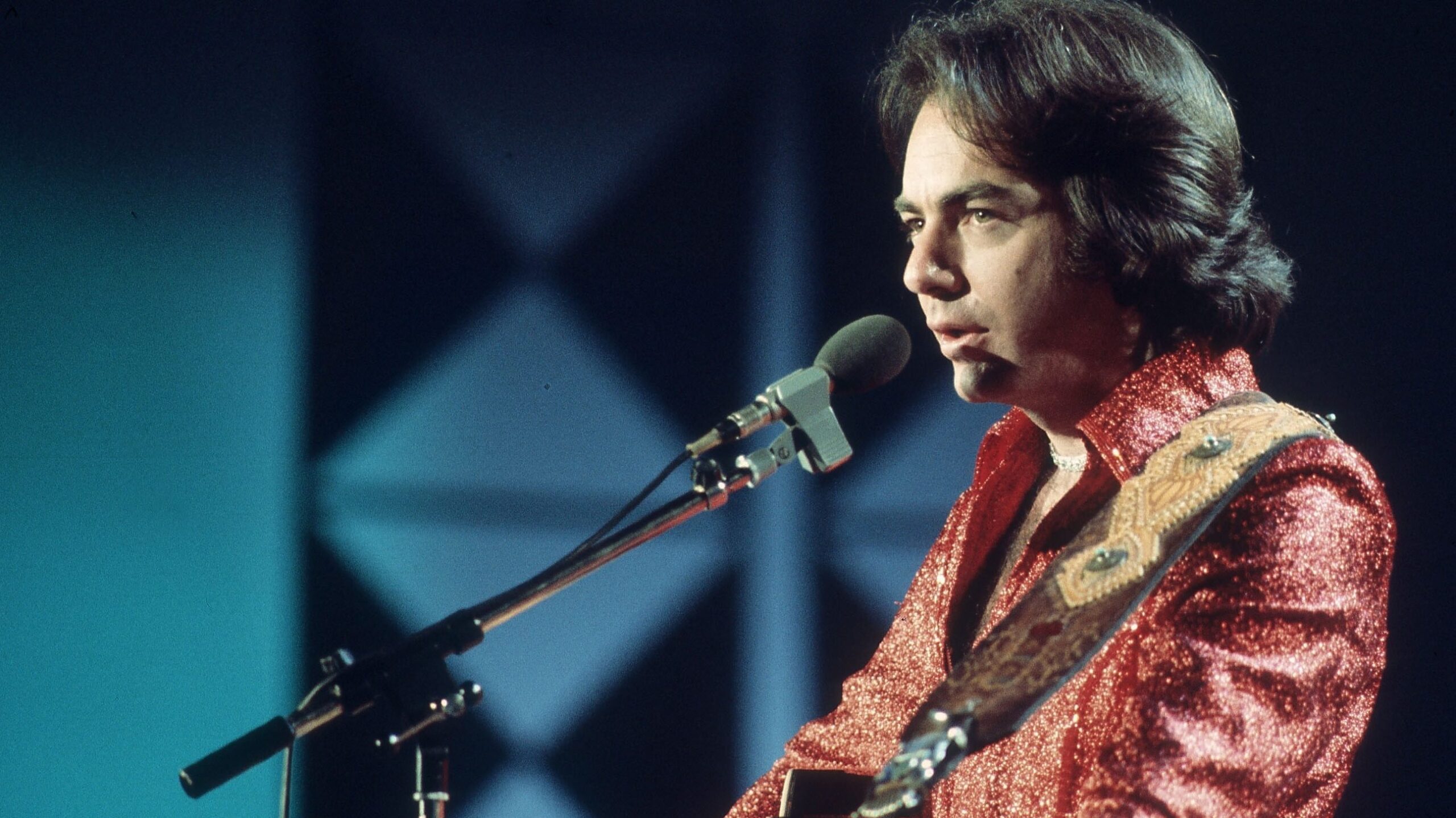
“Thank the Lord for the Night Time” turned Neil Diamond’s after-dark hunger into pure pop electricity — a song where daylight feels like a burden, and the night arrives like freedom, romance, and release all at once.
There are songs that celebrate the night, and then there are songs that seem to need it in order to breathe. “Thank the Lord for the Night Time” belongs to that second, more fevered kind. Written by Neil Diamond, produced by Jeff Barry and Ellie Greenwich, and released in 1967 on Bang Records, the single rose to No. 13 on the Billboard Hot 100 and later ranked at No. 100 on Billboard’s year-end Top 100 singles of 1967. It also appeared on Diamond’s August 25, 1967 album Just for You, where it served as the closing track. Those details matter because they show this was not some minor curiosity tucked away in his early catalog. It was a real hit, one of the records that helped define the young Neil Diamond before the grander 1970s persona fully arrived.
What makes the song so irresistible is how immediately it declares its emotional world. “Daytime turns me off,” Diamond sings, and from that moment the whole record feels charged with impatience, desire, and escape. This is not a nighttime song in the dreamy, moonlit sense. It is a song about release from the grind — from the nine-to-five, from routine, from the blunt, practical pressure of ordinary daylight life. That idea was already present in Diamond’s songwriting from his earliest Bang years: the tension between work and freedom, between the day’s obligations and the soul’s deeper appetite. But “Thank the Lord for the Night Time” may be the clearest, most joyful version of that tension he ever put on record. The lyric is simple, yes, but simplicity is part of its force. It does not overthink its longing. It feels it.
And that is why only Neil Diamond could turn it into gold. In another singer’s hands, the song might have been merely a strong pop rocker, a lively slice of 1967 radio energy. But Diamond had that unusual ability — even very early on — to sound both urgent and strangely intimate at the same time. He pushes the song forward with real hunger, yet never loses the sense that the nighttime he’s praising is personal to him, almost sacred. It is where he can become fully himself. That emotional charge gives the record more weight than its breezy runtime might suggest. It is not just about evening. It is about liberation.
The musical setting matters too. Billboard praised the single’s “strong dance beat” and Cash Box called it a “driving, thumping, rhythmic, pounding venture,” and both descriptions still feel exactly right. This is one of the early Bang-era Neil Diamond records where the studio sound seems to punch and sparkle at the same time. The rhythm drives hard, the arrangement is compact and forceful, and Diamond’s vocal sits right in the middle of it like a man impatient for the sun to go down. That mix of beat and personality is crucial. Plenty of songs had rhythm in 1967. Fewer had this much identifiable character.
It also sits beautifully inside Just for You, one of the key albums from Diamond’s Bang period. That record included other enduring early songs such as “Girl, You’ll Be a Woman Soon,” “You Got to Me,” and “Red Red Wine,” and it was his first album made entirely of original material. In that company, “Thank the Lord for the Night Time” feels like an essential part of the young Diamond myth: the urban romantic, restless in daylight, fully alive after dark, writing songs that made ordinary desire sound grander than it was supposed to. He had not yet become the arena-filling elder statesman of later decades, but the instinct was already there — the instinct to make feeling sound large, immediate, and undeniable.
There is a lovely irony in the song’s enduring reputation, too. It was not his highest-charting Bang single, and it is sometimes slightly overshadowed by the larger legend of “Cherry, Cherry,” “Solitary Man,” or “Girl, You’ll Be a Woman Soon.” Yet “Thank the Lord for the Night Time” has kept a special glow because it captures something quintessential about Neil Diamond. It has movement, grit, melody, and desire, but above all it has attitude — not cynicism, not rebellion for its own sake, but the conviction that night belongs to those who have waited all day to feel alive.
So why does the song still feel like a nighttime anthem only Neil Diamond could turn into gold? Because he sings it not as concept, but as necessity. He sounds like a man who has endured the day and earned the night. He understands that darkness is not always sadness; sometimes it is freedom, romance, and renewal. On “Thank the Lord for the Night Time,” he takes that old truth and wraps it in a beat strong enough to move the body and a vocal urgent enough to stir the heart. That is why the record still crackles. It is not only about nightfall. It is about the moment life begins again when the sun finally gets out of the way.