
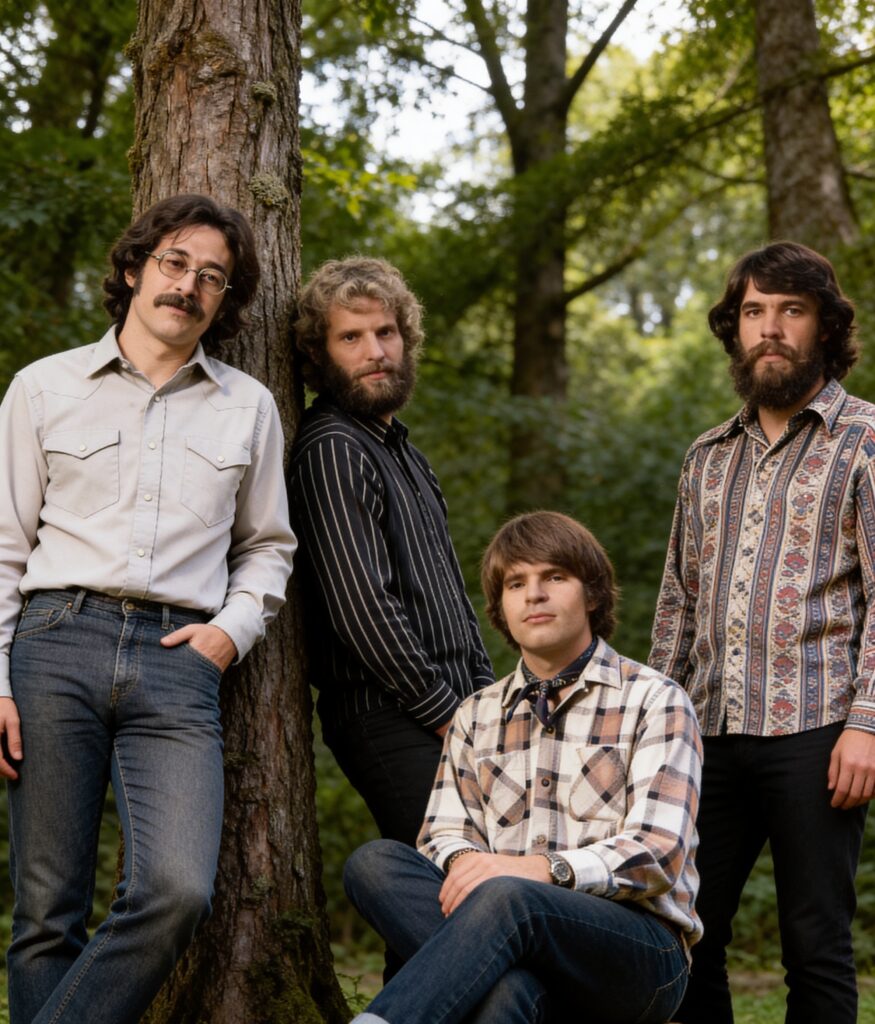
A bright porch-side daydream, Lookin’ Out My Back Door finds wonder in the ordinary and turns a quiet moment at home into pure musical sunlight.
Released in 1970 from Creedence Clearwater Revival‘s landmark album Cosmo’s Factory, Lookin’ Out My Back Door became one of the band’s most warmly remembered hits. Issued as a single with Long as I Can See the Light on the other side, it climbed to No. 2 on the Billboard Hot 100 in the United States. For a group so often linked with grit, motion, and a distinctly American sense of urgency, this song arrived like a deep breath on a shaded porch. It sounded easy, amused, and wonderfully unforced. That relaxed spirit is exactly what made it endure.
Written and sung by John Fogerty, the song opens with one of the most welcoming scenes in the entire CCR catalog: a man getting home, shutting the door, and settling down to rest. In only a few lines, the whole emotional world is set. This is not a story built on grand drama. It is a homecoming, plain and familiar, and because it is so familiar, it carries a special kind of truth. Then, almost before you realize it, the song slips into a parade of impossible images: tambourines, elephants, a flying spoon, music drifting through the air. The ordinary yard becomes a place of wonder.
That playful turn was no accident. John Fogerty has long explained that Lookin’ Out My Back Door was written with his young son in mind, and he has also connected its imagination to the spirit of Dr. Seuss. That background matters because it gives the song its emotional center. The whimsy is not there to confuse the listener. It is there to recreate the feeling of seeing the world through family, through play, through a lighter heart. What sounds effortless is actually very carefully judged. Fogerty knew that if he kept the language vivid and loose, the song could feel like a smile arriving all at once.
Because the lyrics are so surreal, some listeners spent years trying to force a different meaning onto the song. Fogerty has rejected that reading again and again. What he intended was simpler and, in many ways, far more touching: the release of being home, the freedom to be playful, and the joy of letting imagination take over for a few minutes. In that sense, the song is not an escape from real life at all. It is a return to the best part of real life, the part that can so easily get buried beneath work, travel, noise, and routine.
Musically, Creedence Clearwater Revival understood the assignment perfectly. Few bands of their era were better at taking pieces of rock and roll, country, rhythm and blues, and folk directness, then shaping them into something that felt both concise and complete. Here the groove rolls instead of pushes. The rhythm section never hurries. The guitars carry a gentle country flavor, and the lyric’s reference to Buck Owens is more than a passing nod. It tells you exactly where some of the song’s heart lives. This is music with dust on its boots and sunlight on its shoulders. Even when the arrangement fills out, it never loses that porch-swing ease.
Placed within Cosmo’s Factory, the song becomes even more interesting. That album stands as one of the defining American rock releases of 1970, full of strong singles, sharp performances, and a band moving at an astonishing creative pace. Yet Lookin’ Out My Back Door reveals something crucial about CCR: they did not need intensity to make a record memorable. They could just as easily create magic through lightness, humor, and atmosphere. The track proves how much character the band could summon without ever sounding labored. It feels tossed off in the best possible way, but behind that ease is superb control.
There is also a quiet cultural resonance in the song that helps explain why it still feels fresh. Its American imagery is intimate rather than ceremonial. It gives us a porch, a yard, a radio, a hint of country music, and the sensation of finally slowing down. That may be why the song continues to strike such a deep chord. People do not only hear 1970 when they hear it. They hear their own memories of calm: a summer evening, a backyard, a breeze, the comfort of familiar sounds, the luxury of having nowhere urgent to be for a little while.
That is the real meaning of Lookin’ Out My Back Door. It is a song about relief, but not relief announced with fanfare. It is the kind that arrives quietly when the day begins to loosen its grip. It suggests that joy does not always come from monumental moments. Sometimes it comes from sitting still long enough to notice what is already around you. Sometimes it comes from family. Sometimes it comes from imagination wandering into a perfectly ordinary afternoon and transforming it.
More than fifty years later, the record still works because it refuses to oversell its emotions. It smiles instead of straining. It drifts instead of preaching. That restraint was one of John Fogerty‘s great gifts as a songwriter. He understood that a song about contentment should itself feel contented. Creedence Clearwater Revival captured that feeling beautifully here, and in doing so they gave listeners more than a hit single. They gave them a small American dream set to music, modest and bright, the kind of song that can make the whole world seem gentler for three minutes at a time.