
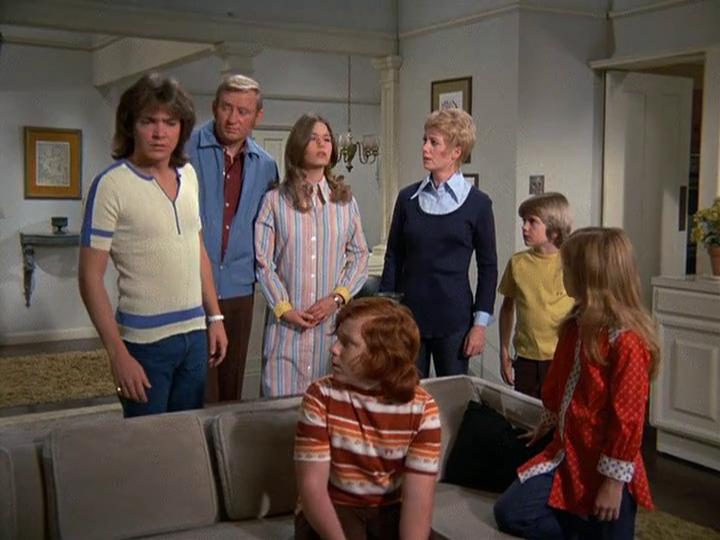
“Am I Losing You” is a small, aching question wrapped in bright early-’70s pop—where the smile stays on the surface, but the heart keeps checking the door to see if love is quietly leaving.
In 1972, The Partridge Family released “Am I Losing You” on Bell Records (U.S. single catalog Bell 45,200), produced by their hit-factory architect Wes Farrell. It wasn’t one of their blockbuster moments, but it was a real charting single: it peaked at No. 59 on the Billboard Hot 100 and stayed on the chart for seven weeks, a modest showing that nevertheless places it firmly among the group’s nine Hot 100 hits. The A-side was written by Irwin Levine and L. Russell Brown—the same songwriting team behind the Partridges’ earlier hit “I Woke Up in Love This Morning.” And on the flip side sat “If You Ever Go,” credited to Wes Farrell and Tony Romeo, like a second little confession tucked behind the first.
The song is most closely associated with the album Shopping Bag (released March 1972), the record that carried the era’s “Willy and the Poor Boys”-style pop innocence into a slightly more polished, second-season glow. And that’s the first thing to understand about “Am I Losing You”: it belongs to a carefully built world. The Partridge Family wasn’t merely a band; it was a television dream of a band—crafted for ABC, with David Cassidy as lead singer, supported by elite Los Angeles studio players and the kind of backing vocalists who could make a chorus feel like sunshine even when the lyric was trembling.
Yet the lyric premise of “Am I Losing You” is anything but sunny. It’s not a love song that boasts. It’s a love song that checks its pulse. The title question is the whole emotional engine: Am I losing you? Not “I’ve lost you,” not “I’m leaving,” not even “don’t go.” It’s that earlier stage—the sickening suspicion, the quiet audit of tone and distance, the moment when you can’t tell if the silence is just a pause… or a goodbye practicing in the hallway.
That’s why the song has always felt like a cousin to real adolescent anxiety, even though it comes dressed in professional pop sparkle. Brown and Levine had a gift for writing hits that sounded breezy while smuggling in insecurity—“I Woke Up in Love This Morning” being the most famous example. With “Am I Losing You,” they aim the camera inward: the narrator isn’t battling a rival or begging for a grand romantic rescue. He’s watching the relationship’s temperature drop by one degree—then another—until he can’t ignore it anymore.
And then there’s David Cassidy—or rather, the Cassidy persona these records captured. The Partridge sound had that special early-’70s paradox: wholesome enough for family television, yet emotionally immediate enough to feel private through a transistor radio at night. “Am I Losing You” thrives in that paradox. You can almost hear the studio craft doing its job—tight arrangement, clean rhythm, harmonies arranged to land like reassurance—while the lyric refuses to relax. The chorus doesn’t resolve the fear; it repeats it, as if repetition might turn uncertainty into certainty.
That may be why the song’s chart fate feels strangely appropriate. No. 59 is not a triumphal number—yet it’s not nothing, either. It’s the position of a song that many people didn’t discover through hype, but through living with the band’s catalog: the kind of track you find because you kept listening after the bigger hits. It sits in that tender middle ground where Partridge Family music often lives best—between the bright public fantasy and the very real private feeling of wanting to be loved back with the same certainty you’re giving.
If “I Think I Love You” is the rush of arrival, “Am I Losing You” is the hush of doubt—the realization that love isn’t only fireworks; sometimes it’s maintenance, attention, timing, and the courage to ask the question out loud before it’s too late. And when the record ends, what lingers isn’t just the melody—it’s that familiar, human ache: the fear that the most important things can slip away quietly… unless someone is brave enough to notice.