
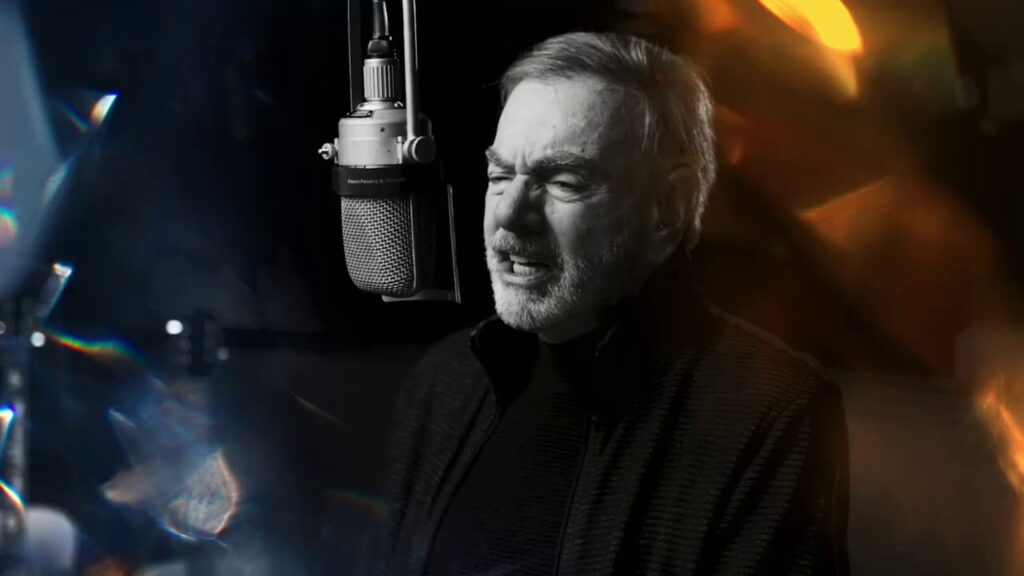
Neil Diamond’s Blackbird does not chase grandeur. It opens the song like a private letter, letting its hope, sorrow, and dignity settle in with uncommon grace.
There are some songs that arrive in one era and somehow keep speaking to every era that follows. Blackbird is one of them. When Neil Diamond recorded his version for the 2010 album Dreams, he did not try to compete with history, and he did not try to modernize a classic that never needed updating. Instead, he did something far rarer. He trusted the song. He stepped into it quietly, sang it with the kind of weathered tenderness only time can give a voice, and let the meaning rise on its own.
- Song: Blackbird
- Neil Diamond release: featured on the covers album Dreams in 2010
- Chart note: Dreams debuted at No. 8 on the Billboard 200
- Original source: written by John Lennon and Paul McCartney, first released by The Beatles on The Beatles in 1968, the album widely known as the White Album
That chart detail matters because Blackbird was not presented as a hit single in the usual sense. It entered the public through the larger frame of Dreams, a deeply personal collection of songs that had shaped Neil Diamond as a listener and an artist. The album’s strong debut at No. 8 showed that there was still a large audience ready to follow him into quieter territory. By then, Diamond no longer needed to prove his power. He had already given the world the anthems, the stadium moments, the singalongs. What made Blackbird so moving in his hands was precisely the opposite of spectacle. It felt intimate, reflective, almost like a conversation held after midnight.
The story behind Blackbird has long given the song its moral weight. Although many listeners first heard it simply as a delicate acoustic piece from The Beatles, Paul McCartney has said that the song was inspired in part by the civil rights struggle in the United States, particularly the pain and courage surrounding school desegregation in the American South. The blackbird in the lyric was not merely a bird in the garden. It was also an image of endurance, awakening, and the right to rise after being held back. That is why the line about taking broken wings and learning to fly has never sounded sentimental when sung honestly. It carries both wound and promise.
Neil Diamond understood that balance. He had always been a singer drawn to emotional directness, but by 2010 his voice carried a different kind of authority than it had in his early hit-making years. The tone was deeper, more lived-in, less interested in polish for its own sake. On Blackbird, that served the song beautifully. He does not over-explain the lyric. He does not lean on ornament. He simply lets each phrase breathe. In that restraint, the performance becomes profoundly human. One hears not only admiration for the song, but gratitude toward it.
And that may be the real secret of this recording. Some cover versions are built to impress; Neil Diamond’s Blackbird feels built to remember. It remembers what the song stood for when it first appeared in 1968, in a world filled with fracture, unrest, and longing for change. It also remembers the way songs travel through the years, gathering new shades of meaning as listeners grow older and life becomes more complicated. In Diamond’s reading, Blackbird is no longer only the hopeful voice of youth. It also becomes the steady wisdom of survival.
There is something especially affecting about hearing an artist so closely associated with bold, unmistakable presence choose understatement instead. It reminds us that strength in music does not always come from volume. Sometimes it comes from patience. Sometimes it comes from a singer knowing exactly how little he has to do. That is where Blackbird lives in this performance: in the pauses, in the softened edges, in the feeling that every word has been considered before it is released.
Within Dreams, the song also makes artistic sense. This was not a nostalgic exercise assembled out of duty. It was a return to foundations. By revisiting songs that had mattered to him, Neil Diamond was, in a way, revisiting his own inner musical life. Blackbird stands out because it fits him so naturally. Its melodic simplicity, emotional clarity, and moral seriousness all match the qualities that made his best performances endure in the first place.
What remains, after the final note, is a feeling of calm that is not simple and hope that is not naive. That has always been the greatness of Blackbird, and it is what Neil Diamond protects so beautifully in his version. He does not try to own the song. He honors it. He enters its long history with humility, and because of that, he leaves a distinct impression all his own.
For anyone returning to Blackbird after many years, this performance offers a different doorway into a beloved classic. It is softer, older, and perhaps wiser. It reminds us that some songs do not fade with time. They deepen. And when a voice like Neil Diamond meets a song like Blackbird, what we hear is more than a cover. We hear one enduring artist recognizing the quiet truth inside another enduring song.