
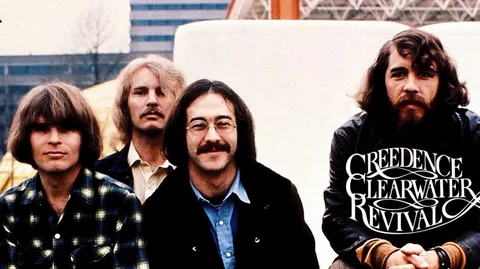
In its brief, rolling stride, Poorboy Shuffle shows how Creedence Clearwater Revival could turn a modest instrumental into a portrait of working-class America—plainspoken, warm, and full of dust-road memory.
Poorboy Shuffle was never a hit single, and that is part of its mystery. Released in 1969 on Creedence Clearwater Revival’s album Willy and the Poor Boys, the track did not chart on its own because it was not issued separately to radio. But the album that carried it became one of the defining records of that remarkable year, reaching No. 3 on the Billboard 200. The album’s famous double-sided single, Fortunate Son and Down on the Corner, also climbed to No. 3 on the Billboard Hot 100. So while Poorboy Shuffle lived in the shadows of bigger, louder songs, it arrived inside a record that was already speaking for a restless America.
That matters, because Poorboy Shuffle is best understood not as a forgotten extra, but as part of the album’s emotional architecture. Willy and the Poor Boys, released in November 1969, came during an astonishing streak for the band. In that same year, Creedence Clearwater Revival had already released Bayou Country and Green River. Most groups would have been exhausted. CCR somehow sounded sharper, leaner, and more confident with each record. John Fogerty, the group’s principal songwriter and creative center, had a rare gift: he could write songs that felt immediate on the radio, yet still carried the grain of older American music inside them. Poorboy Shuffle may be a small track, but it reveals that gift beautifully.
Musically, the piece feels like a loose-limbed side street off the main road. It is a short instrumental, shaped more by feel than by lyrical declaration. There is no grand statement, no heavy-handed chorus trying to force emotion. Instead, the song moves with an easy shuffle rhythm, like a band warming up on a back-porch stage or drifting through a neighborhood where music belongs to everyday life rather than spectacle. That is one reason it still charms attentive listeners. It sounds lived-in. It sounds unpretentious. It sounds as if Creedence Clearwater Revival paused long enough to remember where rock and roll came from.
The title itself is revealing. Poorboy Shuffle carries the same plain, weathered spirit that runs through Willy and the Poor Boys. This was an album deeply invested in American character—ordinary people, plain talk, and songs that seemed pulled from the curbside rather than the penthouse. Even the album cover, photographed outside a market in Oakland, California, gave the band a street-corner identity. They were not dressing themselves in psychedelic mystique or aristocratic glamour. They were presenting a tougher, humbler mythology: the working band, the common voice, the sound of people who knew how to keep moving.
That is why Poorboy Shuffle means more than its running time suggests. On an album that includes the biting social charge of Fortunate Son, the playful energy of Down on the Corner, and the late-night unease of Effigy, this little instrumental offers breathing room. It loosens the collar. It smiles without becoming silly. And in doing so, it reminds the listener that CCR were never only about protest, toughness, or hit-making efficiency. They also understood pacing, atmosphere, and the old-fashioned pleasure of groove.
There is something especially moving about that now. Many songs from the late 1960s announce their importance with a raised voice. Creedence Clearwater Revival, at their best, often did the opposite. They trusted compression. They trusted instinct. They trusted the sound of American roots music filtered through electric instruments and a no-nonsense band chemistry. Poorboy Shuffle feels like one of those quiet decisions that tells you everything about an artist’s depth. A lesser band might have filled the space with excess. CCR used it to create texture.
The story behind the song, then, is not one of scandal or dramatic studio conflict. Its story is subtler, and perhaps more lasting. It shows a band at the height of its powers choosing restraint. It shows John Fogerty and company building an album world, not just stacking potential singles. It shows their affection for older musical traditions—the shuffle, the informal instrumental, the communal feel of music made for gathering rather than display. In that sense, Poorboy Shuffle is a small doorway into the larger vision of Willy and the Poor Boys: an album rooted in the language of the street, the South, the jukebox, and the American imagination.
For listeners returning to the record after many years, this is often the kind of track that grows in stature. The obvious classics arrive first, as they always do. But then a smaller piece begins to glow. Poorboy Shuffle does exactly that. It may not deliver the album’s loudest message, yet it carries some of its deepest feeling. Humility. Motion. Memory. A sense that music can still be playful and handmade, even in a turbulent time. That is why this overlooked track endures. Not because it demanded attention, but because it never had to.