
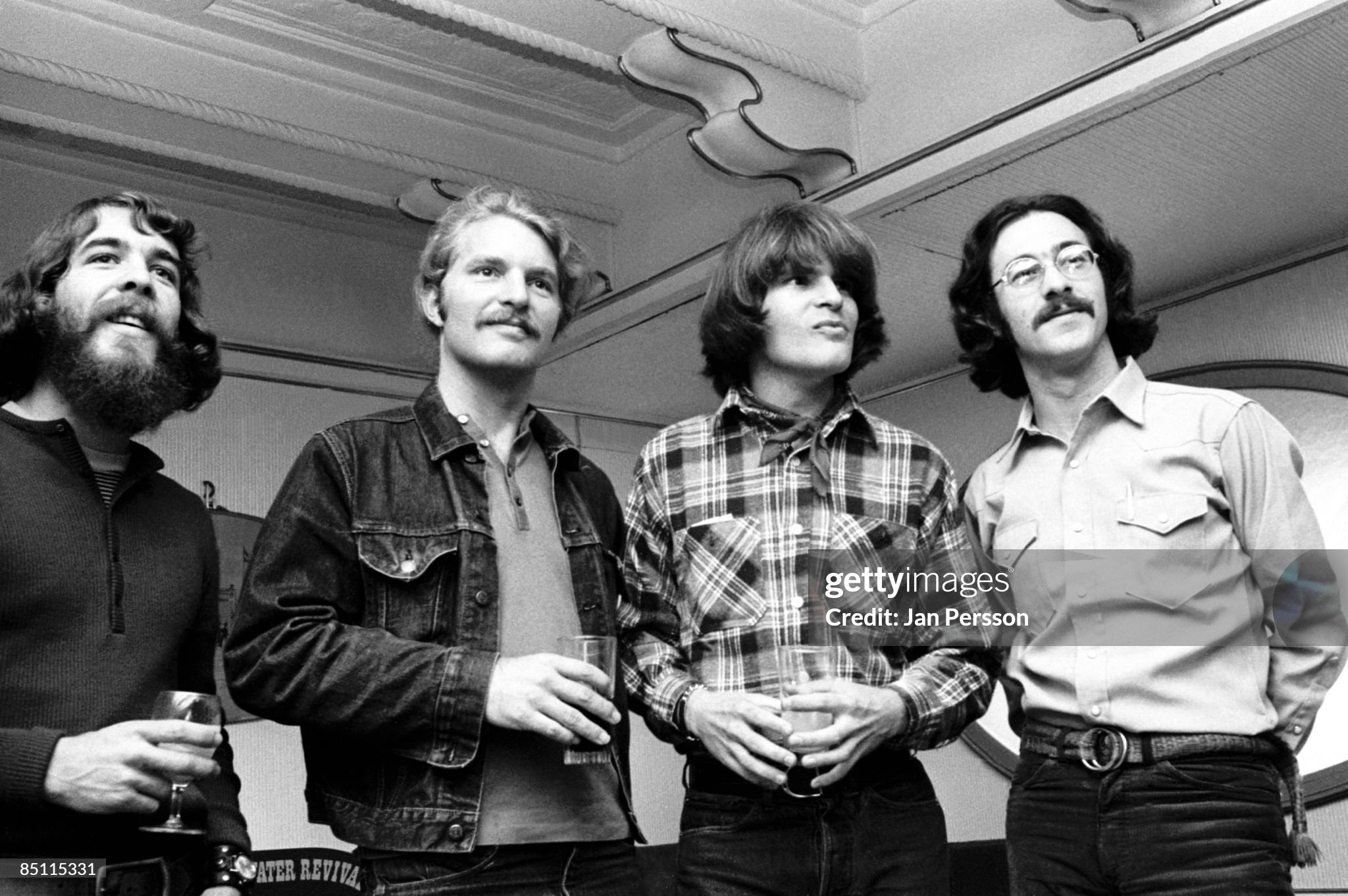
Long before Proud Mary rolled down the river, Creedence Clearwater Revival had already shown its shadowed side in Graveyard Train, a debut-album track that sounded like midnight America put to rhythm.
Before the triumph of Proud Mary, before the swamp-rock identity of Creedence Clearwater Revival became one of the defining sounds of late-1960s American music, there was a darker signal coming through the speakers. It arrived on the group’s self-titled debut album, Creedence Clearwater Revival, released in 1968, and it was called Graveyard Train. For listeners who know the band mainly through the bright momentum of their hits, this song remains one of the most revealing early clues to what made CCR special. It was not polished for radio, not designed as a singalong anthem, and not released as a major single. Yet in many ways, it said something essential about the band before the world fully understood them.
The debut album itself came at an important turning point. Issued by Fantasy Records in 1968, the record was the band’s formal beginning under the name Creedence Clearwater Revival, after earlier years recording as The Golliwogs. Commercially, the album’s biggest breakthrough came from the extended version of Suzie Q, which climbed to No. 11 on the Billboard Hot 100. That success helped the album reach No. 52 on the Billboard 200. Graveyard Train, however, was not the chart-maker. Its role was more mysterious and, in hindsight, more artistically revealing. It showed that John Fogerty was already drawn to mood, menace, and old American imagery in a way that set the band apart from many of their contemporaries.
Written by John Fogerty, Graveyard Train feels less like a conventional rock song than a ritual in motion. Its title alone carries a rough, mythic force. The train is one of the oldest symbols in American song, but here it does not promise freedom, romance, or escape. It sounds like fate. The track moves with a churning insistence, built on repetition, tension, and atmosphere. Instead of reaching for bright harmonies or psychedelic decoration, CCR sinks into something earthier and more ominous. The rhythm seems to crawl and thunder at the same time, while Fogerty’s vocal performance sounds urgent, raw, and slightly haunted. It is easy to hear in this recording the early shape of the artistic world he would later master: part blues, part Southern Gothic, part working-class American fever dream.
That is one reason the song matters so much. In 1968, rock music was full of experimentation, color, and expansion. Many bands were reaching outward into ornament and abstraction. Creedence Clearwater Revival did something different. They stripped things back and dug down. On Graveyard Train, the darkness does not come from studio trickery alone, but from groove, tone, and suggestion. The band sounds as though it has uncovered some old story buried under railroad tracks and grave soil. There is movement in the song, but not comfort. It pulls the listener forward with the steady pressure of something unavoidable.
The story behind the song is also the story of CCR finding its identity. Though the group came from El Cerrito, California, their music often felt rooted in an older, imagined America of bayous, river towns, back roads, and freight lines. That was one of John Fogerty’s greatest gifts: he could create landscapes so vivid that listeners often assumed they came from lived Southern experience. Graveyard Train is one of the earliest and strongest examples of that talent. The song does not simply imitate blues traditions; it reshapes them into something cinematic and personal. You can hear the blues in its bones, but you can also hear the emergence of a writer already building his own mythic map of America.
Its meaning, then, is broader than the literal image in the title. Graveyard Train suggests inevitability, dread, and the passage of time. It carries the feeling of being summoned by forces larger than oneself. In that sense, it belongs to a long line of American songs where trains symbolize destiny, but CCR gives that tradition a rougher, more threatening edge. This is not a train heard wistfully from a distant porch. It is a train that seems to be coming straight through the night, shaking the ground beneath your feet. The song’s power lies in that feeling. It does not explain itself too neatly. It lets image, rhythm, and tone do the work.
There is also something important in hearing this song before hearing Proud Mary. The later hit, released in early 1969 on Bayou Country, would become one of the band’s signature recordings and rise to No. 2 on the Billboard Hot 100. It had motion too, of course, but a different kind: rolling, cleansing, open-hearted. Graveyard Train feels like the shadow before the sunrise. If Proud Mary invited listeners onto the river, Graveyard Train pulled them into the night. Together, they reveal the range of John Fogerty’s imagination, but the earlier song remains especially fascinating because it arrived before the full legend was established. It captured a band still becoming itself, and in that uncertainty there is electricity.
For many listeners, that is why the debut album still rewards a return. Its rough edges are part of its charm. The record contains covers, experiments, and signs of transition, but Graveyard Train stands out because it sounds like a door opening. You can hear Creedence Clearwater Revival moving beyond bar-band roots and into something more distinctive, more atmospheric, more enduring. It is the sound of a group discovering that simplicity can be unsettling, that repetition can hypnotize, and that American rock can be both immediate and deeply haunted.
Long before fame settled around CCR, Graveyard Train carried the mood of a band with dust on its boots and storm clouds in its music. It may not have been the song that made them stars, but it helped reveal what kind of artists they were becoming. And all these years later, that darkness still feels alive. It still rumbles. It still comes on like a warning from another room, reminding us that some of the most unforgettable chapters in music begin not with a hit, but with a shadow.