
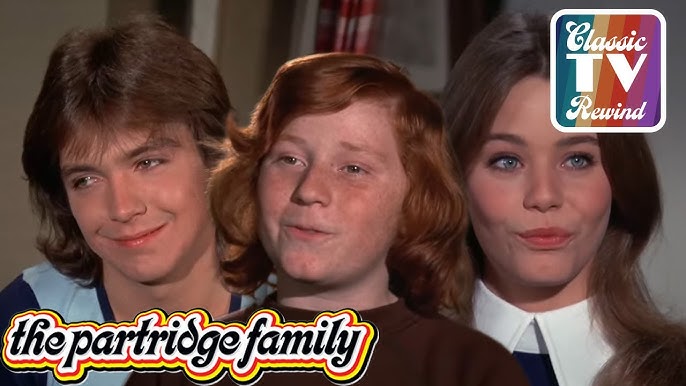
“Twenty-Four Hours a Day” is the sound of love turning into a clock—where every minute echoes one name, and waiting becomes its own kind of devotion.
If you’ve ever loved someone so completely that time itself seemed to take sides—stretching the hours, thinning the daylight, making the night feel twice as long—then The Partridge Family’s “Twenty-Four Hours a Day” will feel less like a “TV-pop deep cut” and more like a private thought set to melody. The facts place it precisely in that golden pocket of early-’70s radio romance: the song appears on The Partridge Family’s third album Sound Magazine, released in August 1971 on Bell Records, produced by Wes Farrell.
And for anyone who still remembers the ritual of flipping a 45, here is the song’s most telling public “position” at release: “Twenty-Four Hours a Day” was issued as the B-side to “I Woke Up in Love This Morning” (Bell 45,130), released in 1971. The A-side became a genuine hit—reaching No. 13 on the Billboard Hot 100 and No. 4 in Canada—meaning that countless listeners found their way to “Twenty-Four Hours a Day” the old-fashioned way: by turning the record over and letting the “other side” speak. That kind of discovery leaves a different imprint. It feels chosen, not assigned.
The craftsmanship behind it is equally specific. “Twenty-Four Hours a Day” was written by Wes Farrell and Danny Janssen, and recorded on May 5, 1971 at United Western (Hollywood)—the same sessions that helped give Sound Magazine its smooth, bright, tightly made sound. On the album, it sits on Side Two (often listed as B3), running about 3:16—long enough to settle into your chest, short enough to leave you with the feeling that the thought isn’t finished when the fade arrives.
But statistics don’t explain why the song lingers.
What “Twenty-Four Hours a Day” really captures is the peculiar arithmetic of longing: how love can make the world smaller and the hours larger at the same time. The title is almost painfully simple—no metaphor, no disguise. Just the blunt truth of obsession softened into melody. In this song’s emotional universe, the day isn’t divided into work and rest, morning and night; it’s divided into the moments you can bear and the moments you can’t. You can hear a narrator who didn’t plan for this kind of all-consuming feeling—someone who expected love to be neat, balanced, reasonable… and instead discovers it is constant, tidal, and a little humiliating in its honesty.
That’s where the Partridge magic works best. The Partridge Family brand is often remembered for brightness—sunlit choruses, pop that smiles easily. Yet “Twenty-Four Hours a Day” suggests another shade: a gentle ache beneath the polish, the way a cheerful room can still hold a quiet loneliness when one chair is empty. This is not the defiant “I’ll move on” kind of breakup song. It’s the more human one—the one where you’re still counting. Still listening. Still noticing how the smallest daily routines become painfully loud when the person you want isn’t there to share them.
Even the album context deepens the feeling. Sound Magazine was a major success in its own right, reaching No. 9 on Billboard’s album chart—proof that the Partridges were not merely a weekly TV habit, but a real pop presence with listeners who lived with the records. In that world, “Twenty-Four Hours a Day” functions like a quieter scene in the middle of a bright movie: the camera pulls in close, the smile relaxes, and suddenly you’re hearing the private truth behind the public gloss.
That’s the meaning, finally: love without pride, without distance, without a clean escape route—love that fills the whole day. “Twenty-Four Hours a Day” doesn’t ask to be crowned a hit; it asks to be kept. It’s the kind of song that survives not by shouting, but by returning—whenever life hands you one of those stretches where the clock seems louder than usual, and every hour sounds like the same soft question: where are you now?