
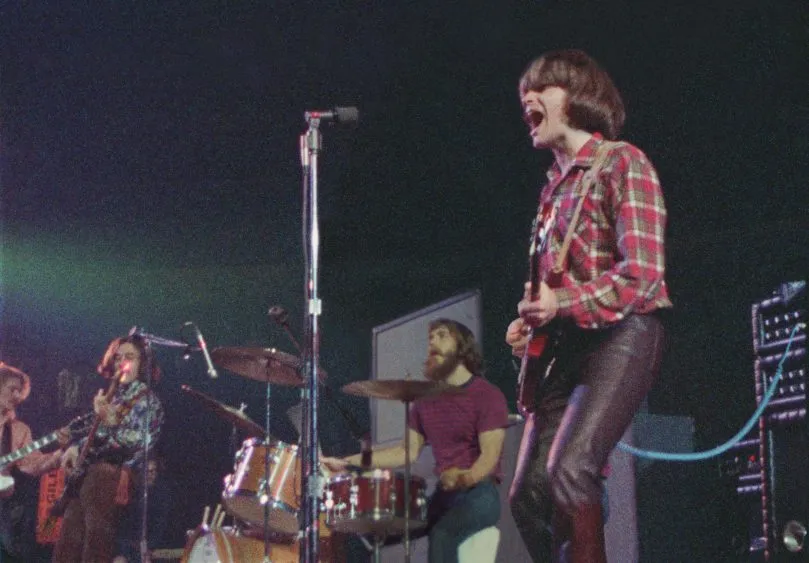
“Rude Awakening #2” is CCR’s strange, sleepless epilogue—six minutes where the band stops driving down the highway and simply stares into the dark, letting the noise of the mind speak.
For most listeners, Creedence Clearwater Revival is motion: a tight rhythm section, a guitar that bites cleanly, songs that feel like tires gripping wet asphalt. That’s why “Rude Awakening #2” can still feel so startling—even a little unsettling—when it arrives at the end of Pendulum. It is the album’s closing instrumental, running 6:19, credited (like every track on the record) to John Fogerty.
Pendulum itself was released on December 9, 1970, and despite the internal strain that was beginning to show, it remained a major commercial event—peaking at No. 5 on the Billboard 200. Those are important “at release” coordinates, because they underline the risk: CCR were still a top-tier hit band, still expected to deliver compact, radio-ready certainty. Instead, they ended their album with something that refuses to behave like a “song” in the usual sense. It doesn’t resolve. It doesn’t comfort. It lingers like an argument you can’t stop replaying after the door has closed.
The story behind “Rude Awakening #2” is inseparable from the atmosphere of the sessions. Wikipedia summarizes a tense band meeting before recording, where Tom Fogerty, Stu Cook, and Doug Clifford demanded more creative input from John—an early sign that the machine was starting to creak. CCR had entered the studio hoping to “jam and experiment,” but the method didn’t yield new material the way they’d hoped; Fogerty later described regretting that approach. Against that backdrop, the piece feels like a document of a band trying to loosen its collar—trying to prove, maybe to themselves, that they could do more than just deliver the next perfect three-minute storm.
The most famous frame for the track is its avant-garde influence. The same Wikipedia entry explicitly notes that “Rude Awakening #2” ventures into “avant-garde psychedelia” and was inspired by the Beatles’ “Revolution 9,” while also reporting that it was dismissed in unflattering terms by members of the band. That’s the paradox: CCR—so often praised for discipline—briefly chooses disorder, and the choice divides opinion even within their own circle. Critic Robert Christgau famously called it “a pretentious moment” in his review of Pendulum, which tells you how jarring it sounded beside CCR’s otherwise dependable craft.
And yet, if you listen with the ears of someone who has lived long enough to recognize a restless mind, “pretentious” isn’t the only possible word. Another word is revealing.
Because “Rude Awakening #2” is exactly what the title suggests: that bitter, disoriented moment when sleep breaks, when the room looks unfamiliar, when your thoughts—uninvited—begin to talk louder than the world outside. It starts with an eerie patience, then grows stranger, as if the music is drifting between stations on a late-night radio. CCR’s usual strength is clarity; here, the clarity is psychological rather than musical. This is what it feels like when the brain won’t stop moving, when you can’t quite name what’s wrong but you know the night has teeth.
There’s something quietly poignant about its placement as the last word on Pendulum—an album that, in hindsight, sits at the edge of CCR’s internal breakup story. The record is still full of strong, structured songs, yet the ending refuses structure, like a curtain pulled back to show the nervous system underneath the show. And maybe that’s why the track endures for those who return to it: not because it’s “beautiful” in a conventional way, but because it’s human. It admits that even the most reliable engines sometimes sputter, sometimes wander, sometimes make sounds that don’t fit the blueprint.
In the end, “Rude Awakening #2” isn’t asking to be loved like a hit. It’s asking to be understood like a mood—an unguarded glimpse of Creedence Clearwater Revival stepping out of their own legend for a moment, and letting the late-hour mind speak in its native tongue: uneasy, searching, and strangely honest.