
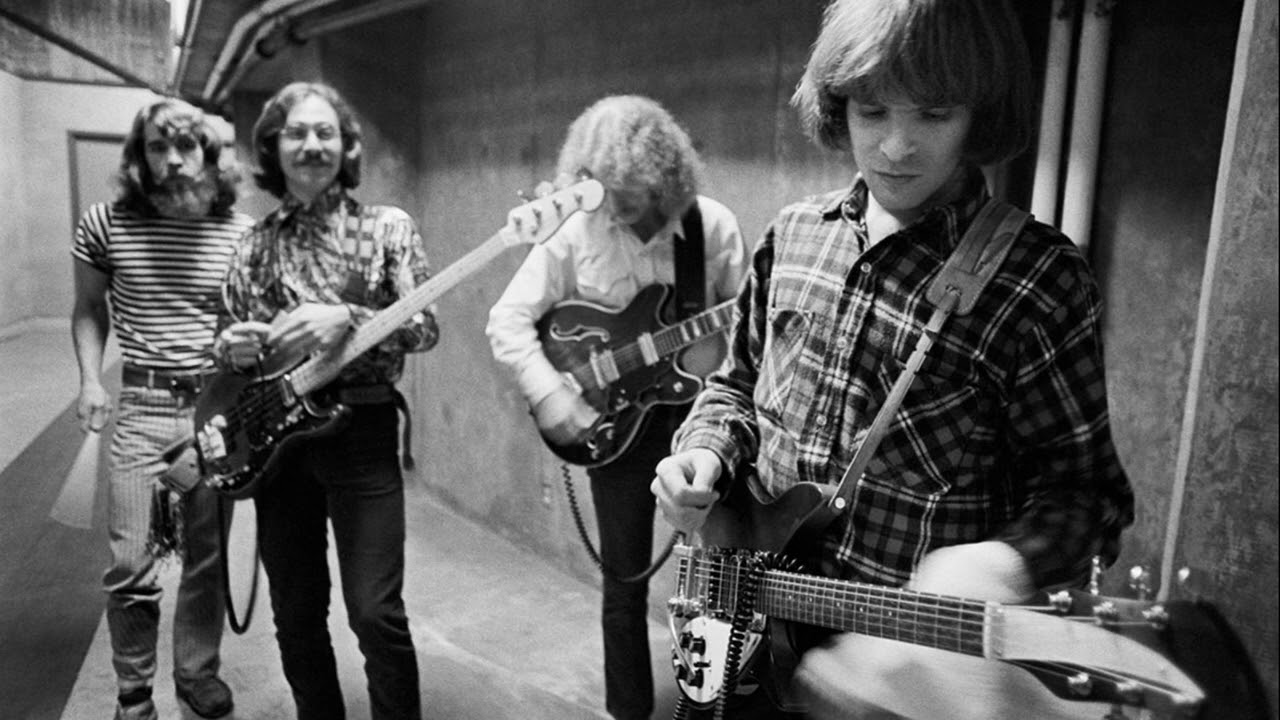
“The Midnight Special” is a prison prayer disguised as a train song—Creedence Clearwater Revival turning old American folklore into electric hope, where a single beam of light can feel like freedom.
Before anything else, it helps to place CCR’s version exactly where it lives. “The Midnight Special” appears on Willy and the Poor Boys, released in November 1969 (often cited with the date November 2, 1969 in anniversary documentation). The album itself was no minor chapter: Billboard’s own chart archive shows Willy and the Poor Boys reaching a peak of No. 3 on the Billboard 200. That’s important context, because this wasn’t a niche folk exercise—it was a top-tier rock band, at full commercial power, choosing to place an old chain-gang spiritual right in the middle of the American living room.
And yet, in the strict “ranking at debut” sense, CCR’s “The Midnight Special” was not released as a U.S. hit single, so it didn’t debut on the Hot 100 as a standalone 45. Its impact was album-deep: the kind of song you discovered by staying with the record, by letting Side One end and the needle keep traveling. (Interestingly, the folk song itself has a long chart history through other artists, but not through Creedence’s recording.)
The story behind the song stretches far beyond 1969. “The Midnight Special” is a traditional American folk song, widely believed to have originated among prisoners in the American South, built around the image of a passenger train—the “Midnight Special”—and its “ever-loving light.” That light is the whole theology of the song. In the worldview of incarceration, you don’t ask for a miracle with trumpets. You ask for something simpler: a sign that the world still exists beyond the bars, that time still moves, that a train still passes somewhere in the dark. If its light shines on you, the old lyric suggests, maybe you’re blessed—maybe you’ll be released—maybe you’ll live to see morning.
What John Fogerty and Creedence Clearwater Revival did—quietly, brilliantly—was to keep the song’s humility while giving it a new engine. They didn’t turn it into ornate nostalgia; they made it feel present tense. On Willy and the Poor Boys, this track sits among songs that already sounded like American documents—working-class scenes, political unrest, roadside dust. Dropping “The Midnight Special” into that sequence is like opening an old trunk and finding a letter that still smells of the place it was written. You realize, with a small shock, that the past isn’t past. It’s only waiting for the right voice to sing it again.
The meaning of CCR’s performance lives in its balance of grit and grace. The groove has that Creedence plainspokenness—no fancy tricks, no studio perfume—just a band locking in as if the song is a tool meant to be used. And in doing so, they preserve the song’s core emotion: hope as survival. Not hope as optimism, not hope as “things will be fine,” but hope as the stubborn inner motion that keeps a person human when the outside world has reduced them to a number.
There’s also a cultural afterlife that proves how deeply this version lodged in the collective ear. The traditional song’s reference page notes that CCR’s 1969 recording was later used memorably in Twilight Zone: The Movie, in an opening sequence where characters sing along—exactly the sort of scene that only works if a song already feels like shared inheritance.
And that’s why “The Midnight Special” endures in the Creedence catalog. It isn’t their loudest track, or their most famous protest statement. It’s something older and, in its own way, braver: a reminder that American music has always carried the voices of the forgotten, the confined, the people who didn’t get to write history—only to sing through it.
When you play CCR’s “The Midnight Special” today, you can still feel that beam of light cutting the darkness. The years fall away. The train keeps coming. And for a few minutes, you understand why a simple chorus could mean everything: because sometimes the only thing between despair and endurance is the belief that somewhere out there, the world is still moving—and its light might, just might, shine on you.