
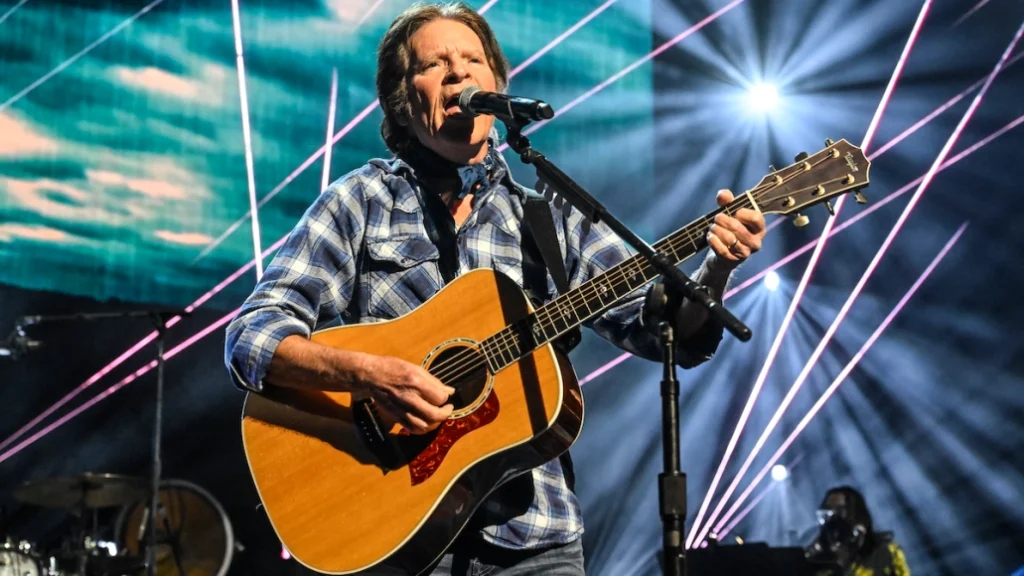
“Jambalaya (On the Bayou)” is a postcard of pure American joy—Fogerty stepping out of the CCR storm to sing about food, dancing, and daylight slipping into a Louisiana night.
What surprises many listeners is that John Fogerty’s hit version of “Jambalaya (On the Bayou)” wasn’t billed as “John Fogerty” at all. It first appeared under the name The Blue Ridge Rangers, a fictional band identity Fogerty adopted as he tried to put a respectful distance between himself and the towering shadow of Creedence Clearwater Revival. On the charts, that strategy didn’t stop the record from finding its way into the national bloodstream: Fogerty’s “Jambalaya (On the Bayou)” debuted on the Billboard Hot 100 at No. 78 and later peaked at No. 16, with its first chart date listed as December 2, 1972.
Those are the hard facts, but the soft truth is more interesting: this song feels like a man choosing lightness at exactly the moment the world expected him to stay heavy.
Fogerty cut “Jambalaya (On the Bayou)” as part of the album The Blue Ridge Rangers, released in April 1973 on Fantasy Records—a collection made entirely of traditional and country covers, with Fogerty playing all the instruments himself. The album reached No. 47 on the Billboard album chart, modest on paper, yet symbolically huge: it was Fogerty rebuilding his musical home from the floorboards up. And the disguise was not accidental. In later reflections, Fogerty explained he didn’t want to “trade on” the Creedence brand—so he invented a band name and tried, in a way, to start over as a working musician rather than a monument.
Now, the song itself carries a history older than rock & roll’s entire skyline. “Jambalaya (On the Bayou)” was written and recorded by Hank Williams and first released in July 1952. Williams’ recording reached No. 1 on the U.S. country charts, and its cultural stature has only deepened with time—so much so that the original 1952 recording was inducted into the Grammy Hall of Fame in 2002. The song’s creation story is wonderfully human: Williams reportedly began shaping it while riding the Hadacol Caravan bus, listening to Cajuns talk about food—turning everyday chatter into a melody you can still hum without thinking.
That origin matters, because “Jambalaya” is, at heart, a celebration of ordinary life made bright: a trip down the bayou, a gathering with family, and a feast that reads like a menu and feels like an embrace—jambalaya, crawfish pie, filé gumbo—the kind of details that make a song smell like a kitchen.
So why did Fogerty, freshly unmoored after CCR’s end, reach for this song?
Because it let him be something the public often forgets to allow famous people to be: carefree. Fogerty doesn’t treat “Jambalaya (On the Bayou)” as a museum piece. He sings it like he’s back on a porch somewhere, the air warm, the hour forgiving, the rhythm loose in the shoulders. And because he’s effectively a one-man band on the Blue Ridge Rangers recordings, the performance has an almost homespun intimacy—less “studio product,” more “I’ll play you something I love.”
The deeper meaning, then, isn’t just the lyric’s bayou romance. It’s the idea of returning—to roots music, to simpler storytelling, to the pleasure of singing a song because it swings and smiles. In that sense, Fogerty’s “Jambalaya” becomes a quiet self-portrait: a musician stepping away from battles and expectations, choosing tradition not as retreat, but as refuge.
And maybe that’s why it still works decades later. A great many comeback narratives are loud. This one is deliciously gentle: a man with a legendary roar deciding to grin instead—slipping into “Jambalaya (On the Bayou)” and reminding us that sometimes the truest freedom is as simple as this: Goodbye, Joe… me gotta go, not to escape life, but to rejoin it.