
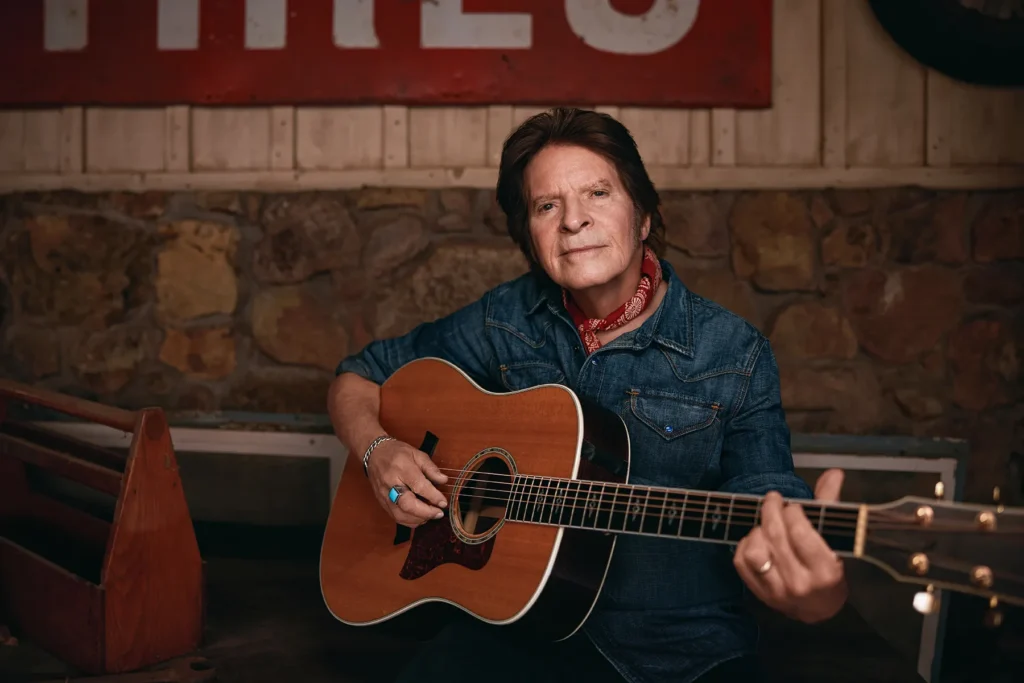
“Walking in a Hurricane” is John Fogerty turning a storm into a stride—proof that you can move forward even when the wind insists you shouldn’t.
The essentials belong right up front. “Walking in a Hurricane” is track 7 on John Fogerty’s album Blue Moon Swamp, released May 20, 1997—and the cut itself runs a lean 3:41, built for radio but carrying the weight of a long personal weather system behind it. The album was no quiet comeback either: Blue Moon Swamp peaked at No. 37 on the Billboard 200, went Gold in the United States (RIAA, 500,000 units), and ultimately won Best Rock Album at the 40th Annual GRAMMY Awards. As a single, “Walking in a Hurricane” reached No. 14 on Billboard’s Mainstream Rock chart, with additional chart appearances in Canada (No. 71) and Canada Country (No. 66).
All of that matters because this song lives at the exact intersection Fogerty was trying to reclaim: classic feel, present-tense life. Every track on Blue Moon Swamp is credited to Fogerty as writer, and he also served as producer—so the record doesn’t feel “assembled,” it feels steered. Even the personnel list reads like a craftsman’s workshop: on “Walking in a Hurricane,” the drums are by Chad Smith (yes, that Chad Smith), with Dave Taylor on bass—players who don’t dilute Fogerty’s identity so much as underline it in bold marker.
But to understand why “Walking in a Hurricane” hits the way it does, you have to remember what kind of silence preceded it. Blue Moon Swamp followed Eye of the Zombie (1986)—an eleven-year gap between solo studio albums, a long season for an artist whose voice once seemed to arrive with the certainty of river fog at dawn. By 1997, something had shifted. A contemporary newspaper profile captured the turning point plainly: Fogerty was, for the first time in more than 20 years, performing his old Creedence Clearwater Revival hits again—after decades of refusal tied to bitterness over ownership and “past slights.” In that same piece, the writer doesn’t treat the new songs as mere side dishes to nostalgia; he names “Walking in a Hurricane” among the standout Blue Moon Swamp tracks and even dares the comparison—“as good as anything Creedence ever did.”
That context changes how the title lands. A hurricane isn’t just bad weather—it’s pressure, a spinning consequence of heat and history. To say you’re walking in it is to reject the usual choices: hiding, fleeing, waiting for permission. The phrase carries a stubborn dignity. And that’s where Fogerty’s artistry has always been most human—he doesn’t mythologize endurance as glamour. He makes it physical: boots on wet ground, eyes narrowed, shoulders braced.
Musically, the song belongs to the same family tree as “Green River” and “Born on the Bayou,” not because it copies them, but because it remembers what made them work: rhythm that moves like machinery, guitar that bites without preening, and a vocal that sounds less “performed” than declared. Yet the emotional temperature is different. In the late ’60s, Fogerty often sounded like the narrator of America’s backroads—observant, urgent, sometimes ominous, but always in command of the scenery. On “Walking in a Hurricane,” the scenery pushes back. The storm is not simply outside the window; it’s in the air you’re breathing.
If there’s a “story behind” this track that matters most, it’s not a single anecdote—it’s the larger arc of return. In 1997, Fogerty wasn’t merely releasing an album; he was re-entering a conversation he’d once walked away from. That same profile describes an “epiphany” in which he accepted the CCR catalog as his legacy and chose to sing it proudly again, rather than treating it like a wound. Read through that lens, “Walking in a Hurricane” feels like a thesis statement: you don’t have to pretend the storm never happened; you just have to keep moving while it’s happening.
And that, finally, is the song’s quiet meaning—at least as it reaches the listener. “Walking in a Hurricane” doesn’t promise calm. It doesn’t offer a tidy sunrise. It offers something more believable: momentum. A man who has known both the roar of the crowd and the long, empty stretch after it, choosing motion over surrender—one measured step at a time, straight into the weather.