
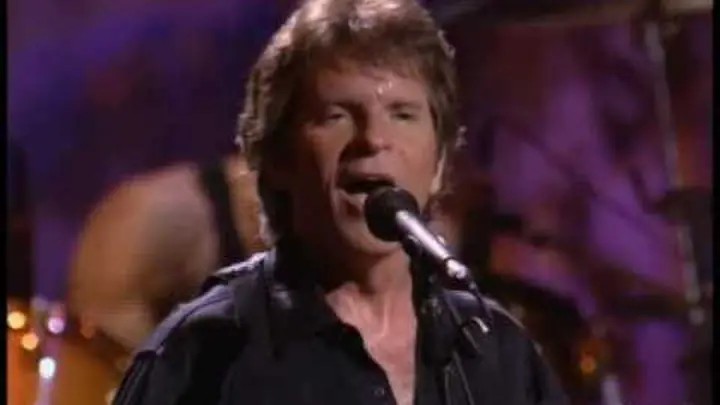
“I Saw It on T.V.” is John Fogerty turning the glow of a living-room screen into a national diary—how America learned to cheer, grieve, fear, and forget, all on cue.
There’s something unsettlingly intimate about “I Saw It on T.V.” because it doesn’t feel like a “song idea” so much as a life remembered in flashes: the news theme at six o’clock, the grainy footage, the familiar faces—heroes and villains, presidents and entertainers—passing across the screen until they begin to pass across you. The track appears on Fogerty’s comeback album Centerfield (released January 14, 1985), where it sits on side one as track 4, running 4:20. It was not released as a chart single, so there’s no “debut position” for the song itself to report—its impact lives inside the album’s larger return-to-form story.
And what a return it was. Centerfield was Fogerty’s first album in nine years, arriving after a long stretch shaped by industry conflict and creative paralysis. The record didn’t just bring him back—it put him on top: Centerfield reached No. 1 on the Billboard 200 for one week, doing so on the chart dated March 23, 1985. In that light, “I Saw It on T.V.” feels like more than an album track; it feels like the moment the songwriter’s voice re-enters the room and says, quietly but firmly, I’m still watching. I still remember.
The story behind the song is almost as evocative as the song itself. Fogerty had been circling the idea for years—“three or four years,” by one account—holding onto a verse and a scrap of melody like a half-remembered dream. Then, during a fishing trip that left him with hours of drifting and thinking, it finally opened up; he walked back to his car with a chorus and more, and felt his confidence snap back into place: he was a songwriter again. That detail matters, because “I Saw It on T.V.” sounds exactly like something that took time to ripen—less a burst of inspiration than a long, slow accumulation of images, feelings, and unanswered questions.
Lyrically, the song moves like a reel of American memory. It’s built on the chillingly casual refrain—“I know it’s true… ’cause I saw it on T.V.”—a line that lands like a shrug and a confession at the same time. Fogerty threads together cultural and political moments as if the television set were both a window and a chain: the early postwar glow, the myth-making, the shock when innocence breaks, the way tragedy becomes “footage,” and footage becomes routine. A critic’s summary captures the sweep: the song traces the liberation of Elvis’ arrival, the idealism and rupture of the Kennedy era, the communal roar around the Beatles, Vietnam’s steady toll, and Watergate’s corruption—history not as textbook, but as shared broadcast emotion.
What makes the meaning linger is Fogerty’s underlying accusation—never delivered as a speech, always delivered as a story. The television doesn’t merely show events; it teaches people how to feel them, then teaches them how to move on. In one of the song’s darkest turns, Fogerty sketches an old man “a prisoner of the porch,” staring down the cruel joke of promises and patriotism, haunted by the cost of war and by the feeling that the powerful escape consequences while ordinary families pay in blood. The bitter poetry hits harder because it’s plainspoken: not abstract politics, but the grief of a living room after the broadcast ends.
That’s why “I Saw It on T.V.” remains one of the most quietly devastating pieces on Centerfield. The album is often remembered for its bright, physical pleasures—guitars, groove, the pure kinetic lift of “The Old Man Down the Road” and the baseball-day euphoria of the title track. But tucked into side one is this heavier weather: Fogerty looking back at the second half of the 20th century and noticing how often the screen became the nation’s conscience, its carnival, and its sedative—sometimes all in the same hour.
In the end, John Fogerty doesn’t ask for nostalgia. He offers something sterner and more tender: remembrance with eyes open. “I Saw It on T.V.” is what happens when a great American songwriter realizes that the brightest light in the room can still cast the longest shadow—and decides to sing from inside that shadow anyway.