
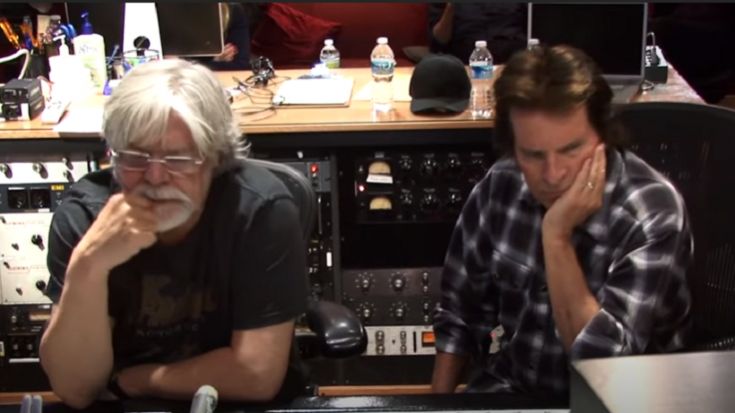
“Who’ll Stop the Rain” turns into a shared, weathered prayer with Bob Seger—two road-hardened voices asking the same old question as the sky darkens again.
John Fogerty’s “Who’ll Stop the Rain (with Bob Seger)” arrived as part of his collaboration album Wrote a Song for Everyone, released May 28, 2013—a record built around revisiting his classics with guests who truly lived with these songs. On that album, Bob Seger joins Fogerty on “Who’ll Stop the Rain,” a pairing that feels less like a stunt and more like a handshake between two American lifers. The album itself debuted at No. 3 on the Billboard 200, Fogerty’s highest-charting solo debut up to that point—proof that this wasn’t nostalgia as dust, but nostalgia as living timber.
To appreciate why the duet lands so deeply, you have to remember where the song first came from. Creedence Clearwater Revival originally released “Who’ll Stop the Rain” in January 1970 as a double A-side with “Travelin’ Band,” written and produced by John Fogerty, and later included on CCR’s Cosmo’s Factory. The single climbed to No. 2 on the Billboard Hot 100—a peak the band has also commemorated in its own official social posts marking the chart date. In the UK, the single charted as “Travellin’ Band” and reached a No. 8 peak on the Official Singles Chart (first chart date April 4, 1970).
Those numbers tell you the scale, but not the ache. The ache is in the song’s strange emotional chemistry: it’s built like a folk hymn—plain chords, steady gait—yet it carries that weary question that never really stops sounding contemporary. In 1970, plenty of listeners heard it as a Vietnam-era protest; others connected it to the mud, crowds, and uneasy grandeur of Woodstock. The song’s own “myth” has followed it for decades, and Fogerty has played along with the legend while also clarifying it. One of the most human details preserved in the song’s history is Fogerty’s recollection of playing the master at home: his little son heard it and said, “Daddy stop the rain.” Fogerty and his wife looked at each other—because, as he put it, that wasn’t quite the point… and yet it was, in the simplest possible way.
Now fast-forward to 2013, and the question gets older—and somehow heavier. On “Who’ll Stop the Rain (with Bob Seger),” the “rain” doesn’t feel like one decade’s crisis. It feels like the recurring weather of adult life: disillusionment, headlines, broken promises, the slow realization that history has a habit of repeating itself in new disguises. That’s why Seger is such a meaningful partner here. He has spent a career singing about distance and endurance—about nights that go long, highways that don’t apologize, and the cost of carrying your own name. When his voice blends with Fogerty’s, the song stops being just a classic re-recording and becomes a conversation between two men who’ve watched the same storms roll in, again and again, from different towns.
The collaboration itself was part of Fogerty’s broader guest-studded vision for Wrote a Song for Everyone, which he began recording around 2011 and built into an album-length celebration of his catalog’s reach. But this track feels unusually natural, because it doesn’t depend on “newness.” It depends on believability. And few things are more believable than two veteran voices singing a line like it matters—not as performance, but as lived worry.
What makes “Who’ll Stop the Rain” endure—whether it’s 1970 CCR or 2013 with Bob Seger—is that it refuses to pretend we can control the sky. It isn’t a victory song. It’s a reckoning song. It admits that good men have tried; that plans and promises come and go; that crowds gather, hoping music can keep them warm. And still the rain falls—sometimes literal, sometimes social, sometimes the private kind that arrives when the door closes and you’re alone with your thoughts.
So when you hear John Fogerty and Bob Seger share this chorus, you’re not just hearing a classic revisited. You’re hearing time itself added to the harmony: the sound of two artists who have survived long enough to know that the question may never be fully answered—yet it still deserves to be asked, clearly, stubbornly, and out loud.