
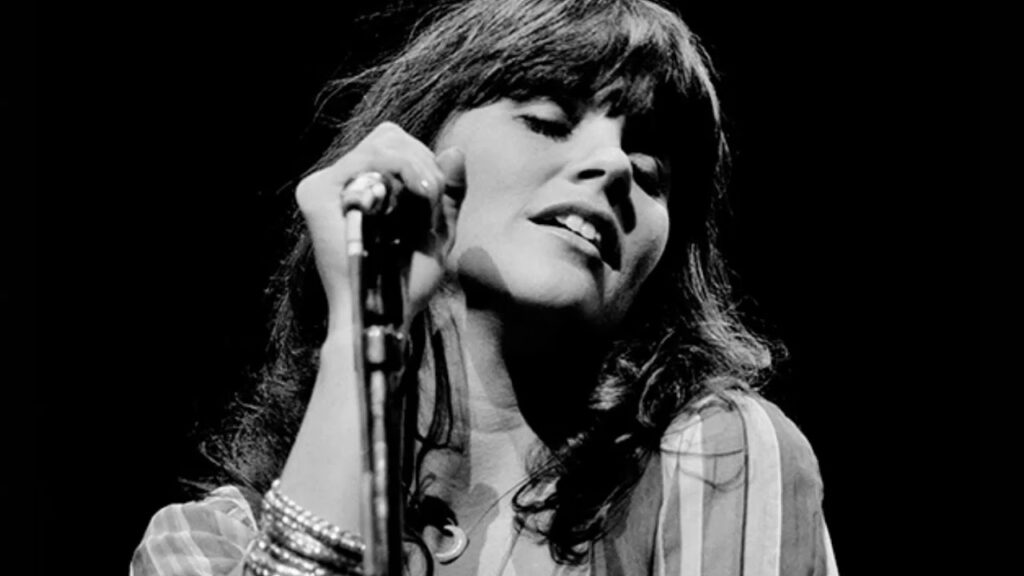
“Old Paint” is a quiet, wind-worn farewell—Linda Ronstadt stepping off the bright highway of pop stardom to sing a cowboy’s simple prayer for loyalty, distance, and home.
By the time Linda Ronstadt recorded “Old Paint,” her voice had already become a kind of American landmark—recognizable from the first breath, equally at home in rock swagger and country ache. And that’s precisely why her decision to include this traditional cowboy song feels so meaningful: she wasn’t showing off range; she was showing roots. Ronstadt’s studio recording of “Old Paint” appears on Simple Dreams (released September 6, 1977, produced by Peter Asher), an album that would go on to be one of the defining commercial peaks of her career.
Yet “Old Paint” itself wasn’t a chart-bound “hit” in the conventional sense. Its most public doorway came quietly—on the flip side of a smash. In 1977, Ronstadt’s single “Blue Bayou” was issued as “Blue Bayou” / “Old Paint” (Asylum E-45431), and while “Blue Bayou” climbed to No. 3 on the Billboard Hot 100, “Old Paint” lived as the B-side—more like a keepsake tucked into the sleeve than a song pushed into the spotlight. There’s something wonderfully old-fashioned about that: the listener turns the record over and finds, not more radio polish, but a dusty, human piece of the long American song trail.
The song’s story is older than any recording studio. “Old Paint” is also widely known as “I Ride an Old Paint” or “Good-bye Old Paint,” a traditional cowboy song that was collected and published in 1927 by Carl Sandburg in The American Songbag. It carries the plain-spoken poetry of working life: horses, water, distance, and the kind of companionship that doesn’t need speeches to be profound. A “paint” is a spotted horse; “dam” is the mare being led. The narrator rides toward Montana—to “throw a houlihan”—and the words feel like a moving postcard from a world where time is measured in miles and weather, not calendars.
Ronstadt doesn’t over-decorate it. She understands the power of this kind of song is in its humility. Her reading has the steady pace of hoofbeats—unforced, unhurried, as if she’s letting the melody breathe the way open land breathes. And because her voice is so naturally luminous, the effect is almost cinematic: you can practically see the horizon line, pale and endless, with a rider growing smaller against it.
What does “Old Paint” mean in Ronstadt’s world? On one level, it’s a portrait of the working West—its vocabulary of animals, trails, and leaving. On another, deeper level, it’s about the tenderness we reserve for what carries us through life: the steadfast partner, the reliable friend, the “old paint” that keeps going even when the road gets long. There’s grief in the song’s farewell, but it’s a grief without melodrama—more like the throat-tightening recognition that the things we love most are often the things we cannot keep forever.
That’s why it fits so tellingly on Simple Dreams, an album filled with bold interpretations and big radio moments. Ronstadt places “Old Paint” in the midst of glossy success like a small piece of weathered wood in a room full of glass—proof that her artistry didn’t depend on volume. She could sell out the room and still choose a song that feels like it was meant for the back porch, for the late hour, for the listener who doesn’t need spectacle to feel something real.
And there’s a final, quietly moving irony: a song about the old ways—about horses, trails, and leaving—found a new life in the hands of a 1977 superstar, and then reached people not by being shouted from the A-side, but by being discovered. That’s the kind of endurance folk songs were built for. They don’t demand your attention; they wait for it.
So when you play “Old Paint” now, try hearing it the way it was often first heard: after the hit fades, after the needle lifts and drops again, after the world’s noise has softened. In that small turning-over of the record is the song’s true spirit—an unassuming goodbye, sung with grace, carrying the scent of distance and the comfort of an old companion still walking beside you.