
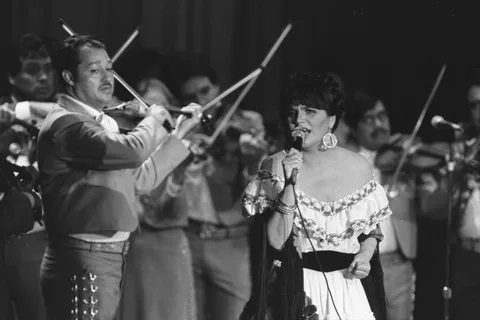
“When I Fall in Love” in Linda Ronstadt’s hands feels like a vow whispered after midnight—love not as excitement, but as a promise to be careful with what’s real.
Here’s the essential map first, because it tells you exactly when and how her version entered the world. Linda Ronstadt opens her 1984 standards album Lush Life with “When I Fall in Love”—a deliberate first step into candlelit territory, arranged and conducted by Nelson Riddle and produced by Peter Asher. The album was released in North America on November 16, 1984 (recorded August 24–October 5, 1984 at The Complex in Los Angeles). It peaked at No. 13 on the Billboard 200, and it was certified Platinum by the RIAA.
Then, the chart story for the song itself—quiet, but real. “When I Fall in Love” was released as a single in March 1985. On Billboard’s Hot Adult Contemporary Tracks, it debuted at No. 33 on the chart dated March 16, 1985, and later reached a peak of No. 24.
Those numbers are modest compared to her roaring 1970s hits—but that’s the point. This recording doesn’t behave like a hit chasing daylight. It behaves like a private room you enter on purpose.
The deeper story begins long before Ronstadt ever sang a note of it. “When I Fall in Love” was written by Victor Young (music) and Edward Heyman (lyrics) in 1952, introduced in the film One Minute to Zero as an instrumental theme, and quickly became a standard—first finding wide success in early vocal versions (including Doris Day). By the time Ronstadt reaches for it in 1984, the song is already a well-worn photograph passed from hand to hand across decades—yet she treats it as if it might still bruise.
What makes her interpretation so haunting is that she doesn’t “decorate” the melody with showmanship. She trusts the lyric’s fear: the idea that love is only worth surrendering to if it can survive the morning. That central line—“When I fall in love, it will be forever…”—can sound like naïveté in the wrong voice. In Ronstadt’s, it sounds like someone who has learned what impermanence costs, and is simply refusing to gamble again on anything less than honesty.
And Nelson Riddle is the perfect companion for that kind of grown-up tenderness. His orchestration doesn’t smother her—it frames her, like soft lamplight around a face you want to remember exactly. This was the second chapter in her celebrated run of big-band/pop standards projects with Riddle (following What’s New and preceding For Sentimental Reasons), a move that many people initially saw as risky in an era that didn’t exactly beg for Great American Songbook reverence. Yet Lush Life didn’t just survive—it carried prestige too: at the 28th Annual GRAMMY Awards, the album won Best Album Package (for art directors John Kosh and Ron Larson), proof that every detail—from sound to sleeve—was meant to feel timeless.
So what is “When I Fall in Love” really about in this moment of Ronstadt’s career? It’s about dignity—romantic dignity, yes, but also artistic dignity. A singer known for filling arenas chooses instead to open an album with a song that barely raises its voice. She sings as if she’s learned that the bravest words are often the softest ones: I will not pretend. I will not settle. I will not confuse the thrill of tonight with the truth of tomorrow.
And that’s why the record lingers. Because it doesn’t ask you to remember your wildest love—it asks you to remember your truest one. The kind that arrives slowly, when you’re no longer impressed by charm alone, when you’ve outgrown beautiful lies, when you want the peace of something that stays. In Linda Ronstadt’s “When I Fall in Love,” the vow isn’t dreamy—it’s deliberate. And somehow, that makes it even more romantic.