
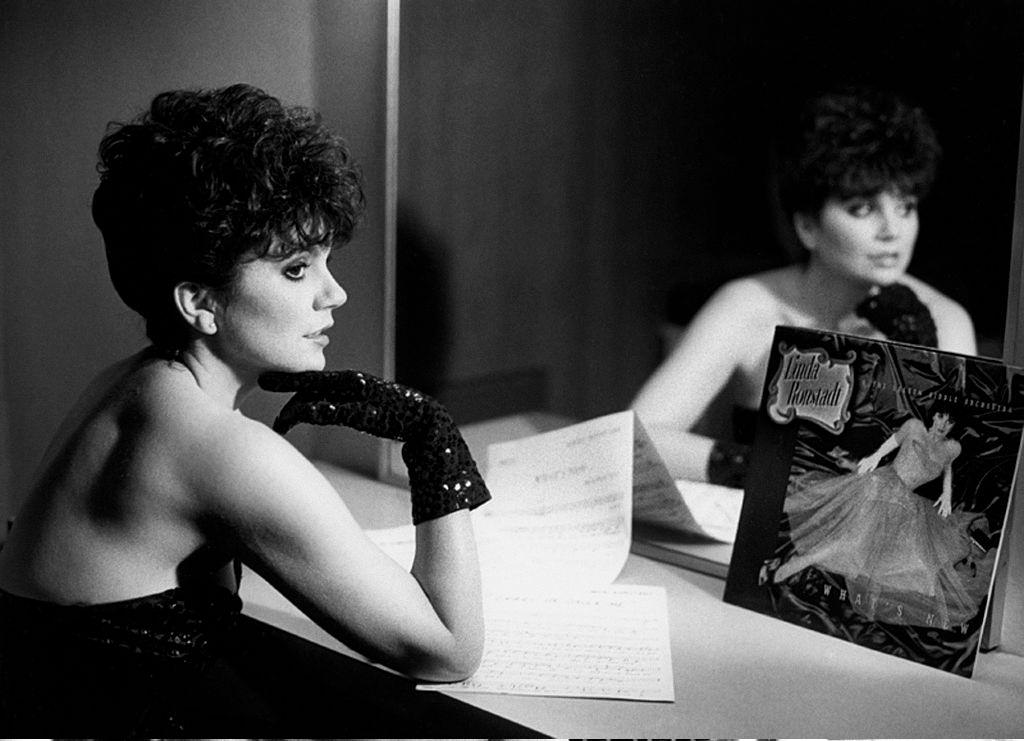
“He Darked the Sun” is Linda Ronstadt singing about a love so consuming it seems to eclipse the sky—beauty, danger, and devotion folded into one haunting shadow.
The key facts first, because they place the song exactly where it belongs in her story. “He Darked the Sun” is an album track—not a charting single—from Linda Ronstadt’s second solo LP Silk Purse, released April 13, 1970 on Capitol Records, produced by Elliot F. Mazer and recorded January–February 1970 in Nashville (Cinderella Sound and Woodland). On the album, “He Darked the Sun” appears on Side Two and runs 2:40. It was written by Gene Clark and Bernie Leadon—two names that quietly signal the song’s pedigree: Clark, a founding Byrds figure and major early songwriter for the band; Leadon, a bluegrass-rooted musician who would soon become a founding member of the Eagles.
Because it wasn’t released as a single, there’s no “debut position” for “He Darked the Sun” itself. What we can state precisely is the album’s commercial foothold at the time: Silk Purse became Ronstadt’s first entry on the Billboard 200, peaking at No. 103 (with additional peaks of No. 59 in Canada and No. 34 in Australia). Those numbers may look modest beside the superstardom that would come later, but they capture something crucial: this is the sound of an artist still stepping into her own outline, testing which kinds of songs would truly hold her voice.
The story behind “He Darked the Sun” begins a couple of years earlier, in a different form. The song originates as “She Darked the Sun,” first released by Dillard & Clark in 1968—a Gene Clark-led project where country-rock was still fresh enough to feel like a secret being passed hand to hand. Ronstadt’s version effectively flips the perspective—turning “she” into “he”—and that shift matters: it changes the song from a male gaze into a woman’s memory of a man whose presence was overwhelming, magnetic, and perhaps quietly ruinous. You can feel the lyric’s core image—this idea that someone’s mind, someone’s aura, can “dark” the sun—like an old bruise you press only to prove it’s still there. (Even brief lyric excerpts and catalog notes preserve that central line, the song’s strange little eclipse.)
Musically, it sits perfectly inside the Nashville texture of Silk Purse—a record Ronstadt later judged harshly, saying she felt she “couldn’t sing then” and “didn’t know what [she] was doing.” And yet, that very early-ness becomes part of the spell on “He Darked the Sun.” The performance doesn’t feel like a polished, knowing star delivering a “deep cut.” It feels like a young singer leaning close to the microphone to tell the truth carefully, as if the truth might bolt if she moves too quickly.
What does the song mean when Ronstadt sings it in 1970? It’s not simply a romance—it’s a portrait of devotion under a dark cloud. The narrator isn’t describing ordinary attraction; she’s describing a force. The beloved is charismatic enough to blot out daylight, and the song never fully clarifies whether that darkness is protection or threat. That ambiguity is the grown-up part. Love, the song suggests, can be sheltering and suffocating at the same time. You can be grateful and afraid in the same breath. You can miss someone who wasn’t good for you—especially if the memories still glow at the edges, the way storms sometimes do at sunset.
There’s also a quiet historical poignancy in the songwriting credit itself. Gene Clark carried a particular kind of lyric gift—tender, haunted, inward—while Bernie Leadon came from the string-band discipline of bluegrass and early country-rock. Put them together and you get a song that feels both literary and plainspoken: an image big enough to be myth, delivered in language simple enough to sting.
So “He Darked the Sun” remains one of those early Ronstadt moments that rewards close listening. It doesn’t announce itself with a hit chorus. It doesn’t try to be the center of the room. It simply sits there—two minutes and forty seconds long—like an old photograph found in a drawer, reminding you how some loves don’t end cleanly. They end as weather. They end as shadow. And every so often, without warning, they pass across the sun again.