
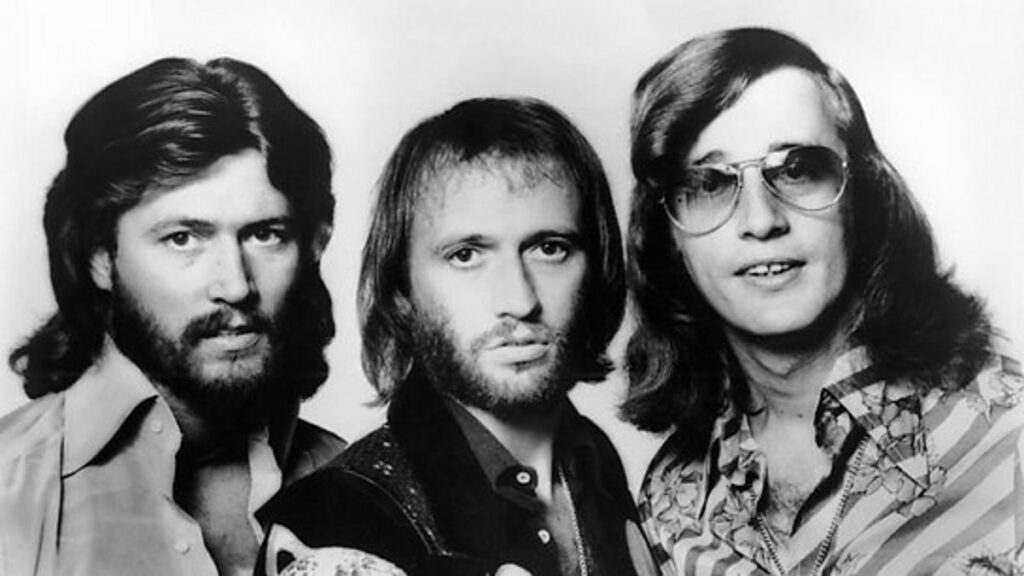
“Paying the Price of Love” sounds like a heartbeat dressed in neon—proof that even late in the story, love can still demand its fee in full.
In August 1993, the Bee Gees returned with “Paying the Price of Love”—a single that didn’t arrive asking for permission, but stepping straight onto the dancefloor with its collar up and its memories intact. Released on August 9, 1993 (with “My Destiny” as the B-side) and issued by Polydor, it was the first calling card from their album Size Isn’t Everything. If you were listening closely in the early ’90s, you could hear what they were doing: not chasing their past, not denying it either—simply insisting that the old craft of melody and harmony could still ride on modern rhythm.
The chart story tells you how the world received that insistence. In the UK, the single entered the Official Singles Chart at No. 32 (chart week beginning August 15, 1993) and reached a peak of No. 23, staying on the chart for five weeks. In the United States, it reached No. 74 on the Billboard Hot 100—a modest number, but one that still mattered in 1993, when the group were often filed away by programmers as “adult contemporary” history rather than present-tense pop. (On U.S. Adult Contemporary radio, some references place its peak at No. 35, while broader summaries describe it more generally as a Top 30-ish AC performer—either way, it found daylight there more easily than on youth-driven pop formats.)
But to reduce “Paying the Price of Love” to positions and peaks is to miss its emotional engine. This is a song built on a familiar Bee Gees truth: love is never free, not when it’s real. The title alone carries a weary tenderness—like someone speaking from experience, not theory. You can feel the grown-up ache behind the groove: the recognition that every sweetness has its cost, and that the bill often arrives later, when the room is quiet and you’re alone with what you said, what you didn’t, and what you can’t take back.
What made the track feel so “now” in 1993 was its sound. The production credits tell the story: produced by the Bee Gees with Femi Jiya, it leans into contemporary percussion and a tight, clipped rhythmic confidence that sits closer to early-’90s R&B and club-pop than to their late-’80s radio sheen. One industry write-up from the period even noted how sharply it signaled that the brothers were flirting with the era’s “jack swing” and dance-floor vocabulary—not as tourists, but as craftsmen who could still build a hook that lands clean and stays landed.
And then there’s the most Bee Gees detail of all: the way the song balances modern bite with timeless melodic sorrow. Under the rhythm, you still hear the old architecture—those instinctive chord turns, that sense of a chorus arriving like inevitability, and the voices (however the spotlight shifts) carrying a family resemblance no decade could erase. The song’s emotional meaning is not complicated, but it is honest: love can be exhilarating and punishing in the same breath, and the price is often paid not in one dramatic moment, but in small withdrawals—pride, sleep, certainty, peace.
Even the music video leans into the idea of “the Bee Gees in a new age,” presenting the brothers as hologram-like performers inside a futuristic MTV setting, directed by Andy Delaney and Monty Whitebloom—a wry, self-aware gesture from artists who knew exactly how long they’d been in the public eye, and how many “new eras” they’d already survived.
So if you return to “Paying the Price of Love” today, hear it as more than a 1993 single. Hear it as a late-chapter love song with a dancer’s spine: seasoned, slightly bruised, still willing to move. Because that’s the Bee Gees’ enduring gift—making sadness singable, and making joy just bittersweet enough to feel true.