
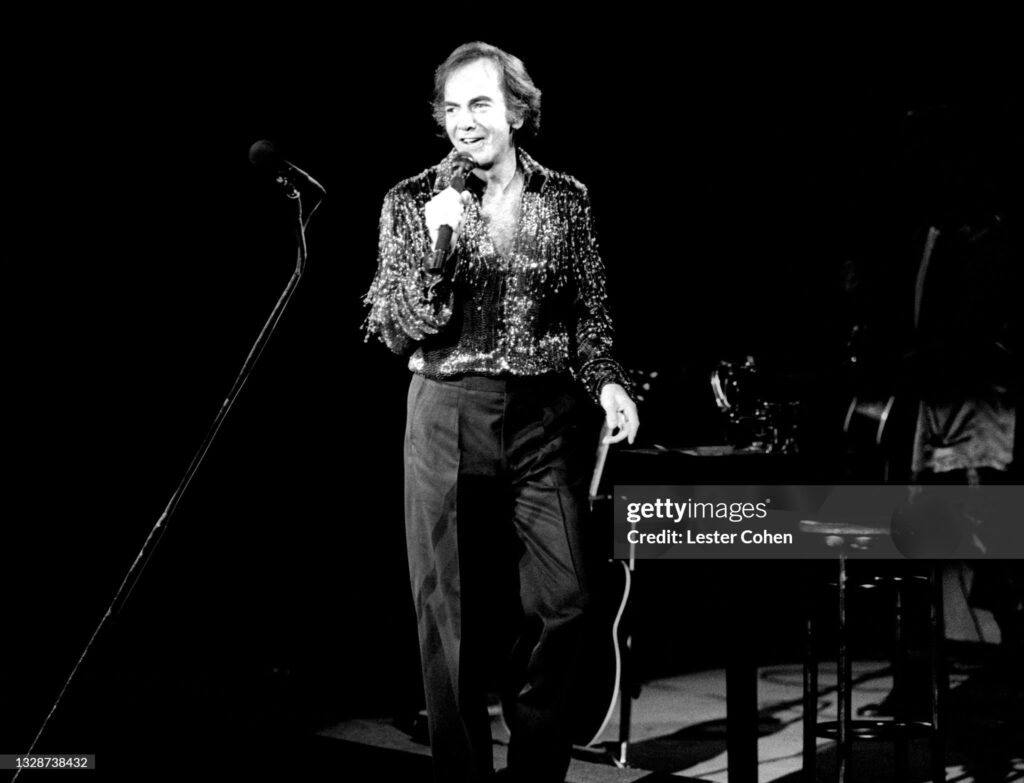
“Kentucky Woman” is Neil Diamond at his most instinctive and elemental—a song where desire feels rooted in the earth itself, drawn not to glamour or artifice, but to a woman who seems to carry her own weather, her own light, and her own unshakable gravity.
One of the most important facts to place right at the beginning is that “Kentucky Woman” was released by Neil Diamond in October 1967, during his Bang Records period, and it became his last major hit for the label before the next phase of his career began. The single reached No. 22 on the Billboard Hot 100, while also charting strongly in other markets, including Canada and New Zealand. That alone tells us something meaningful: this was not one of the giant later Diamond blockbusters, but it was significant enough to mark the end of one era and the threshold of another. It belongs to that fascinating stretch when Diamond was still emerging, still sharpening his public identity, but already writing songs with a distinctive emotional stamp that nobody else quite had.
The song was written by Neil Diamond himself, and that matters because “Kentucky Woman” already carries many of the traits that would define him as a songwriter. It is simple on the surface, but emotionally vivid. It is direct, but not shallow. And above all, it knows how to turn one striking image into a whole emotional world. The title does most of the work. “Kentucky Woman” is not just a woman from a place. She becomes a figure of natural force—grounded, self-possessed, memorable in a way that resists easy explanation. Even Diamond’s own social posts years later still describe her in language that emphasizes her distinct light and presence, which shows how strongly that image remained attached to the song.
That is the deeper beauty of the song. “Kentucky Woman” is a love song, but not in the polished, candlelit sense. It has dust on its boots. It has road heat in it. The attraction here is not toward somebody delicate or distant. It is toward a woman who feels real, strong, and almost mythic in her plainness. Diamond does not praise her by turning her into fantasy. He praises her by making her feel undeniable. She shines, yes, but she shines with what the song calls “her own kind of light.” That line is the heart of everything. It suggests a person whose value does not come from approval, fashion, or borrowed glamour. She is luminous by nature. For a songwriter as alert to emotional symbols as Neil Diamond, that is no small compliment. It is almost reverence.
There is also something especially evocative in the word Kentucky itself. In American song, place names are rarely just geography. They carry mood, class, weather, memory, and cultural texture. Here, Kentucky suggests rootedness, earth, and a kind of unvarnished beauty. The woman in the song is not abstract. She belongs somewhere, and that belonging makes her more magnetic. Diamond was always good at that—taking a specific name or image and giving it emotional breadth. He did it with “Shilo,” with “Sweet Caroline,” and in a different way here with “Kentucky Woman.” A whole person rises from a handful of words.
The song’s afterlife also says something about its strength. In 1968, Deep Purple recorded a very different version, and their cover reached No. 38 on the Billboard Hot 100. That later rock reading, heavier and more aggressive, helped confirm that Diamond had written something sturdy enough to survive transformation. A weak song stays trapped in its first arrangement. A strong one can change clothes and still remain itself. “Kentucky Woman” had that kind of backbone. It could live as Diamond’s late-1960s pop-country-flavored single, and it could also live in the rougher, early hard-rock world of Deep Purple.
Still, Neil Diamond’s own version remains the most revealing. There is an eagerness in it, a romantic pull that feels young but not foolish. He sounds fascinated, slightly overwhelmed, drawn toward someone whose presence has unsettled the room inside him. That emotional urgency is what gives the song its life. It is not simply admiration. It is recognition—the sudden awareness that one person has entered the field of vision and changed its center. Diamond would go on to write many grander songs, many more famous songs, and many more emotionally elaborate songs. But “Kentucky Woman” has a special place because of its clean instinct. It does not overreach. It just knows.
So “Kentucky Woman” deserves to be heard as one of the key early Neil Diamond recordings: a 1967 Bang-era single, a Top 30 U.S. hit, and the last major stop before his next great artistic ascent. But beyond the dates and chart positions lies the real reason it lingers. It captures the old mystery of being drawn to someone who feels at once flesh-and-blood and larger than life. And in Neil Diamond’s voice, that mystery becomes one of those unforgettable pop truths: sometimes love begins simply because one person enters the world carrying their own kind of light.