
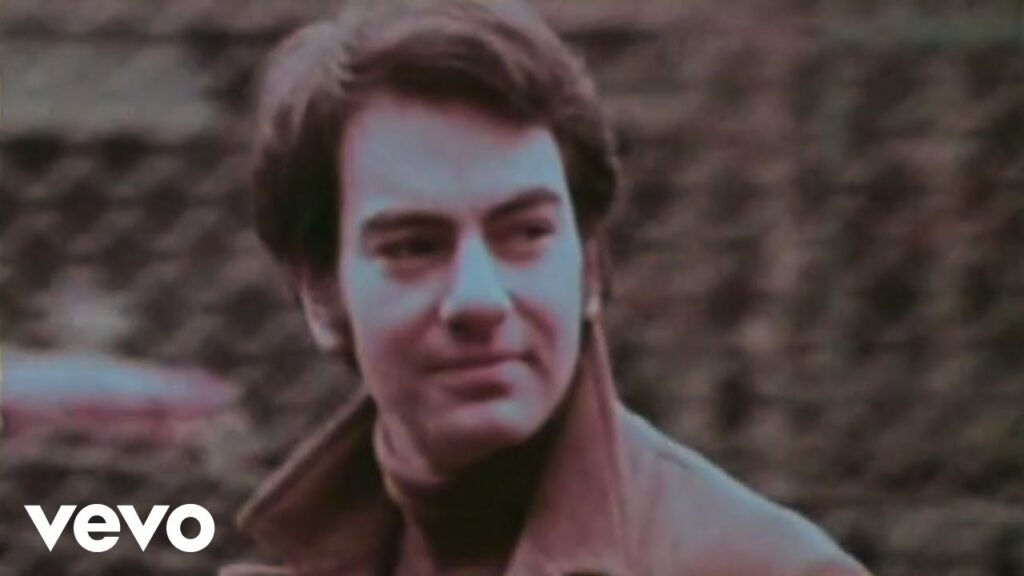
“Lonely Looking Sky” is Neil Diamond’s quiet aerial prayer—where solitude isn’t a mood, but a wide-open horizon that forces the heart to speak honestly.
In 1973, Neil Diamond wasn’t merely writing songs for radio—he was writing for lift, for distance, for the strange hush that comes when you look down at your own life from far above. “Lonely Looking Sky” belongs to that rarer corner of his catalogue: part song, part meditation, born inside the soundtrack album Jonathan Livingston Seagull (released October 19, 1973, produced by Tom Catalano). That project mattered: the album won the 1974 Grammy for Best Original Score Written for a Motion Picture or a Television Special, and it became a defining statement of Diamond’s spiritual-cinematic ambition.
On record, “Lonely Looking Sky” appears as a centerpiece of that narrative arc—its title alone already feels like a camera panning upward, away from crowds and noise. Even the official release archive for Jonathan Livingston Seagull places “Lonely Looking Sky” right among the suite’s essential movements, as if it were one of the sky-windows the whole story needs in order to breathe. And Diamond himself treated it that way onstage: contemporary reporting and later summaries note that he often performed a Jonathan Livingston Seagull suite live—specifically including “Lonely Looking Sky” alongside “Be,” “Dear Father,” “Sanctus,” and “Skybird”—notably in the mid-1970s concert era.
Now, about chart life—because you asked for positions at release, and “Lonely Looking Sky” does have a measurable footprint, though not as a stand-alone A-side. In 1974, it was issued as the B-side to “Skybird”, and the single’s documented chart performance reflects that release. In Neil Diamond’s discography table, “Skybird” / “Lonely Looking Sky” is shown reaching No. 75 in the U.S. (with additional chart columns indicating No. 24 on another U.S. chart and No. 12 in the UK for that release). These aren’t blockbuster numbers compared to his signature hits—but that, in a way, suits the song’s personality. “Lonely Looking Sky” was never built to be a loud crowd-pleaser. It was built to linger, to hover, to return in your mind when the day goes quiet.
And that quiet is the song’s true story.
The lyric feels like Diamond speaking to the sky as if it were an old friend—an enormous witness that never interrupts, never flatters, never lies. There’s something almost tenderly severe about the image of a “lonely looking sky”: it suggests not only the singer’s loneliness, but the world’s loneliness too—as if even the heavens carry a kind of longing. (That’s one of Diamond’s gifts: he can make a simple phrase feel like a philosophical weight you carry in your pocket.)
Musically, you can hear the soundtrack intention: this isn’t just verse-chorus entertainment; it’s a scene. The arrangement supports the feeling of open space, of air under the melody, of a heart trying to find its balance in mid-flight. It’s the kind of track that makes you slow down—almost against your will—because the emotion isn’t chasing you. It’s waiting for you.
And perhaps the deepest meaning of “Lonely Looking Sky” is this: it treats loneliness not as failure, but as clarity. When you’re alone, you can’t hide behind performance. You can’t talk your way out of truth. You simply look up—and whatever is inside you begins to speak. That’s why the song fits so perfectly within Jonathan Livingston Seagull: the whole story is about reaching beyond the obvious limits, and realizing that the cost of that reaching is often solitude—at least for a while.
So if “Lonely Looking Sky” feels like it’s “outside time,” that’s because it is. It’s Neil Diamond stepping away from the noise of the world and writing a moment where the sky becomes a mirror. Not the cheerful sky of postcards—but the honest one: beautiful, distant, and so wide it makes your own longing look small… and, somehow, survivable.