
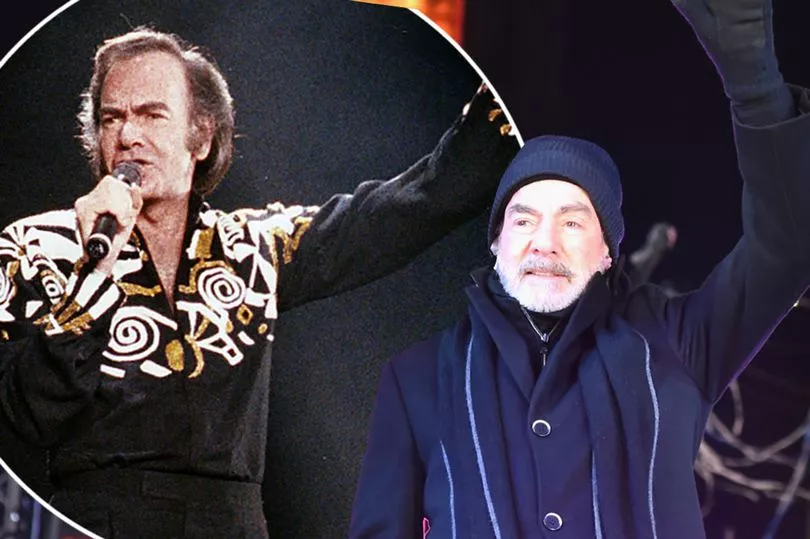
“Ain’t No Sunshine” in Neil Diamond’s hands becomes a late-night confession—less a heartbreak anthem than a quiet vigil, where absence is felt like weather.
Some songs are so perfectly built that every great singer eventually walks up to them the way you approach an old stone church: slowly, respectfully, with your voice lowered before you even realize you’ve done it. “Ain’t No Sunshine” is one of those songs. It began, of course, with Bill Withers—released as a single in July 1971 from his debut album Just As I Am, written by Withers and produced by Booker T. Jones. It didn’t just “do well”; it announced him to the world, reaching No. 3 on the Billboard Hot 100 and No. 6 on the U.S. R&B chart, and later winning the Grammy for Best R&B Song (1972).
When Neil Diamond chose to record it decades later, he wasn’t chasing novelty. He was paying a kind of reverent attention—like a storyteller revisiting a line that still hurts because it’s still true. Diamond’s version opens his 2010 covers album Dreams, released November 2, 2010 on Columbia Records. The album’s chart “arrival” was real and measurable: Dreams debuted at No. 8 on the Billboard 200 (a top-ten entry that Billboard reported at the time), and is also noted as reaching No. 8 overall on that chart. That detail matters, because it frames Diamond’s “Ain’t No Sunshine” not as a casual tribute tossed off in retirement, but as the first page of a late-career project that listeners actually showed up for.
If you listen like an old radio host—the kind who doesn’t rush the silence between songs—you’ll notice what Diamond does immediately: he doesn’t try to “out-cool” Withers, and he doesn’t turn the song into a theatrical monologue. He approaches it with a seasoned patience, the voice of a man who has sung to stadiums yet understands that loneliness doesn’t get smaller just because the room is big. The lyric itself is famously plain: no elaborate metaphors, no clever escape hatch—just that stark household truth, it’s not warm when she’s away. And that’s why it endures. Love, in this song, isn’t fireworks. Love is temperature. Love is light in the next room. Love is the ordinary becoming unbearable because the person who made it ordinary is gone.
Diamond also gave the song a living, televised moment that’s worth remembering. In December 2010, he performed “Ain’t No Sunshine” on NBC’s The Sing-Off, joined by a cappella groups Committed and Street Corner Symphony—a striking cross-generational scene: a classic soul lament, a legendary pop storyteller, and voices arranged like cathedral echoes. It’s the kind of performance that feels like an unexpected reroute on the dial late at night—one of those moments when you pause whatever you’re doing, because the room suddenly feels quieter than it was a second ago.
The deeper meaning of Diamond’s version, to my ear, is about recognition. By 2010, Neil Diamond had already made an entire career out of the big emotional statement. Here, he chooses the small sentence that defeats you. He leans into the song’s repetition—especially that famous “I know” refrain—not as a hook, but as a human tic, the way grief repeats itself when it can’t find a place to sit down. And that’s the secret: the song isn’t only about missing someone; it’s about the mind’s helpless loop when love has nowhere to go.
So if you put on Neil Diamond’s “Ain’t No Sunshine” now, hear it as more than a cover. Hear it as an older voice stepping into a younger man’s truth and finding it still fits—still sharp, still warm in its sadness. The great songs don’t age; they simply change narrators. And when the narrator is Neil Diamond, the darkness doesn’t feel glamorous. It feels familiar. It feels like night.