
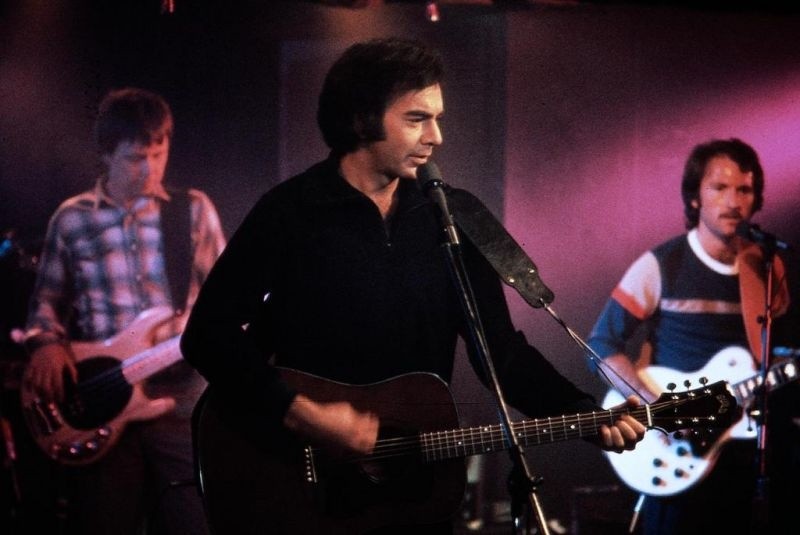
“And the Singer Sings His Song” is Neil Diamond’s quiet credo: when love, youth, and certainty slip away, the one honest thing left is to keep singing—steadily, sincerely, anyway.
There’s a small trap hidden in the title “And the Singer Sings His Song”—because it belongs to two Neil Diamond stories. First, it is a tender album track from 1969. Later, it also became the name of a 1976 compilation LP. The song came first, and it deserves to be heard on its own terms: not as a “deep cut” you stumble upon by accident, but as a soft-spoken mission statement from a songwriter who already understood that the stage is sometimes the only stable ground a person has. The recording appears on Neil Diamond’s fifth studio album Touching You, Touching Me, released November 14, 1969 on Uni Records.
On that album, “And the Singer Sings His Song” sits on Side Two (listed at 3:37 on the original track listing), surrounded by covers and originals that show Diamond’s widening emotional palette—less the brash, early Bang-era hitmaker, more the reflective craftsman learning how to make quietness compelling. The album itself reached No. 30 on the Billboard 200 and was certified Gold, powered by the already-known hit “Holly Holy” (No. 6) and the smaller-charting “Until It’s Time for You to Go” (No. 53). Those are the headline numbers—but the heart of the album often lives in pieces like this, where Diamond isn’t chasing applause so much as trying to tell the truth in a voice low enough to sound private.
The credits are beautifully fitting for a song so inward. Neil Diamond wrote it himself, with Tom Catalano and Tommy Cogbill producing, and Lee Holdridge credited in the album’s world as arranger/conductor—names that helped give Diamond’s late-’60s Uni recordings their polished, late-night glow. It’s the kind of production that doesn’t shout “important.” It simply makes room—soft focus around the edges, like lamplight on an old photograph.
And what is the song saying, underneath its gentle surface? It’s easy to hear “And the Singer Sings His Song” as a romantic recollection—“young it was, true it was,” the sense of a love remembered with the ache of knowing it can’t be returned to. But there’s also something more self-aware in it, something almost meta: Diamond is writing about the role he’s already inhabiting. When life becomes uncertain—when people change, when seasons close, when yesterday stops being negotiable—the singer still has a duty, or maybe a calling: to stand up and sing. Not because singing fixes the world, but because it is the one act that keeps the inner world from collapsing.
That idea lands especially hard when you remember where Diamond was in 1969. This was the year of “Sweet Caroline,” “Holly Holy,” and “Brother Love’s Travellin’ Salvation Show”—a moment when his public success was undeniable, yet his writing was becoming more complicated, more adult, more willing to admit that joy and sadness can exist in the same room. “And the Singer Sings His Song” feels like the quieter cousin of those bigger titles: it doesn’t aim for the stadium; it aims for the conscience. It speaks to the part of us that keeps going through habit, through pride, through responsibility—until we suddenly realize that “going on” is not emptiness at all, but a form of faith.
Because that’s the secret the song seems to hold: continuation as meaning. Not the glamorous continuation of encores and spotlights, but the human kind—the kind that happens when you wash the dishes after grief, when you drive home after a hard conversation, when you wake up and do your life again even though something inside you feels older than it did yesterday. Diamond doesn’t romanticize this. He simply dignifies it. The singer sings—not to win, not to conquer, not even to convince—but because singing is how the soul keeps its shape.
And then, years later, the title returned as the name of a 1976 compilation album, And the Singer Sings His Song, which peaked at No. 102 on the Billboard 200. That later reuse can confuse the trail, but it also feels strangely poetic: the phrase became a kind of banner over Diamond’s catalogue, as if the industry accidentally recognized what the song had been saying all along. The singer sings. The years pass. The listener changes. Yet the song remains—waiting, like a familiar voice in the next room.