
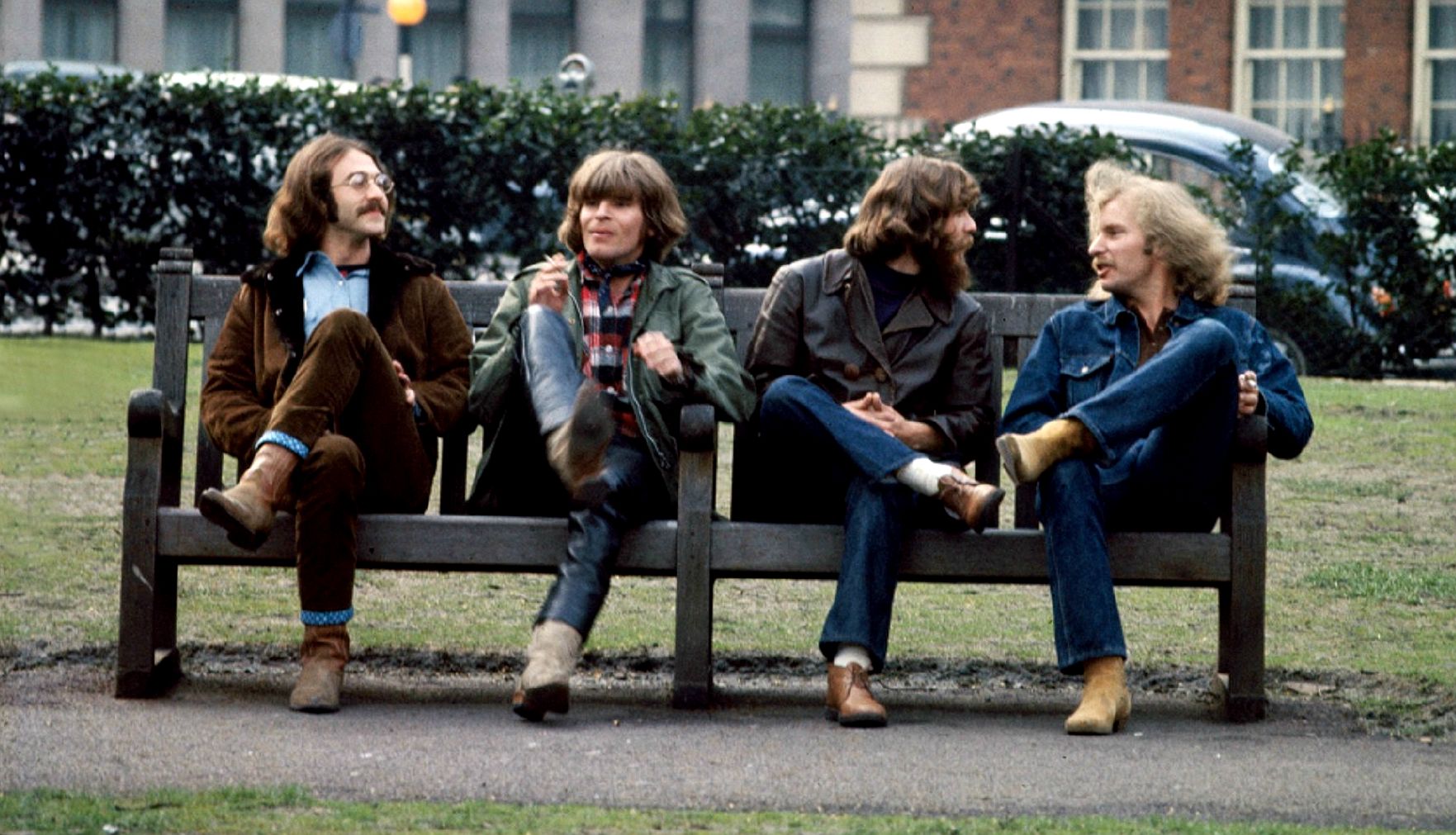
On “Tombstone Shadow (Live At The Oakland Coliseum, Oakland, CA / January 31, 1970),” Creedence Clearwater Revival make dread move like rock and roll — a dark, driving song where fear never slows the pulse, and the night seems to close in with every beat.
There are Creedence Clearwater Revival songs that swagger, songs that preach, and songs that race like weather coming in over black water. “Tombstone Shadow” belongs to that last category. Even in its original studio form, it was one of the most ominous things John Fogerty ever wrote for the band: a song full of pressure, foreboding, and the sense that danger is not merely coming but already standing just behind your shoulder. But in “Tombstone Shadow (Remastered / Live At The Oakland Coliseum, Oakland, CA / January 31, 1970),” that unease becomes even more physical. The song stops sounding like a studio warning and starts feeling like a force in the room. Captured at the Oakland–Alameda County Coliseum Arena on January 31, 1970, the performance was later released on the live album The Concert in 1980—an album famously first issued under the mistaken title The Royal Albert Hall Concert before its true Oakland source was established.
That history matters, because this performance comes from CCR at one of the fiercest points in their rise. By early 1970, the band had already torn through Bayou Country, Green River, and Willy and the Poor Boys, building one of the most concentrated runs in American rock. “Tombstone Shadow” itself came from Green River, released on August 7, 1969, the group’s third studio album and their first No. 1 album on the Billboard chart. That album was the second of the three CCR albums released in 1969 alone, which tells you everything about the band’s momentum: they were not merely productive, they were relentless. In that setting, “Tombstone Shadow” was not a single built for radio glory, but an album track dark enough and strong enough to deepen the whole record’s atmosphere.
And darkness is the right word here. The song’s title alone carries a kind of Southern Gothic chill, but its effect is broader than regional color. “Tombstone Shadow” feels like mortality turned into motion. Rather than treating death as solemn or still, the song makes it prowl. That is one of Fogerty’s sharpest instincts as a writer: he understood that fear often arrives not with dramatic ceremony, but in flashes, omens, speed, and pressure. Later commentary on the song has described its lyrics as expressing the threat of death, and that gets to the center of its emotional design. This is not grief after the fact. It is dread while the wheels are still turning.
That is why the Oakland 1970 performance is so potent. According to the official track listings for The Concert, “Tombstone Shadow” appears early in the set and runs 4:05 on the live album, slightly stretching beyond the tighter studio running time without ever drifting into indulgence. That extra room matters. It lets the band lean harder into the groove and lets the menace breathe a little more. But this is still Creedence Clearwater Revival, so the song never becomes a jam for its own sake. They do not decorate the darkness. They drive it forward. John Fogerty sings with that clipped, urgent edge that could make even a simple warning sound like revelation, while Tom Fogerty, Stu Cook, and Doug Clifford keep the whole performance tight, muscular, and wonderfully unsentimental.
There is something especially compelling about hearing this song in Oakland, because by then CCR were essentially a hometown giant—an East Bay band who had become one of the biggest acts in the country without ever losing their hard, workmanlike core. The live album documents that power beautifully. It was recorded with the Wally Heider Recording Mobile, released by Fantasy, and eventually rose to No. 62 on the Billboard 200; later, it earned Gold and then Platinum certification in the United States. That afterlife tells us the Oakland show was more than an archival curiosity. Listeners recognized it as a serious document of a band in full command.
What makes “Tombstone Shadow” stand out in that set is that it reveals one of CCR’s most underrated gifts: their ability to make a song feel haunted without making it vague. Some rock bands approach darkness through abstraction, atmosphere, or psychedelic drift. CCR were too grounded for that. Their darkness had a hard edge, a road edge, a blue-collar edge. Even when the songs hinted at myth, doom, or bad omens, they still felt built from sweat, amps, and American weather. That is exactly the quality “Tombstone Shadow” carries. It is eerie, yes, but never ethereal. It feels like bad luck on the move.
And that, finally, is why this live version hits so hard. It captures Creedence Clearwater Revival doing what they did better than almost anyone: taking a compact, brutal idea and hammering it into something unforgettable. The original “Tombstone Shadow” already had the bones of a classic deep cut. But “Live At The Oakland Coliseum, January 31, 1970” gives it extra heat, extra menace, and the thrilling sense of a great band meeting one of its darker songs head-on. No excess, no softening, no escape hatch. Just the groove, the warning, and that shadow growing longer as the band plays it out.
So if “Tombstone Shadow” has always sounded like trouble coming down the road, this Oakland performance makes it sound even closer — louder, leaner, and more alive. It is a reminder that CCR were not just masters of hits. They were masters of pressure. And on this performance, pressure becomes the whole point: the band pushing forward, the song closing in, and the listener caught right in the middle of the storm.