
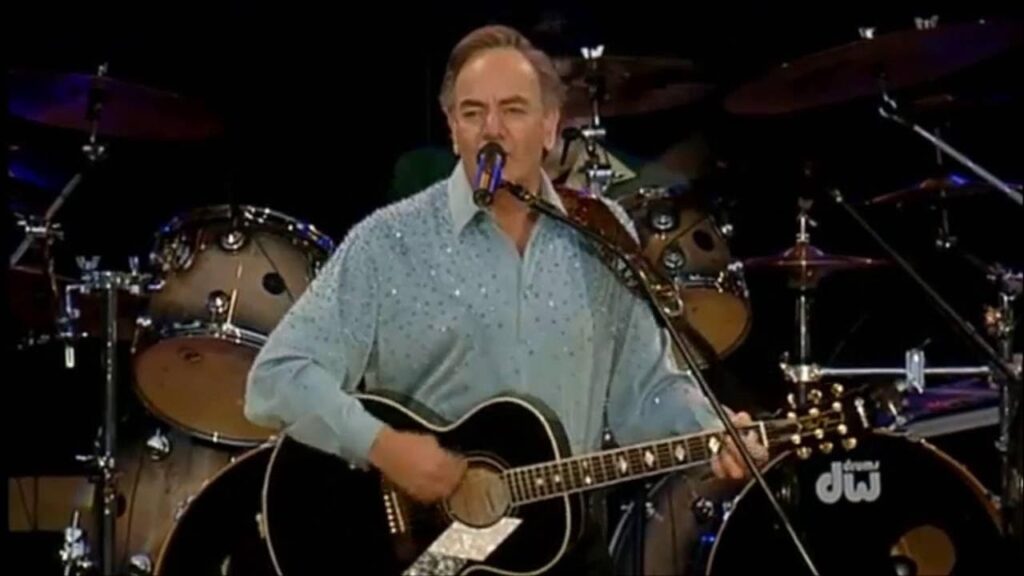
“Sleigh Ride” in Neil Diamond’s hands is winter comfort with a human pulse—less glittery spectacle, more warm breath on cold air, as if the season itself were leaning in to say: slow down, you’re home.
There’s something quietly touching about hearing Neil Diamond—a singer so often associated with big, declarative anthems—step into “Sleigh Ride” and choose ease instead of grandeur. His recording comes from The Christmas Album, Volume II, released by Columbia Records on October 11, 1994, produced by Peter Asher (a longtime Diamond collaborator whose productions often favor clarity and emotional closeness). On that album, “Sleigh Ride” appears as track 8 (running about 2:42), nestled among standards and carols like a little pause for pure seasonal joy.
If you’re looking for the “ranking at launch,” this is best understood through the album’s reception rather than a singles chart moment. The Christmas Album, Volume II reached No. 9 on Billboard’s Holiday Album chart and was certified Gold by the RIAA on December 6, 1994—a clear sign that Diamond’s holiday voice found a real audience quickly, even without the usual pop-single machinery. That matters because Christmas music isn’t just “seasonal content”; it’s memory music. It succeeds when people decide a recording belongs in their yearly ritual—when it earns a permanent chair at the family table.
The deeper story of “Sleigh Ride” is older than any one singer, and that history is part of its charm. The piece was composed by Leroy Anderson and later given lyrics by Mitchell Parish—published in 1948. It began as “light orchestra” music, not explicitly a Christmas song at all, which is one reason it travels so well: it’s really about winter’s physical sensation—bells, wind, speed, the crisp delight of moving through cold air with someone beside you. Anderson even formed the idea during a heat wave in July 1947, finishing it in February 1948—a detail that always feels like a small miracle: a snow scene imagined under summer sweat, proof that seasons can live in the mind before they arrive outside the window.
So what does Neil Diamond add to a song that has been performed countless times?
He adds human scale. His “Sleigh Ride” doesn’t try to out-sparkle the orchestral classics or chase novelty. Instead, it feels like a familiar voice turning toward the listener with a half-smile—inviting you into the scene rather than performing it at you. Part of that comes from the album’s overall aesthetic: The Christmas Album, Volume II features orchestral and choir arrangements by David Campbell, giving the record a cinematic glow while still leaving space for Diamond’s conversational warmth. The result is a version of “Sleigh Ride” that feels less like a Christmas-card illustration and more like an evening you can actually remember: the kind where the world outside is sharp and bright, and the inside is soft—lamplight, laughter, the small relief of being safely nowhere else.
The meaning of “Sleigh Ride”—especially in Diamond’s setting—isn’t complicated, and that’s its strength. It’s about the simplest holiday wish: togetherness without urgency. It’s about letting the cold stay outside while the music keeps you moving. And maybe that’s why a singer like Neil Diamond suits it so well. He has always understood that the biggest emotions don’t always need big words; sometimes they need a steady voice, a familiar melody, and the permission to feel joy without explaining it.
In the end, “Sleigh Ride” is winter as reassurance. And Neil Diamond’s version—anchored in the very real success of The Christmas Album, Volume II in late 1994—offers exactly what a great holiday recording should: not a performance you admire once, but a moment you return to, year after year, when you want the season to feel like it used to.