
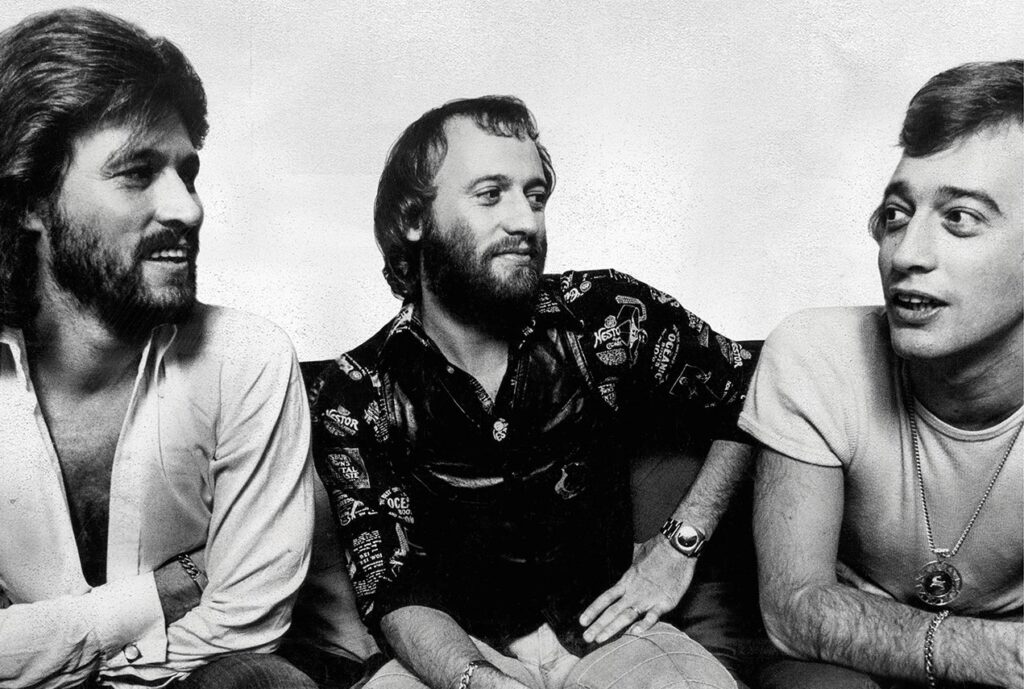
Nostalgia in Sepia: The Sound of Memory Woven Through Melancholy and Grace
When “Country Lanes” by the Bee Gees emerged in 1975 as part of their album Main Course, it was a quiet moment of introspection nestled within a record that otherwise signaled a bold reinvention. While the album climbed into the Top 20 on both sides of the Atlantic—propelled by chart-topping singles like “Jive Talkin’” and “Nights on Broadway”—this song lingered in the background, never released as a single, yet radiating a subtle emotional power that has only deepened with time. In an era when the Bee Gees were redefining themselves from baroque pop romantics into architects of modern soul, “Country Lanes” stood as a reminder of their songwriting origins: wistful, delicate, and intimately human.
At its heart, “Country Lanes” is a lament—a return to gentler terrains of memory and loss after years spent traversing the intricate architectures of fame and reinvention. Robin Gibb’s voice—aching, spectral, and imbued with that unmistakable tremor of vulnerability—carries the melody like a confession whispered through mist. The song is built upon lush piano textures, a tender orchestral backdrop, and harmonies that unfold like fragile recollections surfacing from time’s long drift. Barry Gibb’s production choices on Main Course, guided by producer Arif Mardin’s sophisticated ear, granted each track its own emotional landscape; here, that landscape is pastoral but shadowed, reminiscent of English countryside memories refracted through the Bee Gees’ Miami exile.
Lyrically, “Country Lanes” evokes a sense of distance—not only geographical but temporal and emotional. Its imagery draws upon rural pathways as metaphors for life’s diverging routes, for the bittersweet passage from youth to maturity, love to regret. The listener senses an almost cinematic atmosphere: raindrops on windows, fading sunlight on empty fields, the slow ache of remembering someone who no longer occupies one’s present but still inhabits every echo of the past. In this way, the song stands as one of Robin Gibb’s most poignant performances—a dialogue between the heart that remembers and the world that moves on.
What makes “Country Lanes” enduring is its emotional sincerity amid transformation. Main Course was a pivot point where the Bee Gees absorbed American R&B influences and discovered the rhythmic vitality that would define their later global dominance. Yet here they paused to breathe—to acknowledge the poetic melancholy that had always defined their best work. The harmonies are less about polish than empathy; each chord change feels like an inhalation before tears fall. This is not nostalgia as sentimentality but as survival—the act of holding onto one’s essence when everything else is changing.
“Country Lanes” may never have sought radio glory, but its quiet beauty reveals the Bee Gees at their most introspective—artists aware that even amid reinvention, one must occasionally look back down those winding roads where dreams were first born. It remains a haunting testament to memory’s persistence and to music’s capacity to make loss sound like grace itself.