
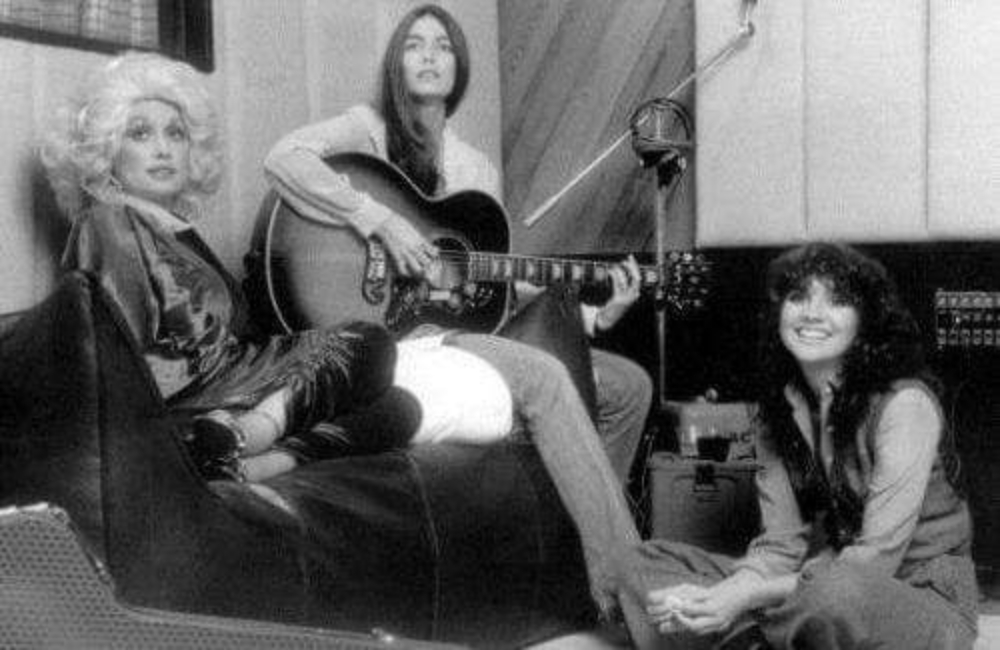
A honky-tonk warning wrapped in harmony—Linda Ronstadt and Emmylou Harris singing as if neon could glow and grieve at the same time.
Before we talk about feeling, it helps to place the song’s bones on the table. “Honky Tonk Blues” was written and first recorded by Hank Williams—released as a single in February 1952 on MGM (with “I’m Sorry for You, My Friend” as the B-side), after being recorded on December 11, 1951 in Nashville. Williams’ version became a cornerstone of honky-tonk mythology: not the romanticized kind, but the kind that tells the truth about how easy it is to mistake bright lights for a better life.
Now jump forward to a different kind of country royalty: Linda Ronstadt and Emmylou Harris. Their duet “Honky Tonk Blues” is widely known today through archival releases, notably appearing on Box Set (the 4-CD Linda Ronstadt retrospective issued in 1999), where it’s listed as “Honky Tonk Blues”. It wasn’t a radio-era “single debut” moment for them—no neat chart launch to point at—because this performance lives in that rarer category: a recorded glimpse of two voices meeting for the sheer love of the song, later rescued from the vault and placed gently into listeners’ hands.
That’s the first reason it stays with you. Ronstadt and Harris don’t approach “Honky Tonk Blues” like museum curators. They approach it like women who understand what the lyric is really saying: that the honky-tonk isn’t merely a place—it’s a habit, a loop, a bright room you enter to feel less alone, only to discover the loneliness has followed you inside.
The song’s narrator is always on the verge of confession. He’s not bragging about wild living; he’s explaining how it happened—how the road, the restlessness, the hunger for company all add up until you’re standing under a bar’s glow, telling yourself you’re fine. Hank’s original carries that weary clarity: the voice of someone who’s seen the morning after too many times. And when Emmylou Harris and Linda Ronstadt sing it together, the story changes shape without changing its truth. The warning becomes more dimensional—less a lone man’s spiral, more a human pattern both voices recognize.
What makes their pairing so special is the contrast in grain and intention. Linda Ronstadt has that steel-and-satin force—she can turn a line into a clean blade without ever raising it theatrically. Emmylou Harris brings the hush of a witness: airy, lucid, and emotionally exact, like she’s singing from the far side of experience rather than the middle of it. Put together, they don’t “outlaw” the song; they illuminate it. It’s still honky-tonk, still cheeky in its swing, but there’s a quiet sorrow in the harmony—the sense that the fun isn’t free, and the bill always arrives.
There’s also something beautifully symbolic in the fact that this duet surfaced as part of a curated retrospective rather than arriving as a contemporary hit. By the time most listeners encountered it, both singers were already legendary—meaning you hear the track with a different kind of attention. You’re not listening to see if they can sing it (of course they can). You’re listening for what they believe about it. And what they seem to believe is this: the honky-tonk is a place where people go to forget, but the best country songs insist you remember—remember your own patterns, your own weak spots, your own need for something truer than noise.
So “Honky Tonk Blues” in the hands of Ronstadt and Harris becomes more than a cover. It becomes a small act of preservation—two master vocalists holding up Hank’s cautionary tale and letting it shine in a new light. Not to moralize. Not to scold. Just to say, softly and clearly, what country music has always said at its best: be careful what you call comfort—sometimes it’s only the doorway to another kind of hurt.