
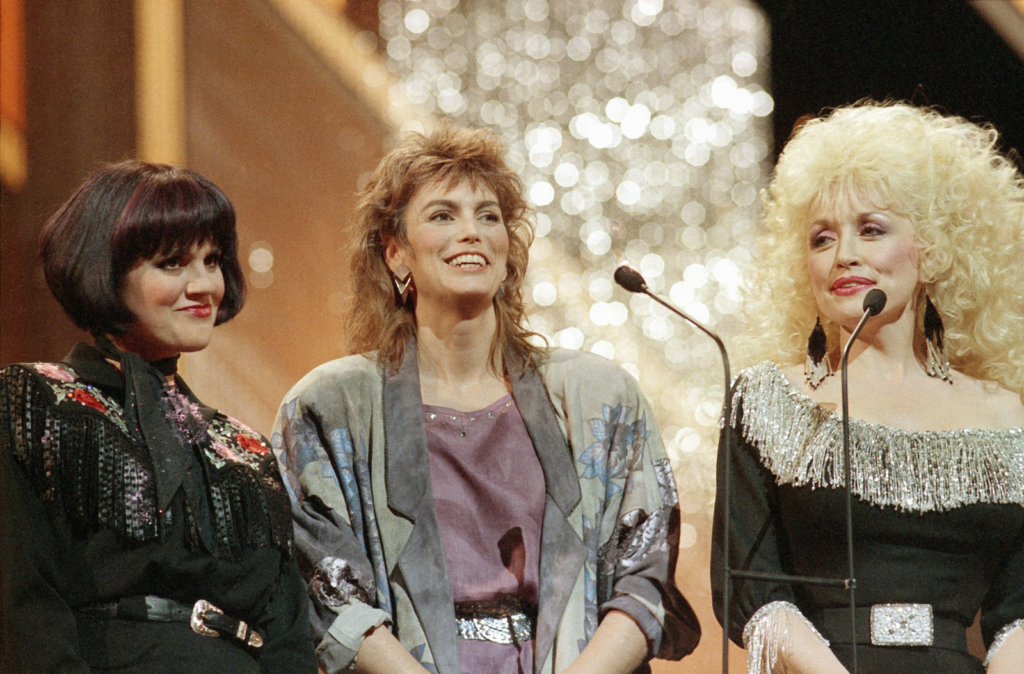
“My Dear Companion” becomes a quiet ache you can almost touch—three legendary voices turning an Appalachian lament into a shared, tender goodbye that refuses to hurry.
The performance you’re pointing to—Dolly Parton, Linda Ronstadt, and Emmylou Harris singing “My Dear Companion” on Dolly—aired as Episode 3 of the 1987 ABC variety series on October 11, 1987. In that segment, Dolly introduces Emmylou and Linda, and the three perform “My Dear Companion” (along with “Hobo’s Meditation” and “Those Memories of You”). That date and context matter, because it places the performance right at the moment their long-rumored collaboration was finally public and real: the album Trio had been released earlier that same year, on March 2, 1987, and it went on to peak at No. 6 on the Billboard 200 and reach No. 1 on Top Country Albums for five weeks.
Now, the song itself—its “backstory” is the kind that feels older than the room you’re standing in. “My Dear Companion” is credited to Jean Ritchie, the Kentucky-born singer, folklorist, and dulcimer player who helped carry Appalachian music into the wider world. On Trio, the track listing explicitly credits Jean Ritchie as the writer of “My Dear Companion.” Yet the song also carries the scent of tradition: folk scholarship notes that Ritchie’s piece may be an evolution of an older ballad (“The Dear Companion”) collected in the Southern Appalachians, the kind of melody that travels through time by passing from mouth to mouth rather than through paperwork.
That’s why this 1987 television moment lands the way it does. The lyric is plain—Have you seen my dear companion?—and that plainness is its power. It doesn’t perform grief; it states it. It sounds like someone asking a question they already know the answer to, because asking is the only way to keep the person “real” a little longer. There’s no melodrama, no clever twist—just the devastating folk truth that abandonment isn’t always loud. Sometimes it’s simply the fact that someone has gone “to some far country,” and the world keeps moving as if that isn’t the end of your private universe.
What makes Dolly, Linda, and Emmylou so extraordinary on this song is that they don’t try to modernize it. They honor its stillness. A medley on a variety show can easily feel like a sampler plate—bright and quick, meant to keep the audience from drifting. But here the arrangement behaves like a candle: steady flame, steady breath. In 1987, each of these women already had the authority to dominate a stage alone—yet on “My Dear Companion,” the real thrill is how willingly they disappear into the harmony. You don’t hear three stars competing for attention. You hear one shared emotion, braided from three different timbres.
And those timbres matter. Dolly Parton carries that high Appalachian brightness—like daylight on mountain air. Linda Ronstadt brings the clear, firm strength of a singer who can cut through any band, then soften into velvet without losing truth. Emmylou Harris is the silvery thread between them—cool, poised, almost weightless, the voice that makes sorrow sound strangely beautiful without romanticizing it. Put together, they make the old folk wound feel newly human: not “back then,” not “somewhere else,” but right now, in your own chest.
The deeper meaning, though, is not only personal heartbreak. It’s also about tradition—about how songs survive by being carried carefully. A Jean Ritchie lament, sung on mainstream American television in 1987, becomes an act of preservation disguised as entertainment. And that’s the sweetest irony: a song built from loss becomes, in their hands, a kind of saving grace—proof that what vanishes in life can still be held in music.
If you listen closely, that’s what this performance offers: a reminder that sometimes the most “complete” goodbye isn’t the dramatic one. It’s the quiet one—sung gently, in perfect harmony—where you finally admit the person is gone… and yet, for three minutes, they’re still here, because the song remembers for you.