
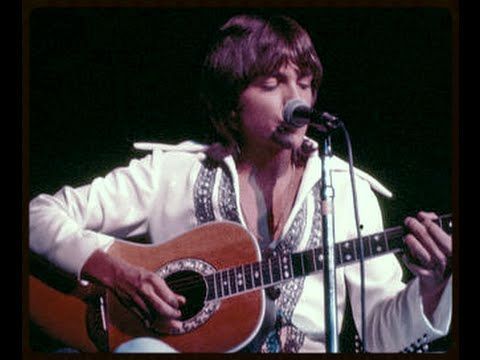
“Rosa’s Cantina” is David Cassidy slipping out of the spotlight and into a dusty backroom of laughter—where hard days end, the bottle opens, and the night politely refuses to take responsibility for tomorrow.
Before the feelings take over, the facts deserve to be placed right up front. “Rosa’s Cantina” is a song co-written by David Cassidy and Bryan Garofalo, and it appears as track 4 on Cassidy’s 1976 RCA album Gettin’ It in the Street. The album itself has one of those frustrating, half-buried histories: it was released in Germany and Japan in November 1976, but it wasn’t properly issued in the United States at the time; U.S. copies that had been pressed later surfaced in July 1979. That context matters, because it helps explain why a song as instantly visual and sing-along-ready as “Rosa’s Cantina” never had the usual runway to become a mainstream “moment.”
As for chart life: “Rosa’s Cantina” was not a charting single in its own right. It turned up publicly as the B-side of “Saying Goodbye Ain’t Easy (We’ll Have To Go Away)”, issued as a 7-inch single (RCA Victor PB-10921) with a documented release date of April 12, 1977. Even the A-side didn’t score a chart placement in the major territories listed in standard discographies—those columns remain blank, a quiet reminder that popularity and visibility are not always the same thing.
Now—what the song is, when you actually sit with it, is something warmer than its modest paper trail suggests. “Rosa’s Cantina” plays like a postcard from the edge of town: men “working in the sun,” the evening arriving like a pardon, and the pull of a familiar refuge where you don’t have to be noble, only present. The lyric keeps returning to a simple ritual—going “down” to the cantina, getting “high,” toasting with a wink (“here’s mud in your eye”), and ignoring the idea of getting home on time. It’s not sophisticated storytelling; it’s folk memory—the kind you feel in your bones even if you’ve never been to that exact bar, because you’ve lived the emotion: the day that took too much, the night that gives back just enough.
What makes it especially poignant in Cassidy’s catalogue is where it sits in his career. By the mid-’70s, he was fighting to be heard as more than a teen idol—writing, co-producing, surrounding himself with musicians who could pull him toward grown-up pop-rock credibility. Gettin’ It in the Street was co-produced by Cassidy and Gerry Beckley of America, and later retrospectives and reissue talk have emphasized how the record showed him aiming for maturity and craft rather than the old bubblegum glow. In that light, “Rosa’s Cantina” feels like a clever choice: it’s lively and accessible, but it isn’t “cute.” It’s a song about adult escape—not fantasy, not innocence, but that familiar bargaining we all do with fatigue: one more round, one more laugh, one more song before the world returns.
Musically, it’s built to move. The chorus is repetitive on purpose, like footsteps on a wooden floor: down, down, down—not merely a direction, but a surrender. And there’s something oddly tender about how the lyric frames the night: the bartender calls “last call,” yet someone insists it’s fine, nobody needs to go home. That’s the line where the smile turns a little bittersweet. Because underneath the camaraderie is a small confession: sometimes we stay out not because we’re celebrating, but because going back to quiet rooms—and quiet thoughts—feels harder than another glass.
So the meaning of “Rosa’s Cantina” isn’t really about drinking at all. It’s about belonging—that old, nearly sacred need to be somewhere you’re known, somewhere the evening has a door you can open and a name you can say. And maybe that’s why it lingers for listeners who collect the overlooked corners of famous careers: it captures David Cassidy in motion, shaking off the day, reaching for the ordinary joys that don’t ask for applause.
In the end, the song’s charm is its humility. No grand manifesto, no chart conquest—just a small, bright scene with dust on its boots and music in its throat. And if you listen closely, you can almost hear what made it worth writing in the first place: the relief of stepping into night air and realizing, for a little while, you don’t have to be anyone’s poster. You only have to go down to Rosa’s Cantina—and let the world wait outside.