
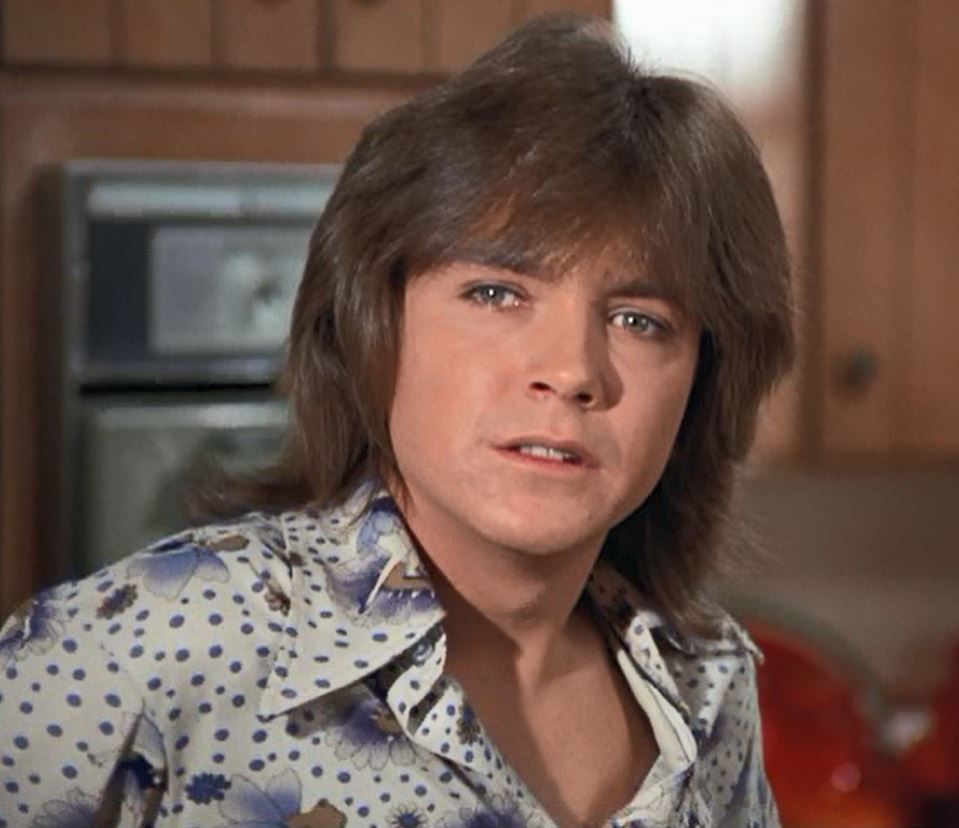
“I Never Saw You Coming” is the quiet sting of being blindsided—when love doesn’t end with thunder, but with a door closing so softly you only notice the silence afterward.
There’s something almost painfully fitting about David Cassidy singing “I Never Saw You Coming” on an album whose own life arrived in fragments—pressed, postponed, released far from home, then resurfacing later like a message finally delivered. The song sits at the head of Side Two on Gettin’ It in the Street (RCA, 1976), where it’s listed as Side Two, track 1—a placement that feels deliberate: the moment the record flips over, the emotional weather changes. On many later tracklists (including digital services and reissues), it appears as track 5, following the Side One sequence. Either way, its job is the same: it opens a more inward chapter, where the smile fades and the accounting begins.
The album context is essential, because it explains why the song can feel like a private letter rather than a public “hit.” Gettin’ It in the Street was scheduled for U.S. release in November but was shelved at the last minute; according to Cassidy’s discography notes, after the title song “stiffed” in America, the already-pressed U.S. copies were eventually dumped in July 1979, while the LP was released on schedule in Germany and Japan. That odd, delayed trajectory gives the whole project—especially a song like “I Never Saw You Coming”—the aura of something half-hidden, like music made during a turning point that the marketplace didn’t quite know how to present.
Musically and emotionally, the track belongs to Cassidy’s mid-’70s attempt to step out of the teen-idol frame and into a more adult, songwriter-driven identity. The album itself is credited as produced by David Cassidy and Gerry Beckley (of America), a partnership that quietly signals Cassidy’s intent to be taken seriously as a craftsman, not just a face. “I Never Saw You Coming” also carried enough “official” weight to be documented as a 1976 single in Germany’s database, listing David Cassidy for “music/text” and naming Gerry Beckley and David Cassidy as producers. (That listing doesn’t show a chart entry on the page itself, and the song isn’t commonly cited as a charting hit—its significance is more artistic than statistical.)
As for the writing credit, it’s a small story of its own. Some sources credit the song to David Cassidy and Jay Gruska—consistent with album-era documentation. But later discography references expand the credit to include Bill Mumy and David Jolliffe alongside Cassidy and Gruska, hinting at a more collaborative origin than the simplest credit line suggests. That kind of credit “drift” happens in pop history more often than people realize—songs travel through demos, co-writes, revisions, and paperwork that doesn’t always capture every hand the first time around. What matters, in the end, is the voice that carries it to you.
And Cassidy carries it with a particular kind of restraint—no melodramatic pleading, no grand revenge fantasy. The title “I Never Saw You Coming” is the whole bruise: the shock isn’t only that love left, but that it left without warning, leaving the singer to replay the final days like a detective searching for the clue he missed. On streaming listings, the track runs about 3:31, long enough to let the realization settle in, short enough to feel like someone stopping mid-sentence because continuing would hurt too much.
What gives the song its deeper meaning is how universal that shock really is. Most of life’s heartbreak doesn’t arrive like a movie scene. It arrives like a change in tone—fewer questions, shorter answers, a hand that doesn’t quite reach back. Then one day you’re standing in the aftermath, holding your own feelings like leftover luggage, thinking: How did I not notice the goodbye being practiced right in front of me? Cassidy’s performance captures that mature sorrow: not just grief, but the humiliating bewilderment of it.
In that sense, “I Never Saw You Coming” isn’t only about losing someone—it’s about losing the illusion that love always announces its turning points. And maybe that’s why it still resonates, tucked inside an album with a complicated release story. Sometimes the most truthful songs don’t arrive with fanfare. They arrive the way the lyric does: suddenly, quietly, and once you’ve heard them, you can’t quite un-hear the lesson.