
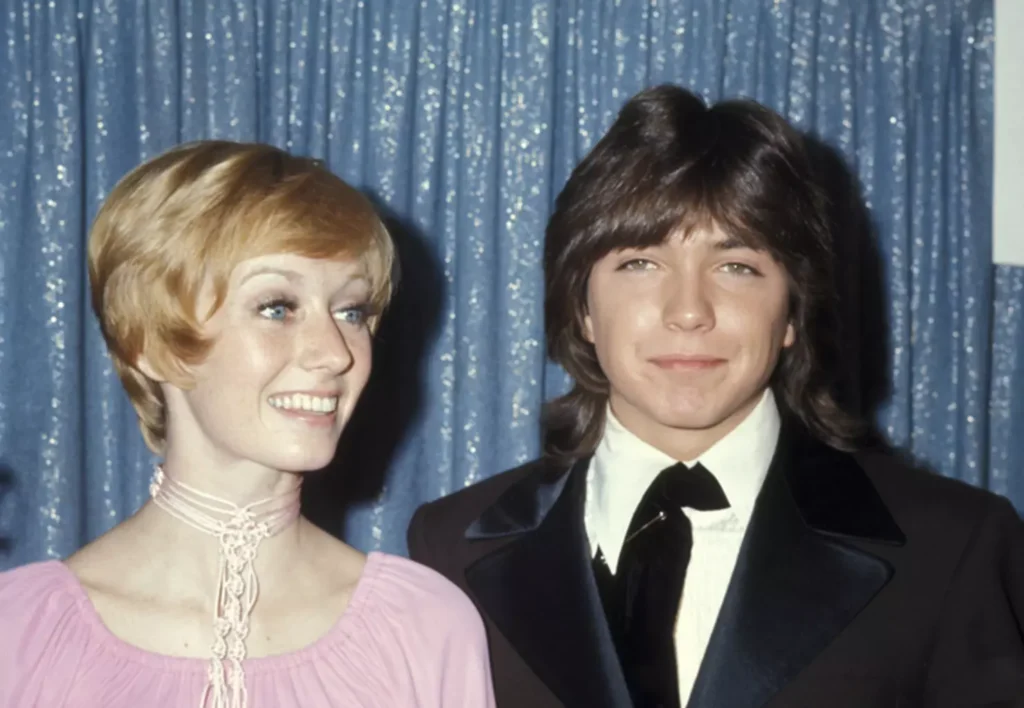
“I Saw Her Standing There” in David Cassidy’s hands is a joyous return to first loves and first records—proof that beneath the teen-idol mythology, there was always a real rocker grinning at the edge of the stage.
What makes David Cassidy – “I Saw Her Standing There” so moving isn’t that it’s a clever cover of a famous song. It’s when he chose it—and what it quietly says about who he wanted to be heard as. Cassidy’s best-known studio years were welded to a very specific kind of pop fame, the kind that arrives fast and leaves people thinking they already know you. But when he brought “I Saw Her Standing There” into his live set, he was doing something more personal than chasing nostalgia: he was reaching back to the raw, electric roots that made so many of us fall in love with rock ’n’ roll in the first place.
The track most commonly circulates from Cassidy’s concert recording filmed in Scotland: David Cassidy – Live in Concert (2002), recorded at the Clyde Auditorium, Glasgow, on 29 April 2002, where “I Saw Her Standing There” appears in the show’s sequence. The performance was released on DVD on February 24, 2004. Later, the same concert program was issued as Live In Concert (CD + DVD), with the audio CD release dated May 19, 2008, again listing “I Saw Her Standing There” as a featured track. And if you’ve encountered it digitally, it also appears on I Think I Love You – Greatest Hits Live, released November 1, 2009, where the song runs just under three minutes—tight, bright, and built to make a room lift its head.
Because you always ask for a clear “ranking at launch”: Cassidy’s “I Saw Her Standing There” was not released as a chart single, so there is no debut position to report for his version. Its life is the life of the stage—an earned song, not a marketed one. (Setlists from the early 2000s confirm he was indeed performing it as a Beatles cover in concert.)
To understand the emotional weight of Cassidy choosing this particular song, you have to remember what “I Saw Her Standing There” is at the source. It’s a Beatles ignition key—written by McCartney–Lennon, recorded on 11 February 1963, and released in the UK as the opening track on Please Please Me on March 22, 1963. In the United States it became the B-side to “I Want to Hold Your Hand” (released December 26, 1963), and it still climbed on its own power—entering the Billboard Hot 100 on February 8, 1964 and peaking at No. 14. The song is pure early-rock adrenaline: a breathless count-in, that teenage rush of seeing someone across a room, and the feeling—so innocent it hurts—that the night might last forever.
So when David Cassidy sings it decades later, the meaning shifts in a beautiful way. It’s no longer only about a girl “just seventeen.” It becomes about the moment music first hit you in the chest and made you believe in possibility. Cassidy doesn’t need to imitate the Beatles; the smarter move is what he actually does—he treats the song as a live-wire standard, something you play because it still makes your blood run a little faster. In that sense, his performance feels like a reclaiming. Not reclaiming the Beatles—no one can do that—but reclaiming himself from the neat boxes history tries to store artists in.
There’s also something quietly defiant in the choice. Cassidy came of age in an era when pop stardom could be both blessing and cage. Singing “I Saw Her Standing There” in a packed venue—guitars up, tempo bright, crowd leaning forward—lets him step out of the soft-focus image and into the harder light of rock tradition. It says, without speechifying: I was listening to the same records you were. I wanted the same freedom those records promised.
And maybe that’s why this cover lingers after the applause fades. Because beneath the song’s famous grin is a deeper tenderness: the knowledge that youth doesn’t come back… but the feeling of youth, sometimes, can. For three minutes, in a live room, David Cassidy borrows the Beatles’ early thunder and turns it into a kind of homecoming—back to the pulse of the music, back to the simple joy of a band kicking off a song, back to the part of the heart that still believes the night is wide open.