
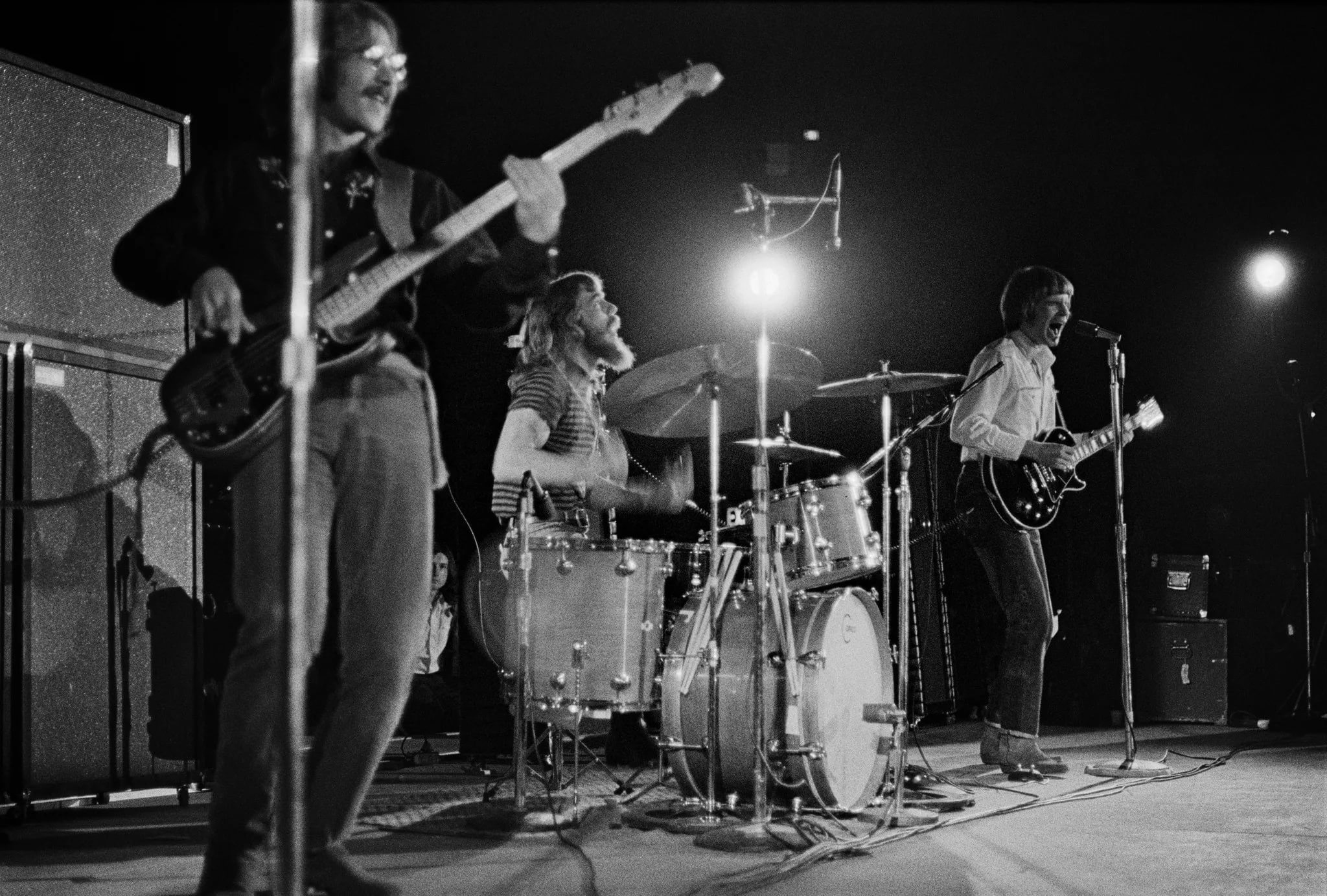
In “Commotion (Live Oakland, 1970),” Creedence Clearwater Revival take a song already built on pressure and velocity and make it feel even more urgent—like city nerves, highway heat, and rock-and-roll instinct all colliding in real time.
There are Creedence Clearwater Revival songs that swagger, songs that brood, and songs that seem to move with the blunt force of weather. “Commotion” belongs to that last kind. Even in the studio it was one of the band’s leanest jolts of nervous energy, but in “Commotion (Live Oakland, 1970)” the song becomes something even sharper: not just a rocker, but a burst of pure acceleration, as if John Fogerty and company were trying to outrun the noise the song is describing. The original “Commotion” was released in 1969 as the B-side of “Green River,” yet it still climbed to No. 30 on the Billboard Hot 100 and No. 16 in Germany—a reminder that CCR were so strong at their peak that even the flip side could behave like a hit. It was also included on Green River, the album that gave the band its first No. 1 on the Billboard 200.
That background matters, because “Commotion” was never filler. It came from the same astonishing 1969 streak that made CCR feel less like a band chasing momentum than one creating it. The song was written and produced by John Fogerty, recorded at Wally Heider Studios in San Francisco in June 1969, and it carried exactly the sort of compressed force he understood better than almost anyone: short running time, no wasted motion, and a groove that feels like it has already hit the ground running. Contemporary trade reviews noticed it immediately—Billboard called it a “hard rock item with a strong lyric line,” while Cash Box heard in it the kick of an early rock-and-roll workout.
What gives the song its special edge is its subject. “Commotion” portrays the manic side of modern life—traffic, freeways, rushing, urban pressure—and later commentary on the song consistently identifies that sense of city chaos as central to its design. One summary of Fogerty’s own explanation notes that he was writing out of what was “in the air,” which suits the song perfectly: it sounds like agitation translated into rhythm. This is not romantic road music. It is motion as pressure, speed as irritation, everyday life turned into a rockabilly panic. That is why the song has always felt a little different from other CCR staples. It is not swampy or mythic. It is immediate, crowded, and a little claustrophobic.
And that is precisely why the Oakland 1970 performance lands so hard. This version comes from January 31, 1970, recorded at the Oakland–Alameda County Coliseum Arena and later issued on the live album The Concert in 1980. For years that album was mistakenly known as The Royal Albert Hall Concert, until it was correctly identified as the Oakland show. The track itself runs about 2:37 on the live release, and that brevity is part of its power. CCR do not expand the song into a jam or decorate it with live indulgence. They hit it fast, hard, and clean. It sounds like a band at full efficiency, already famous, already battle-tested, and still unwilling to pad a good song by even a few unnecessary seconds.
The timing of the performance makes it even richer. January 1970 caught CCR in that rare moment when a great rock band is not merely successful but almost frighteningly concentrated. Green River had already hit No. 1, “Green River” the single had reached No. 2 in the U.S., and the group were moving into the Cosmo’s Factory era with supreme confidence. In Oakland, you can hear that confidence not as arrogance but as command. They know exactly how this kind of song should work: Doug Clifford’s drumming keeps the engine hot, Stu Cook holds the floor steady, Tom Fogerty locks in the rhythm guitar, and John Fogerty rides over it with that cutting, impatient vocal attack that could make even a two-minute song sound like a full-blown event.
What makes “Commotion (Live Oakland, 1970)” so satisfying is that it captures one of CCR’s deepest strengths: their refusal to confuse power with excess. Plenty of bands could play louder. Plenty could stretch longer. Very few could generate this much tension with such economy. The song’s meaning—rush, strain, the whole modern-day scramble—actually becomes clearer live, because the band sound as if they are inside the commotion, not simply describing it. The performance has no softness to spare. It is clipped, efficient, and wonderfully impatient.
So this live “Commotion” endures not because it transforms the song into something unrecognizable, but because it reveals the song’s true nature more completely. It reminds us that Creedence Clearwater Revival were masters of compression, and that some of their finest moments came when they took a simple idea and drove it until it sparked. In Oakland, “Commotion” becomes exactly what its title promises: a brief, blazing collision of nerves, motion, and rock-and-roll certainty. And once it starts moving, it hardly gives you time to breathe before it is gone—which is exactly why it stays with you.