
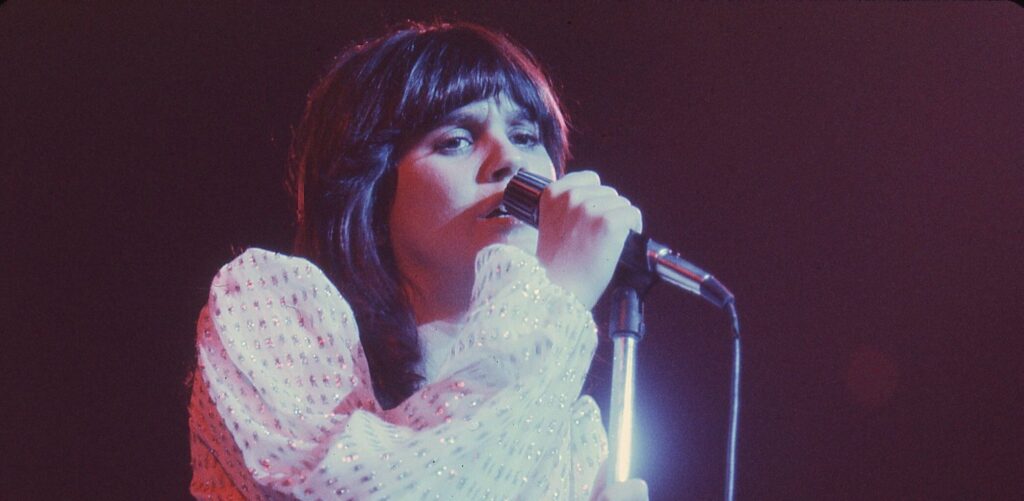
“Alison” is a love song that refuses to flatter—an awkward, tender encounter where affection survives embarrassment, and memory hurts precisely because it still feels true.
When Linda Ronstadt recorded “Alison,” she took one of Elvis Costello’s most emotionally exposed early songs and gave it a different kind of gravity—less jagged, more bruised-in-the-open, like a confession sung with the lights on. Her version appears on Living in the USA (released September 19, 1978, produced by Peter Asher), an album that became her third and final No. 1 on the Billboard 200. But “Alison” wasn’t positioned as the album’s big pop-cannon single; it was released later as the fourth single in spring 1979, and its chart life reflected that quieter role. It became a moderate hit, reaching No. 30 on Billboard’s Adult Contemporary chart, and in the UK it reached No. 66 on the Official Singles Chart (with its first chart date May 26, 1979).
That “not-quite-a-smash” profile is actually perfect for the song. “Alison” has never felt like a tune that wins by volume. It wins by staying in your head after the music stops—by making you replay a conversation you wish you’d handled better.
To understand why Ronstadt’s cover matters, you have to return to the song’s first life. Costello wrote and recorded “Alison” for his 1977 debut album My Aim Is True, and released it as a single in the UK on May 21, 1977 (produced by Nick Lowe). Costello later suggested it began as an ode to a woman he saw working at a supermarket—yet he stayed famously elusive about what, exactly, the lyric “means,” as though the song’s power depended on keeping its heart slightly out of reach. Even his original single didn’t chart, but the song became one of his most acclaimed—proof that some songs find their “position” in culture, not in columns of numbers.
Ronstadt approached it from the opposite direction: she was already an arena-level star, sitting on the kind of success that could easily have encouraged safe choices. Instead, she pulled this slightly prickly, new-wave-adjacent ballad into her world—where rock craft met pop clarity—and sang it as if she were willing to look directly at its discomfort. The lyric isn’t a romantic bouquet; it’s a complicated glance across time. It’s the ache of seeing someone “after so long,” realizing you still care, realizing you may not deserve to care, and saying it anyway. In Ronstadt’s hands, the narrator’s vulnerability feels less like a young man’s nervousness and more like an adult’s uneasy honesty: the knowledge that attraction and remorse can share the same breath.
There’s also a fascinating aftertaste to the cover—one that belongs to the strange economy of pop history. Years later, Costello joked that he may have sounded publicly dismissive of Ronstadt’s version, “but I didn’t mind spending the money that she earned me.” And in a gesture that complicates the story further, he donated royalties from Ronstadt’s version to the African National Congress, tied to controversy around her appearance at Sun City in South Africa. Even when you hear only the sweetness of her vocal, the song carries those real-world echoes: art moving through other people’s lives, through politics, through consequences, still remaining—at its center—an intimate human moment.
What makes “Alison” endure, especially in Ronstadt’s reading, is its refusal to tidy itself up. It doesn’t give you the clean reward of reconciliation. It gives you recognition: the sting of seeing someone who once mattered, the flash of what you were, the quiet humiliation of realizing you still want to be seen kindly. Ronstadt sings as if she understands that kind of longing—how it can be tender without being pure, sincere without being proud.
And perhaps that’s the real gift of her “Alison.” Set against the huge commercial glow of Living in the USA—a No. 1 album built to fill rooms—this song feels like a small corner of shadow where the heart can speak plainly. Not loudly. Just truly.