
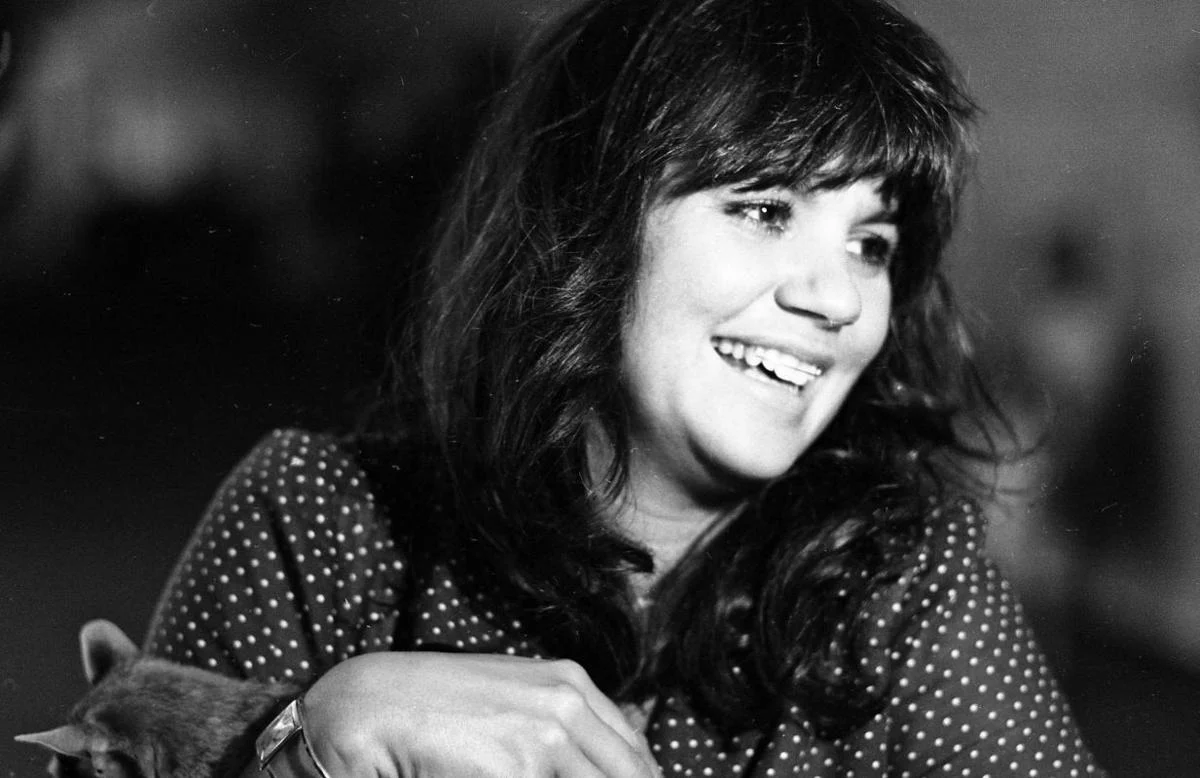
“Poor Poor Pitiful Me” in Atlanta, 1977 is heartbreak told with a grin—Linda Ronstadt turning bruises into brightness, and self-pity into swagger you can dance to.
On December 1, 1977, at the Fox Theatre in Atlanta, Linda Ronstadt stepped into “Poor Poor Pitiful Me” not as a “heritage hit,” but as a living, breathing part of her present tense—caught on a pro-shot concert performance often circulated under the title Live at the Fabulous Fox. The setlist from that night places it squarely in the show’s beating heart—coming right after “Crazy” and before “Desperado”—a placement that tells you how she understood the song: not a novelty, not a throwaway, but a jolt of dark humor and human truth that keeps the evening’s emotional engine running.
The timing is deliciously specific. Ronstadt’s studio version lived on Simple Dreams, released September 6, 1977, produced by Peter Asher and recorded at The Sound Factory in Hollywood. Yet as a U.S. single, “Poor Poor Pitiful Me” didn’t truly begin its chart journey until the start of 1978—debuting at No. 78 on the Billboard Hot 100 on January 28, 1978, and later peaking at No. 31 on March 11, 1978. In other words, Atlanta heard it before the numbers did—before it was officially filed away as “a hit,” when it still had the electricity of something freshly chosen, freshly claimed.
And claimed it was—because the song’s bones belong to Warren Zevon, who wrote and first recorded “Poor Poor Pitiful Me” for his 1976 self-titled album, produced by Jackson Browne. Zevon’s original is pure barbed-wire wit: the kind of lyric that laughs while it bleeds. Ronstadt’s genius wasn’t to sanitize it, but to translate it—most famously by flipping the gendered references and letting the narrative walk out onto the stage in high heels and hard-earned confidence.
That’s why the Atlanta 1977 performance matters so much. Live, the song becomes a little play. The narrator isn’t simply unlucky; she’s storytelling—spinning her misfortunes into something shareable, survivable, even funny. Ronstadt sings like someone who’s done with whispering about bad nights. She gives the words a forward motion that says: yes, this happened—and I’m still here, and I can still sing. The title phrase, “poor, poor, pitiful me,” stops being a puddle of self-pity and becomes a punchline she controls. It’s not defeat. It’s reclamation.
The deeper meaning is hiding in plain sight: this is a song about the strange dignity of admitting you’ve been knocked around, without letting the knockdown define you. Zevon’s lyric is famously sardonic and heavy with adult messiness. Ronstadt doesn’t pretend otherwise. She simply refuses to collapse under it. In a way, she turns the song into a small manifesto of resilience—proof that humor can be a life raft, and that a voice can stand taller than the story it’s telling.
And then there’s the broader Simple Dreams atmosphere around it—an album that didn’t just succeed; it dominated, becoming the best-selling studio album of her career. That context casts the Atlanta performance in a particular glow: she’s at a peak, but she’s singing material that’s emotionally complicated, even rough-edged, and making it feel glamorous without losing its grit. The pop world often rewards polish; Ronstadt, that night, rewards honesty—delivered with a rock singer’s bite and a storyteller’s timing.
Even the chart details echo the song’s personality. When Billboard caught up in 1978, the track’s climb—from No. 78 to No. 31—wasn’t the rocket-launch trajectory of a gimmick. It was steadier, word-of-mouth strong, the kind of rise that suggests listeners came back to it. And beyond Billboard, the song also reached No. 26 on the Cash Box Top 100, another small testament to how widely her version landed.
So when you watch or listen to “Poor Poor Pitiful Me (Live in Atlanta, 1977)”, you’re not just hearing a cover. You’re hearing a moment when Linda Ronstadt turns a songwriter’s dark joke into a stadium-sized smile—sharp, human, and strangely comforting. Because the real comfort isn’t in pretending life is clean. It’s in hearing someone sing the mess with such command that, for a few minutes, the mess becomes music—and music becomes a way of getting safely home.