
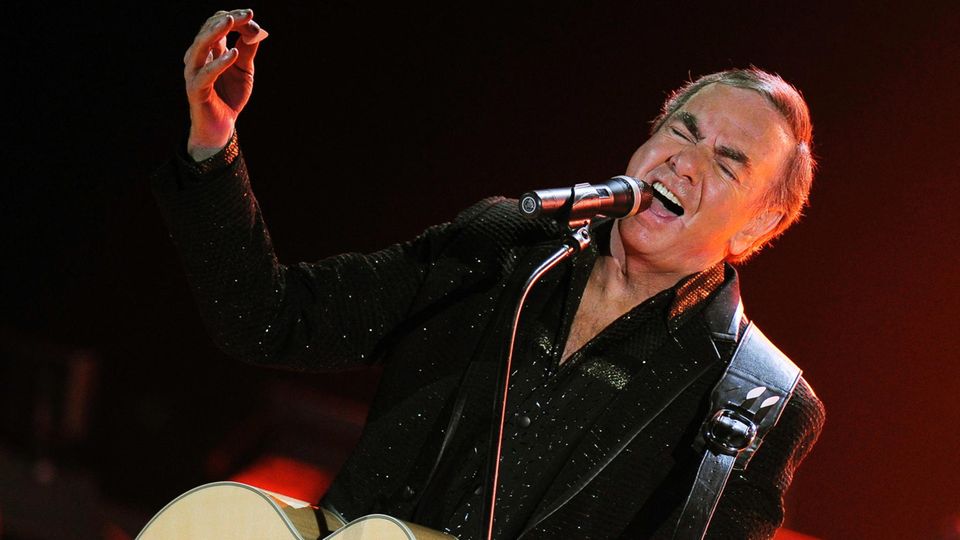
“A Song for You” is the rare confession that doesn’t ask to be admired—only understood: a man looking back on his own flaws and offering music as his most honest apology.
When Neil Diamond sings “A Song for You”, he’s stepping into a room already heavy with history—and doing so with the humility of a craftsman paying tribute to another craftsman. His version appears on Dreams (released November 2, 2010), an album of covers Diamond described as personal favorites, produced by Diamond himself. The record debuted and peaked at No. 8 on the Billboard 200—a top-ten showing that, in 2010, quietly reaffirmed his place as a living institution rather than a museum exhibit. On that album’s track list, “A Song for You” sits late in the sequence (around the final third), like a candle lit after the conversation has already turned reflective.
But the real weight of this performance comes from what the song is before Diamond ever touches it. Leon Russell wrote “A Song for You” and first released it on his self-titled debut album Leon Russell in 1970. Russell later explained he wrote it quickly—almost as if it arrived from “another place”—and that he was trying to write a “standard,” something Frank Sinatra and Ray Charles could both sing. That intention matters: the song isn’t built like a trendy statement of its era. It’s built like a timeless room—simple enough to enter, deep enough to echo.
The lyric’s central ache is almost unbearably human. The narrator admits he’s been “so many places,” sung “a lot of songs,” made “some bad rhyme,” and “acted out” love on stages—then turns and faces the one person who really matters, the one witness whose verdict can’t be bought with applause. (Diamond sings it with a storyteller’s calm, not begging—more like admitting.) This is not romance as fantasy; it’s romance as accountability. It’s a song about the distance between who we perform as and who we truly are when the lights go down.
So why does it fit Neil Diamond so naturally?
Because Diamond’s entire career has been a negotiation between the public and the private. His voice—famously direct, unmistakably present—has always sounded like a man speaking from the center of the chest. On Dreams, he isn’t trying to out-soul Leon Russell or compete with the many legendary versions that have gathered around this song over the decades. Instead, he does something more Diamond-like: he makes the confession feel like it’s coming from an older man’s ledger, written neatly, with no excuses in the margins.
And Dreams is the perfect container for that. The album is an act of looking back—Diamond revisiting songs he admired, as if walking through a gallery of musical memory and pausing longest in front of the pieces that still make him feel something. When “A Song for You” arrives, it doesn’t sound like a detour; it sounds like the thesis statement you only understand once you’ve heard the earlier tracks: that a lifetime of music is, at its core, a lifetime of trying to say “this is who I am” in a way that someone you love might finally believe.
The meaning of “A Song for You” has always been bigger than a love song, and Diamond’s reading underlines that. It’s about artistry as confession. About performance as both gift and disguise. About the strange sorrow of realizing you can move a room full of strangers… and still feel unworthy in the one room that matters most. In that sense, the title is almost modest to the point of heartbreak: a song—not a speech, not a grand defense—just the one thing the narrator can offer with clean hands.
If you listen carefully, you can hear why Leon Russell’s wish for “standard” status came true. The song leaves space for the singer’s life to seep in. And in Neil Diamond’s hands—late career, steady voice, unhurried phrasing—“A Song for You” becomes what it always wanted to be: a simple, durable truth, carried forward by another man who has lived long enough to know that love doesn’t need perfection… it needs honesty.