
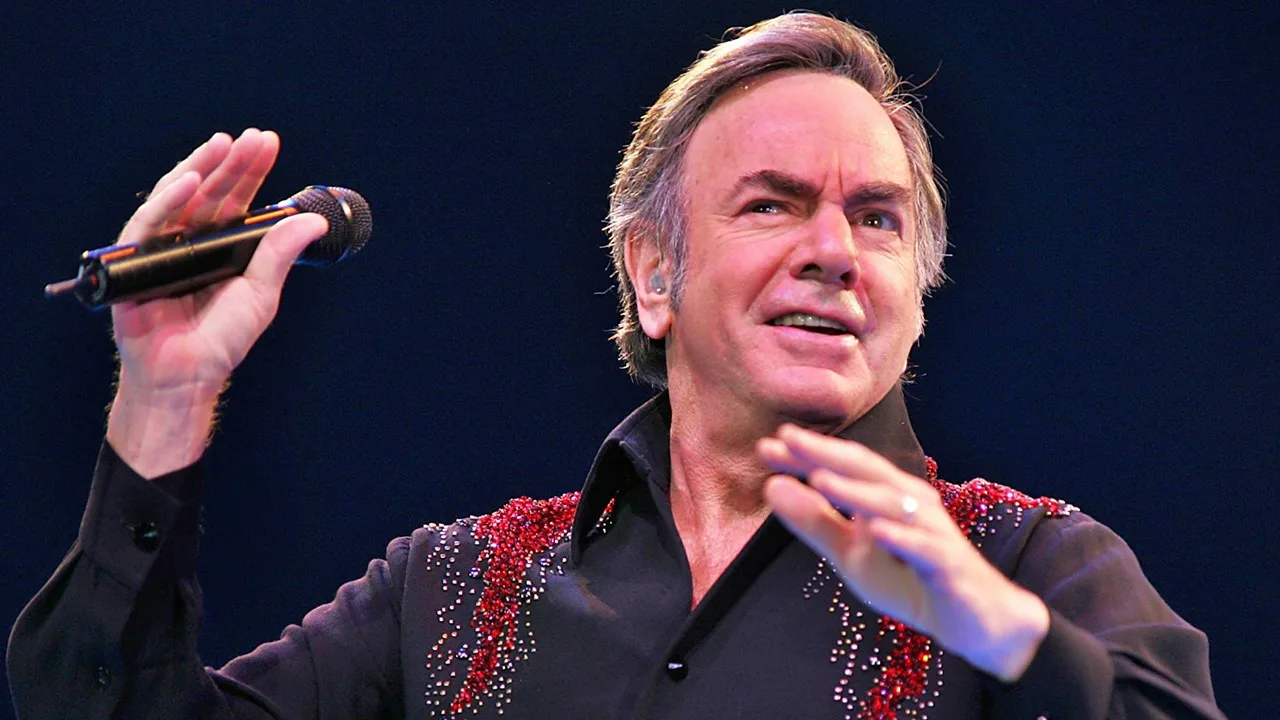
“Midnight Train to Georgia” in Neil Diamond’s voice is nostalgia with a different accent—less Southern soul testimony, more late-career reflection, as if the same train now carries memory instead of urgency.
Let’s set the record straight with respect, because accuracy deepens the feeling: “Midnight Train to Georgia” is not a song that originated with Neil Diamond. It was written by Jim Weatherly, and it became immortal in August 1973 through Gladys Knight & the Pips, whose recording went to No. 1 on the Billboard Hot 100 and later won a 1974 Grammy for Best R&B Vocal Performance by a Duo, Group or Chorus.
What Diamond did—beautifully, and in his own unmistakable way—was adopt the song decades later, bringing it into his personal gallery of beloved standards.
Neil Diamond released his version on Dreams (released November 2, 2010, via Columbia), an album explicitly built from cover versions of songs he admired, produced by Diamond himself. The album debuted and peaked at No. 8 on the Billboard 200, which is the closest thing this track has to a “chart arrival” under Diamond’s name—because his rendition was not rolled out as a separate charting single. On the official Neil Diamond site’s track list, “Midnight Train to Georgia” sits among other carefully chosen classics, like a passenger car in a long, affectionate journey through other people’s songs.
So why does Diamond’s interpretation matter, when the original is so iconic? Because Diamond approaches the lyric like a storyteller who has lived long enough to hear echoes inside familiar lines. In Gladys Knight’s hands, the song is a dramatic, communal farewell—gospel-schooled harmony and hard-earned grit turning a departure into a public reckoning. In Diamond’s hands, it can feel more inward, more like a late-night confession said softly so it won’t wake the house. His phrasing tends to linger, as though he’s less interested in the train’s whistle than in what the whistle dredges up—old choices, old compromises, the bittersweet dignity of going back to where you can breathe.
The backstory of the song itself is already rich enough to carry a lifetime. Weatherly originally wrote and recorded it as “Midnight Plane to Houston,” and the title shifted when producer/song plugger Sonny Limbo wanted to cut it with Cissy Houston—asking to change “plane” to “train” and “Houston” to “Georgia.” Weatherly later said the phone conversation that sparked it involved Farrah Fawcett, and he used her and Lee Majors “as kind of like characters.” That origin story gives the song a strangely cinematic quality: it’s rooted in everyday talk, yet it blooms into something archetypal—fame, disappointment, love that doesn’t quite save you, and the stubborn need to return to a truer self.
By the time Neil Diamond recorded it in 2010, he was no longer the hungry Brooklyn striver proving he could fill rooms with choruses. He was an elder craftsman revisiting songs as if revisiting old photographs—some of them not even his, but meaningful because they once illuminated his own life from across the radio dial. Dreams was framed as a collection of favorites; that framing matters, because it tells you Diamond is singing here as a fan, not as a conqueror.
And that, perhaps, is the secret tenderness of his “Midnight Train to Georgia.” When a great songwriter interprets another great songwriter, something intimate happens: the performance becomes a conversation across eras. The lyric remains about leaving—about a public dream collapsing into a private reality—but Diamond’s voice adds the shading of time. It suggests that “going back” is not always defeat. Sometimes it’s the bravest form of clarity: choosing the life that fits, even if it isn’t the life that impressed strangers.
If the original is a soul classic that pours its feeling into the street, Diamond’s version feels like it pours the feeling into the listener’s hands—warm, heavy, and honest. Different train. Same destination. The place where pride quiets down, and the heart finally admits what it needs.