
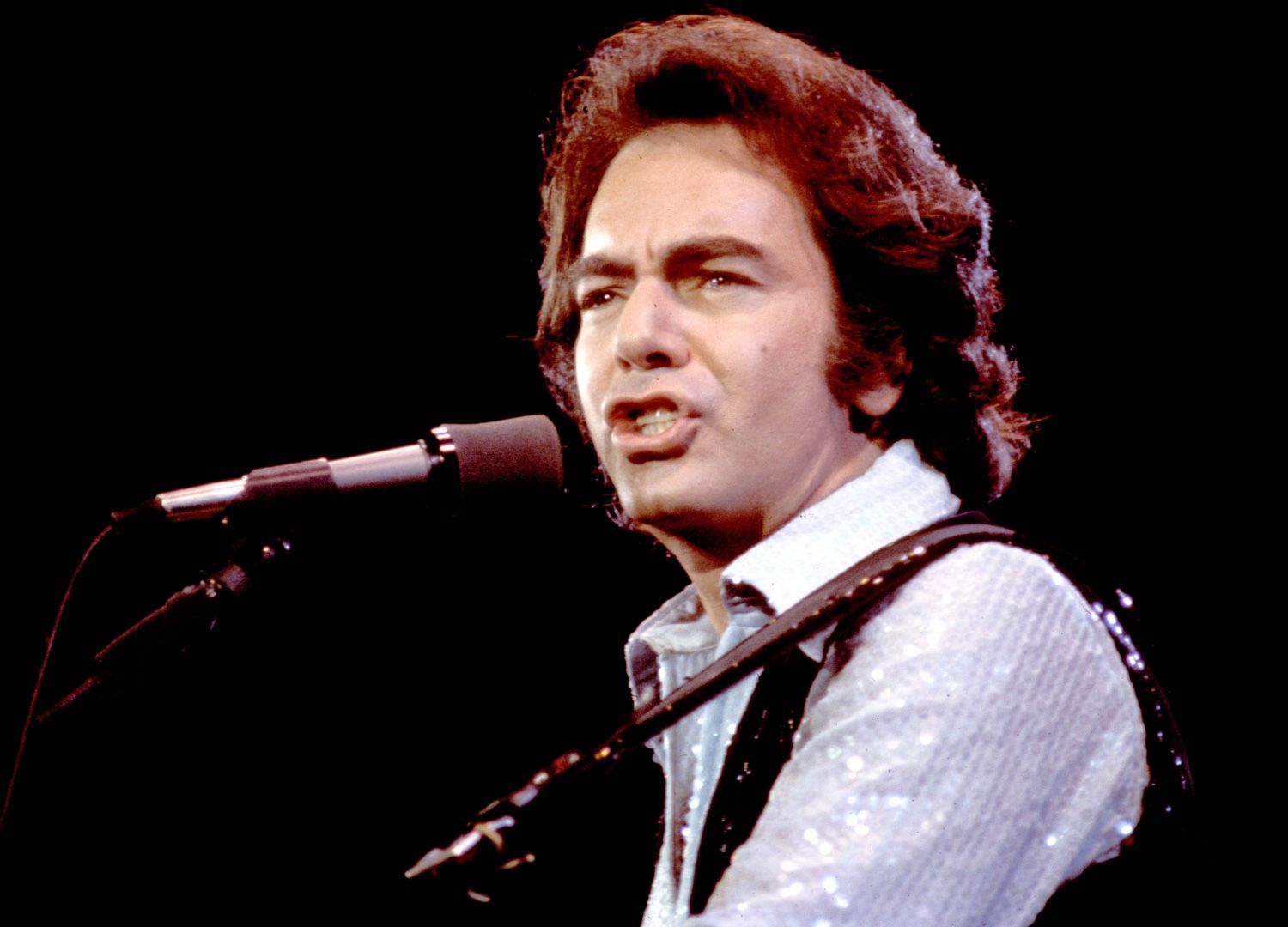
“Sunday Sun” is Neil Diamond capturing that rare, soft hour when the week loosens its grip—when you kick off your shoes, let hope back into the room, and remember how simple it can feel to be alive.
In the long arc of Neil Diamond’s catalog, “Sunday Sun” is one of those early songs that doesn’t arrive with stadium drama—it arrives with light. It belongs to the moment just before Diamond’s songwriting would begin landing the truly massive pop blows of 1969–70, when his name would become inseparable from radio’s biggest choruses. Here, in 1968, you hear him still shaping his own language: conversational, melodic, a little dreamy, and unusually intimate for a single.
The historical anchor points are beautifully clear. “Sunday Sun” was released as a 7-inch single on Uni Records, backed with “Honey-Drippin’ Times.” Many discographies list the single’s release as September 11, 1968. The song was also included on Diamond’s third album, Velvet Gloves and Spit, released October 15, 1968—his first album for MCA’s Uni label—and the album notes that it contained three “low-charting” singles: “Brooklyn Roads”, “Two-Bit Manchild”, and “Sunday Sun.”
And yes—“Sunday Sun” did chart. Its “position at launch,” in the measurable sense, was modest but real: it reached No. 68 on the Billboard Hot 100. That number tells an honest story about where Diamond stood at the time—already visible, already respected, still climbing. The world hadn’t yet fully caught up to the fact that this songwriter was about to become a household voice, but the door was opening.
What makes “Sunday Sun” so memorable is its tone: it feels like a walk rather than a speech. Trade-paper coverage from the period captures something of how it landed on radio—Record World described it as a “walking-talking” song and called it rhythmic and hypnotic (I’m paraphrasing their phrasing rather than quoting at length). That “walking” quality is the heart of the track: it’s built on the idea that the best conversations happen when you’re moving gently through the day—no pressure, no agenda, just companionship and air.
The “story behind” “Sunday Sun” is also the story of Diamond’s Uni era in miniature. Velvet Gloves and Spit is credited as his first release for Uni, and it lists all songs as written by Neil Diamond—a reminder that even before the biggest hits, he was already insisting on being the author of his own world. In 1968, pop was splintering into psychedelia, soul, folk-rock, and baroque experiment; Diamond’s gift was that he could sound contemporary without losing the plainspoken emotional directness that made his songs feel like they belonged to real life.
And that brings us to meaning—because “Sunday Sun” is, at its core, a song about permission. Sunday is framed not just as a day, but as a mood: the week’s noise receding, the mind returning to its own softer voice. The lyric’s invitation—walk with me, talk with me, dream with me—turns love into a small sanctuary. It’s not a grand romantic claim; it’s a gentler proposal: let’s be together while the world isn’t demanding anything from us. That’s why the song feels nostalgic even if you didn’t live in 1968. It remembers a kind of time that modern life rarely grants us—the unhurried hour, the daylight that feels like it’s on your side.
Listen closely and you can hear Diamond’s enduring theme already forming: the belief that ordinary moments deserve ceremony. Later, he would build choruses large enough for arenas. Here, he builds something more domestic—a window opened, a street walked, a quiet certainty that tomorrow will come, but today can still be kind. In that sense, “Sunday Sun” isn’t a “minor” Neil Diamond single at all. It’s an early self-portrait: the songwriter as companion, the melody as warm weather, the weekend as a brief mercy—held carefully, before the week begins again.