
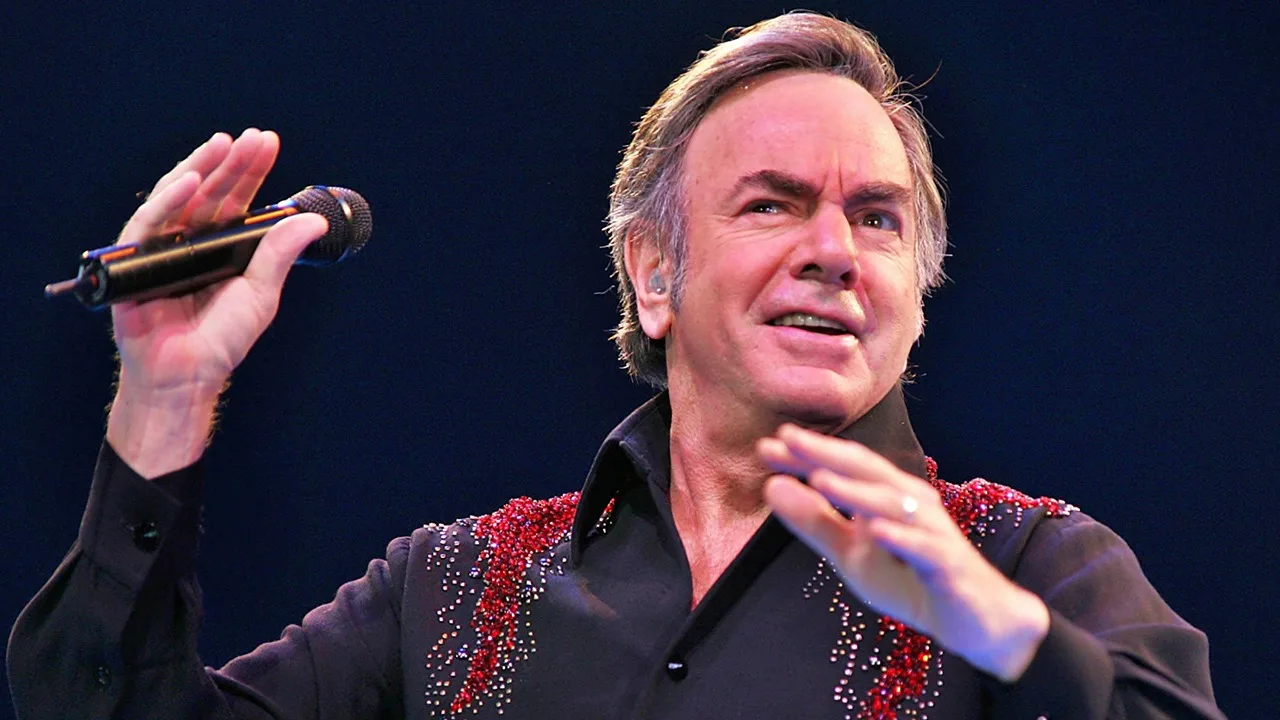
“The Sun Ain’t Gonna Shine (Anymore)” becomes, with Neil Diamond, a late-night confession—when love leaves, even the sky feels like it has resigned.
There are covers that feel like tribute, and then there are covers that feel like adoption—as if an artist has lived with a song so long that it starts to sound like part of their own autobiography. Neil Diamond’s “The Sun Ain’t Gonna Shine (Anymore)” belongs to the second kind. He didn’t record it at the peak of youthful bravado; he recorded it in 1979, in that mature phase when his voice had learned how to carry sadness without exaggeration—how to let heartbreak speak in a lower register, where it feels less like drama and more like truth.
The key facts deserve to sit near the top. The song was written by Bob Crewe and Bob Gaudio. It was first released in 1965 as a single credited to Frankie Valli, and then it truly caught fire when The Walker Brothers remade it in 1966, taking it to No. 1 in the UK and No. 13 on the U.S. Billboard Hot 100. Those numbers matter because they explain the song’s aura long before Diamond touched it: by the time he arrived, it was already a standard of pop desolation, a melodrama so elegant it could pass as a hymn.
Diamond’s version entered the world not as a standalone single moment but as an album jewel—track 9 on September Morn, released December 1979, produced by Bob Gaudio (yes, the same Gaudio who co-wrote the song), with Gaudio also credited on piano in the album’s personnel. That “full-circle” detail is more than trivia; it’s atmosphere. It’s like hearing a songwriter return to an old photograph and decide to reframe it with warmer light. The album itself was a significant late-’70s success, peaking at No. 10 on the U.S. Billboard 200, and charting strongly elsewhere (including No. 14 in the UK, No. 3 in Australia, and No. 3 in New Zealand).
So what does Neil Diamond do with this song that’s different?
The original “Walker Brothers” reading is famously cinematic—towering in its despair, dressed in orchestral shadow, the kind of performance that makes loneliness feel like a cathedral. Diamond’s approach, by contrast, often feels like the cathedral after closing time: the same echo, but fewer footsteps, more silence between the pillars. He brings a storyteller’s gravity. He doesn’t merely perform the loss—he seems to accept it, and that acceptance can be even more painful than pleading.
And the lyric, in any voice, is one of the great hyperboles of pop heartbreak: when love goes, the sun itself “ain’t gonna shine.” It’s an emotional overstatement that only works if the singer commits fully—if we believe they really are living in a world where weather has turned personal. Diamond’s gift has always been sincerity that doesn’t blush. He can sing a line that would sound melodramatic in lesser hands and make it feel like a private sentence you’ve thought but never admitted out loud. In his version, the title becomes less a slogan and more a diagnosis: the heart has lost its climate.
There’s also something quietly symbolic about Diamond recording this in 1979, when pop was pulling in multiple directions—dance-floor urgency on one side, soft-rock introspection on the other. September Morn contains its own stylistic range, yet “The Sun Ain’t Gonna Shine (Anymore)” sits like a deliberate pause: a willingness to stop moving long enough to feel the bruise. It’s the kind of track you don’t put on to be distracted—you put it on when you want the music to keep you company while you remember.
In the end, the meaning of “The Sun Ain’t Gonna Shine (Anymore)” in Neil Diamond’s hands is not just devastation; it’s the dignity of surviving devastation. The world doesn’t actually go dark—but for a while, it honestly feels as if it might. Diamond gives that feeling its proper scale, without mocking it, without rushing it. He lets the song sit in the room like a heavy coat you can’t quite take off yet—until, gradually, the night loosens its grip and you realize the sun will rise again… even if it rises on a different life than the one you once imagined.