
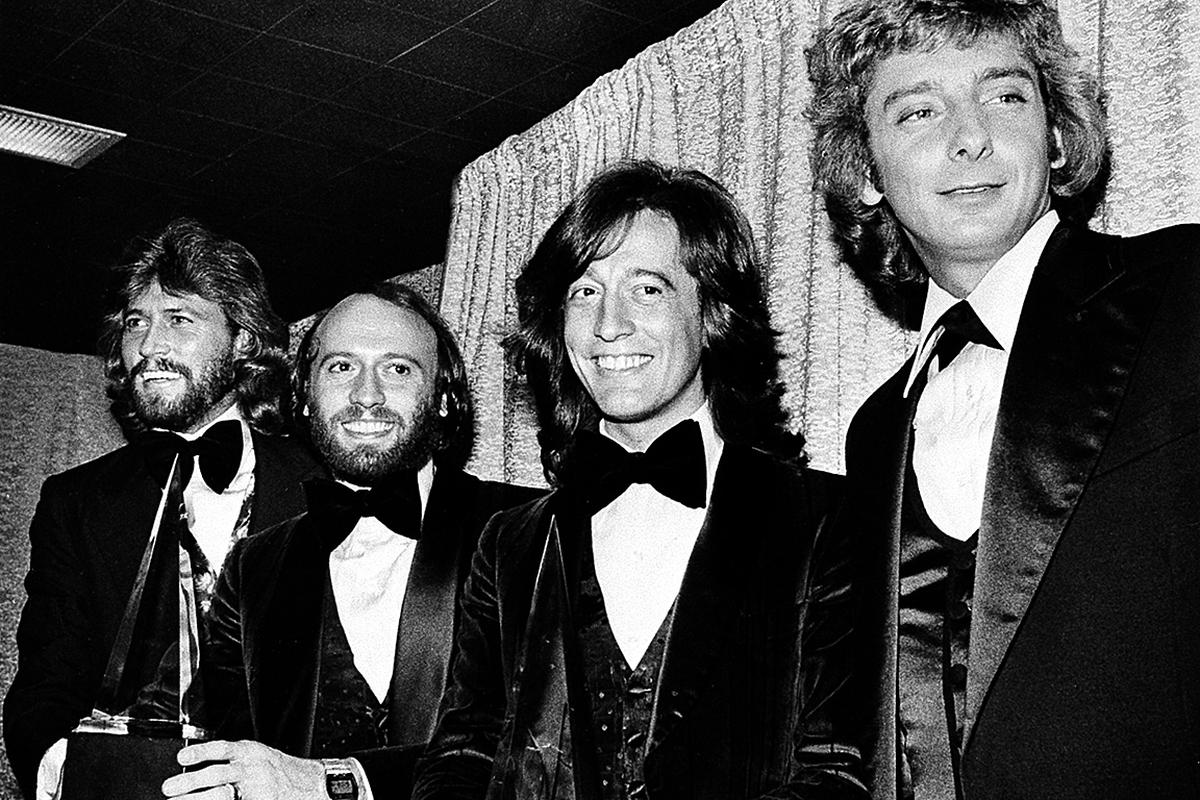
“Obsessions” is the Bee Gees’ late-night confession—when desire stops feeling romantic and starts feeling like a spell you can’t break.
“Obsessions” sits near the heart of the Bee Gees’ mature 1990s comeback: it’s track 10 on Still Waters, with Barry Gibb on lead vocal, and it runs 4:43—long enough to let the feeling tighten its grip, short enough to leave you slightly unsettled when it’s over. The album itself was released March 10, 1997 (UK) and May 6, 1997 (US), and it became their most successful studio album in nearly twenty years, peaking at No. 2 on the UK Albums Chart and No. 11 in the United States. Importantly, “Obsessions” wasn’t pushed as a headline single—those honors went to songs like “Alone”, “I Could Not Love You More,” and “Still Waters (Run Deep)”—so it doesn’t carry a neat “debut at No. ___” singles-chart story.
Yet it’s precisely that “non-single” status that makes “Obsessions” feel so intimate, like a thought you weren’t supposed to overhear.
The behind-the-scenes mood of the era matters. Before Still Waters became a polished late-career statement, the group had endured delay and disappointment: a planned tour was postponed due to Barry Gibb’s arthritis, and an earlier album project—described as Love Songs—was announced and then rejected by their record company. In the mid-’90s sessions that followed, the Bee Gees leaned into a modern sound with multiple high-profile collaborators and producers, but what they kept, unmistakably, was their emotional fingerprint: harmonies like memory, melodies that ache even when they’re whispering.
Within that landscape, “Obsessions” is tellingly credited to the brothers—Barry, Robin, and Maurice Gibb—and it was produced by the legendary Arif Mardin, with Steve Skinner credited for synthesizers and arrangements on the track. That producer credit is not just trivia: Mardin had a gift for sophistication without coldness, for making adult feelings sound elegant rather than heavy. Here, the polish doesn’t sanitize the theme—it frames it, like dim lighting around a confession.
Lyrically, “Obsessions” opens like a startled diary entry: something happened in the middle of the night… and suddenly the speaker isn’t steering anymore. It’s the anatomy of fixation—the moment attraction stops being a choice and becomes a tide. The song’s voice isn’t proud of what it’s feeling; it’s almost embarrassed by how quickly “control” evaporates. That’s what makes it persuasive. Many love songs glamorize obsession as devotion with better hair and brighter chords. The Bee Gees do the opposite: they let obsession sound like what it often is—compulsion dressed up as romance, tenderness tangled with fear.
And there’s an older, deeper sadness running beneath the surface: the speaker seems to know that turning someone into an “obsession” is a way of not truly seeing them. When you obsess, you don’t just desire—you cling, you project, you build a private religion out of another person’s existence. The chorus lands like an admission you can’t take back: “Just another one of my obsessions.” The word “another” is the bruise. It suggests pattern. History. A man recognizing his own cycle even as he’s caught inside it again.
Musically, the track feels like Still Waters in miniature: late-night R&B sheen, soft percussion, and a melody that knows how to ache without raising its voice. The arrangement doesn’t explode—it tightens, slowly, like a hand closing around a thought. In that restraint, you can hear the Bee Gees’ maturity: they don’t need to overwhelm you to convince you. They simply lay the feeling down and let you realize—maybe with a small shiver—that you’ve known this feeling too.
So “Obsessions” becomes a kind of private room inside a very public album. Still Waters climbed charts and revived reputations; “Obsessions” did something quieter. It captured the moment when love is no longer innocent, when longing turns inward and starts arguing with dignity. And decades later, that’s why it lingers: not because it “won the week,” but because it tells the truth about what the heart can do when it’s frightened of being alone with itself.