
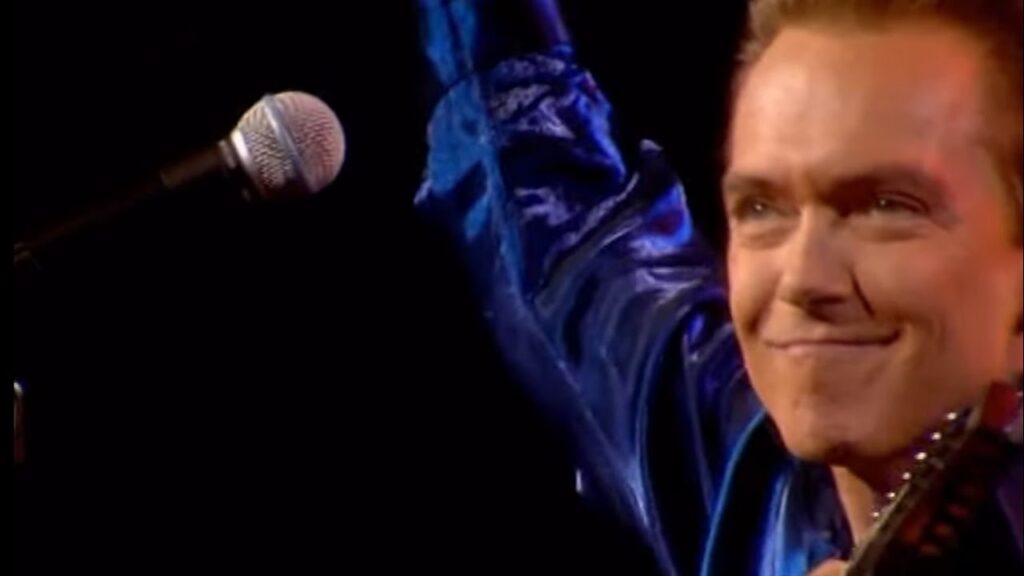
“It’s Over” is David Cassidy closing a door with shaking hands—accepting that some love stories don’t end in flames, but in quiet threads that simply stop holding.
By the early 1990s, David Cassidy had nothing left to prove as a symbol. The screams, the posters, the pop mythology—those belonged to another decade’s bright, dizzy weather. What he was chasing now was believability. And “It’s Over”—a restrained, adult break-up song built on the image of a torn tapestry—captures that later Cassidy with almost painful clarity.
The track appears as track 9 on Didn’t You Used to Be… (his ninth studio album), released in 1992 on Scotti Bros. Records and recorded from February to June 1992 at Santa Monica Sound Recorders, with production by Eric “E.T.” Thorngren. In a catalogue that includes so many youthful declarations, this record is striking for how inward it is: the album notes emphasize that the ten songs are all written or co-written by Cassidy’s wife, Sue Shifrin—a detail that makes the whole project feel less like a “comeback product” and more like a private ledger of grown-up emotions.
“It’s Over” itself is credited to Sue Shifrin and Ken Gold, and runs 3:42. (Ken Gold’s name carries its own quiet resonance—one of those professional songwriters whose work spans eras—so hearing him paired with Shifrin here feels like craft meeting confession.) It’s not a single with a celebrated chart “debut position,” and the album didn’t register a notable Billboard 200 peak the way Cassidy’s 1990 self-titled album did. That absence is, in a way, part of the song’s character: “It’s Over” isn’t performing for the room. It’s speaking for the person who stayed after the room emptied.
What makes “It’s Over” linger is how it frames heartbreak not as drama, but as workmanship undone. The lyric opens on the image of “threads that weave together… in a tapestry of life,” something “meant to last forever,” and then the devastating, human admission: “I promised you forever.” It’s an old idea—love as something you build—but here it’s delivered without grand gestures. Cassidy doesn’t sound like he’s trying to “win” the breakup scene. He sounds like he’s staring at the evidence: time, effort, devotion—now frayed.
That metaphor matters because it’s so adult. Young heartbreak tends to speak in absolutes: you ruined me, I’ll never love again. “It’s Over” speaks in materials: threads, weaving, the slow labor of staying. And when the relationship fails, the grief isn’t only about losing a person—it’s about losing the meaning you thought the work would guarantee. In that sense, the title doesn’t feel like a slam of the phone. It feels like a verdict reached reluctantly, after too many nights of trying to talk yourself out of what you already know.
There’s also a deeper layer that comes from the album’s broader story. Didn’t You Used to Be… was the one and only album Cassidy released on Scotti Bros., a label era that sits between his earlier fame and his later, more reflective projects. The very title of the album—Didn’t You Used to Be…—is a question aimed at identity: who you were, who you became, what time has changed, what time has revealed. In that frame, “It’s Over” becomes more than a relationship post-mortem. It becomes an argument with the past: the past that promised permanence, the past that believed devotion could prevent decay.
And yet—this is the song’s quiet mercy—it doesn’t sound bitter. It sounds tired, truthful, and strangely tender toward the life that was lived, even if it didn’t last. That tenderness is the hallmark of Cassidy’s later best work: the sense that he’s not trying to preserve the boy the world adored, but to honor the man who survived the noise and learned to speak plainly.
So when David Cassidy sings “It’s Over,” he isn’t chasing the kind of “ending” pop songs usually sell. He’s acknowledging the kind most people actually endure: not the theatrical collapse, but the moment you finally stop stitching the same tear, because the fabric itself has changed. And in that moment—soft, unglamorous, devastatingly recognizable—the song becomes what great late-career recordings often are: a small, honest light left on for anyone who has ever loved hard, promised forever, and had to learn—quietly—how to let go.