
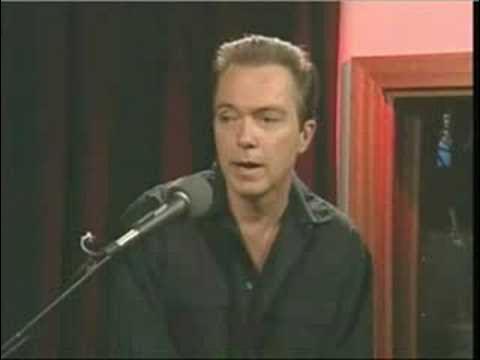
“More Than Words” in David Cassidy’s hands feels like a late-night vow: that real love isn’t proved by speeches, but by the quiet courage to stay gentle.
For accuracy’s sake, let’s place this recording exactly where it belongs in the timeline. “More Than Words” (the famous acoustic ballad written by Nuno Bettencourt and Gary Cherone) appears as a cover on David Cassidy’s final studio album, A Touch of Blue, released November 3, 2003. It was not issued as a standalone single from Cassidy’s album, so it did not have an official single-chart “debut position” under his name. Instead, its public footprint is tied to the album’s performance: A Touch of Blue reached a peak of No. 61 on the UK Official Albums Chart and stayed on that chart for 2 weeks. (In other words, the era didn’t announce this track with a trumpet blast; it let the song sit inside the album like a private page you find only if you keep reading.)
But the song itself carries a legendary chart story—just from an earlier life. Extreme released “More Than Words” as a single in 1991; it debuted at No. 81 on the Billboard Hot 100 (chart date March 23, 1991) and later reached No. 1 (peak date June 8, 1991). Knowing that history deepens the poignancy of Cassidy’s choice: he wasn’t borrowing a small cult favorite—he was stepping into one of pop’s most recognizable confessions, and doing so late in his recording career.
That context matters, because David Cassidy arrived in the public imagination as a bright emblem of youth—television fame, stadium screams, the rush of being a face on bedroom walls. By 2003, the voice belonged to a different chapter: seasoned, weathered by decades of expectation, and—on A Touch of Blue—drawn toward songs that lean more toward atmosphere than spectacle. The album is explicitly positioned as his 17th and final studio album, and it carries a reflective design: a main disc of songs plus a bonus disc of re-recorded hits. Even the title, A Touch of Blue, suggests a mood more than a marketing plan—music meant for the spaces where memory speaks louder than applause.
So what does “More Than Words” mean when Cassidy sings it?
At its core, the lyric is a plea against performative love. The narrator doesn’t want “I love you” as decoration; he wants proof in touch, patience, presence—love made tangible. In the original Extreme version, that message arrives with disarming simplicity: bare acoustic guitar, intimate vocal, the sense of someone confessing rather than entertaining. Cassidy’s reading, placed within a later-life album context, can feel less like the earnest impatience of youth and more like the earned clarity of experience—an understanding that words can be beautiful and still be used as hiding places. That’s where the song’s title becomes almost quietly accusatory: if love is “more than words,” then words alone can also be less than love.
There’s also a tender irony here. Cassidy spent years living inside words other people projected onto him—teen idol fantasies, tabloid narratives, the public’s endless insistence on a fixed version of who he was. In that light, “More Than Words” becomes more than a romantic plea; it becomes a small act of self-definition. Not a grand statement—just a song that insists on the reality underneath language. On nights when nostalgia can feel like a trick mirror, a track like this can sound like someone choosing honesty over mythology.
And perhaps that’s why the cover resonates even without a chart debut of its own. “More Than Words” doesn’t need a “new” commercial arrival to matter—because its emotional arrival is personal. It lands the way certain truths do: softly, almost politely, and then—once you recognize yourself in it—it refuses to leave.