
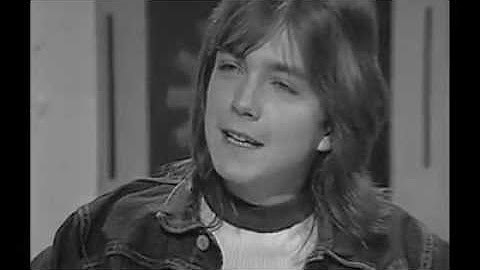
“Blackbird” becomes, in David Cassidy’s late-career voice, a hush of hope—proof that even long after the noise fades, the heart can still learn to fly.
David Cassidy recorded “Blackbird”—Paul McCartney’s aching, minimalist classic—as a cover on his final studio album, A Touch of Blue (released November 3, 2003). It sits early in the running order (Disc One, track 3), credited simply to P. McCartney, and runs about 2:41, refusing any extra ornament it doesn’t need. The album itself made a modest but real chart entrance in the UK: it debuted on the Official Albums Chart at No. 61 on November 9, 2003, and remained on the chart for 2 weeks (peak No. 61). Cassidy’s “Blackbird” was not issued as a single, so it didn’t have an individual single-chart debut—its “arrival” is folded into the album’s quiet appearance and quiet exit.
That, in a way, is exactly the right scale for this song.
Because “Blackbird” was always a miracle of restraint. The original was released by The Beatles on The Beatles (the “White Album”) on November 22, 1968—written by Paul McCartney (credited to Lennon–McCartney) and performed essentially as a solo piece. McCartney has explained, across the years, that the lyric carried inspiration from both the natural world (a blackbird’s call) and the American civil rights struggle—often framed as a message of encouragement in the face of discrimination, with “blackbird” sometimes understood as “black girl” in that context. This is important: the tenderness isn’t decorative. It’s purposeful. It’s a lullaby with backbone.
So what happens when David Cassidy—a voice the world once associated with bright posters, studio lights, and mass adoration—steps into a song built from almost nothing?
He doesn’t try to turn it into a “moment.” He lets it be a meaning.
On A Touch of Blue, Cassidy was clearly curating more than a set of covers; he was arranging a mood—songs of love, loss, and aftertaste, performed in a late-night register rather than a stadium shout. The album is widely described as his final studio album, produced by Ted Carfrae, and packaged with a bonus disc of re-recorded earlier hits—almost like an artist placing both his present and his past on the same shelf, then closing the door gently. In that frame, “Blackbird” reads as a kind of personal thesis: not about fame, not about youth, not about proving anything—just about endurance.
The lyric’s central image—broken wings learning to fly—has always carried a double edge: it comforts, but it also challenges. It says: yes, you are hurt, and yes, you must still move. In Cassidy’s hands, that challenge can feel less like a pep talk and more like a lived observation. His tone (especially in this era) suggests a singer who understands how time changes the meaning of “waiting for this moment to arise.” When you’re young, it can sound like prophecy. Later, it can sound like a decision you keep making—quietly, repeatedly—no applause required.
And that’s the peculiar magic of a great cover: it doesn’t replace the original. It reopens it.
The Beatles recorded “Blackbird” in 1968 with stark intimacy—voice, acoustic guitar, and the sensation of private thought made audible. Cassidy, decades later, approaches it from the far end of a career and lets the song’s simplicity do the work. The result isn’t about virtuosity. It’s about vulnerability with good posture. A man choosing to sing a small song truthfully, trusting that the smallest songs sometimes carry the largest rooms inside them.
If you listen closely, “Blackbird” on A Touch of Blue doesn’t feel like nostalgia for the 1960s so much as reverence for what survives them: the human need to believe in lift, even after the fall. And in that sense, David Cassidy doesn’t merely cover “Blackbird.” He inhabits it—like someone stepping into an old house at dusk, touching the walls, remembering what the light used to look like… and still finding, somehow, a window left open.